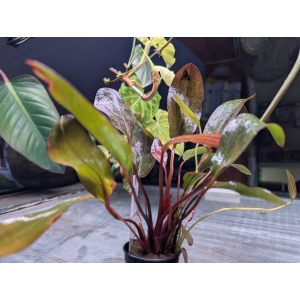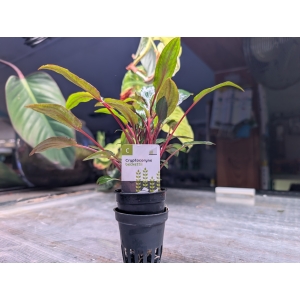
Cryptocoryne balansae
£4.50
Cryptocoryne balansae
Bulk Offer – 5 for £20.00
Discount will apply at checkout.
- Description
- Store Policies
- Enquiries
Description
Cryptocoryne crispatula var. ‘balansae’:
Species Profile:
Cryptocoryne crispatula var. ‘balansae’—most commonly referred to in the aquarium hobby simply as Cryptocoryne balansae—is a majestic, long-established aquatic plant native to Southern Asia. Renowned for its extraordinarily long, strap-like leaves and highly hammered texture, this species is a staple of the aquascaping hobby. It offers an elegant, flowing background backdrop that contrasts beautifully with broad-leaved or fine-textured aquatic flora.
Natural Habitat and Origin
In the wild, Cryptocoryne balansae is predominantly found across Southern China, Thailand, Laos, and Vietnam. It primarily populates fast-flowing, limestone-dense rivers and streams. Unlike many other Cryptocoryne species that thrive in soft, blackwater rainforest environments, C. balansae is uniquely adapted to hard, alkaline water heavily enriched with dissolved minerals and calcium. During the dry season, these plants often grow emersed along the exposed, muddy riverbanks, transitioning back to completely submerged growth when the monsoon season triggers heavy flooding.
Morphology and Appearance
Cryptocoryne balansae is a larger rosette-forming plant that commands significant vertical space within the aquarium.
-
Leaf Structure: The leaves are distinctly strap-shaped (ensiform), remarkably narrow, and can grow anywhere from 30 to 60+ centimetres (12 to 24+ inches) in length, whilst remaining only 1 to 2 centimetres wide.
-
Bullate Texture: The most captivating feature of this plant is its highly “bullate” or puckered surface. Under optimal conditions, the leaves develop a deeply crinkled, hammered texture that gives them a heavily puckered, leather-like appearance.
-
Colouration: The foliage ranges from a rich, vibrant olive-green to a deep brownish-bronze under high lighting. The underside of the leaf blades often displays a lighter green or faint reddish hue.
Aquarium Requirements and Water Parameters
Because of its potential length, Cryptocoryne balansae is strictly suited for the background of medium-sized aquaria, or as a dominant midground feature in extra-large tanks where its leaves can trail gracefully across the water’s surface.
Optimal Parameter Targets
Unlike the delicate Cryptocoryne wendtii ‘Flamingo’, this species is exceptionally robust but demands harder water to truly flourish.
| Parameter | Target Range |
| Water Temperature | 22°C to 28°C (72°F to 82°F) |
| pH Range | 6.5 to 8.0 (Prefers slightly alkaline water) |
| General Hardness (dGH) | 8 to 20 dGH (Moderately hard to very hard water) |
| Carbonate Hardness (dKH) | 4 to 12 dKH |
| Water Flow | Moderate to strong |
Cultivation and Nutrition
The Critical Importance of Calcium and Substrate
⚠️ Calcium & Root Nutrition Note
Reflecting its limestone river habitats, Cryptocoryne balansae requires an abundance of calcium and substrate-bound nutrients. A deficiency in calcium will cause new leaves to emerge deformed, curled, or stunted.
-
Preferred Medium: A rich, porous aquasoil is ideal. If planted into inert sand or gravel, the addition of a calcium-rich substrate additive or regular root tabs is mandatory.
-
Root Feeder Status: Like most members of the genus, it feeds heavily through its expansive root system. Liquid dosing into the water column is rarely sufficient on its own to support its fast-paced vertical growth.
Lighting Strategy
This species is highly adaptable regarding light, but its aesthetic qualities will vary dramatically depending on the intensity provided:
-
Low to Moderate Light: The plant will grow steadily, but the leaves will remain smoother, flatter, and greener.
-
High Light: High-intensity, full-spectrum lighting triggers the intense, sought-after puckered texture and allows the leaves to take on darker, bronze-tinted hues.
Carbon Dioxide (CO2) and Fertilisation
Cryptocoryne balansae is entirely viable for low-tech aquaria and will grow perfectly fine without pressurized carbon dioxide injection, provided the water is rich in bicarbonates. However, introducing 15 to 20 ppm of CO2 noticeably quickens its growth rate, increases leaf width, and accentuates the dramatic puckering of the foliage.
Managing “Crypt Melt” and Acclimatisation
Like all crypts, C. balansae is susceptible to Crypt Melt when introduced to a new aquarium or subjected to sudden environmental changes (such as a massive water change or swapping filter media).
When stressed, the plant may dissolve its existing leaves into a clear sludge over a matter of days. If this occurs, do not uproot the plant. Trim away the decaying leaves and keep water parameters completely stable. Because it possesses a thick, resilient underground rhizome, it will rapidly adjust to the new chemistry and push out hardier, fully adapted leaves within a few weeks.
Aquascaping Use and Placement
Due to its sheer height and flowing habit, Cryptocoryne balansae is a quintessential background plant.
-
The Curtain Effect: When planted in dense groups along the rear glass of the aquarium, the leaves rise vertically before bending at the surface, creating a stunning, moving green curtain. This is highly effective for concealing heaters, filter intake pipes, and internal equipment.
-
Visual Synergy: The crinkled, narrow texture pairs brilliantly alongside smooth, broad-leaved plants like Anubias barteri or large Echinodorus (Amazon Swords), creating an excellent play on contrasting shapes and textures.
Propagation
Once a specimen has settled into its environment and established a strong root system, it will propagate freely via underground runners.
Over time, it will send out horizontal runners beneath the substrate, from which new daughter plants will emerge several centimetres away from the parent cluster. To propagate the plant manually, wait until the daughter plant has reached roughly one-third of the parent’s size and has developed its own roots. Carefully slice the underground runner with a sharp pair of aquascaping scissors and gently replant the new individual in its desired location.
General Enquiries
There are no enquiries yet.