
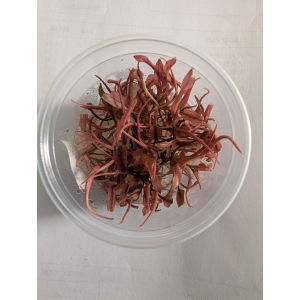
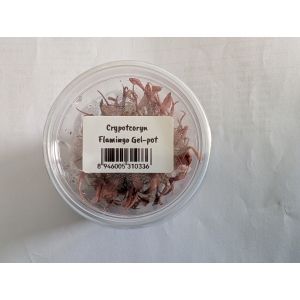

Cryptocoryne Flamingo
£7.50
Cryptocoryne Flamingo
- Description
- Store Policies
- Enquiries
Description
Cryptocoryne wendtii ‘Flamingo’:
Species Profile:
Cryptocoryne wendtii ‘Flamingo’—frequently referred to in the hobby simply as Crypt ‘Flamingo’—is one of the most distinctive, highly sought-after cultivars within the Neotropical and Asian aquatic plant hobby. Unlike the vast majority of its green and brown conspecifics, this mutation boasts striking, vibrant pink foliage. This cultivar is a mutation that arose in cultivation, stabilized and propagated primarily through laboratory tissue cultures. It provides aquascapers with a rare pop of solid pastel pink or intense magenta without the extreme care demands usually associated with red stem plants.
Morphology and Appearance
As a classic rosette-forming plant, Crypt ‘Flamingo’ produces its leaves from a central crown anchored by an extensive, fleshy root system.
-
Leaf Structure: The leaves are lanceolate to slightly ovate, typically exhibiting a gently hammered or puckered texture along the surface when mature.
-
Colouration: The defining trait of this cultivar is its unique pigmentation. Foliage can vary from a soft, delicate pastel pink to an intense, glowing fuchsia. Under improper care or deeply shaded conditions, it can revert to an uncharacteristic olive-brownish green with faint pink undersides.
-
Dimensions: It is a relatively compact cultivar compared to the wild-type Cryptocoryne wendtii. Depending on light intensity and nutrient availability, it typically reaches a height of 5 to 15 centimetres (2 to 6 inches), making it highly versatile for foreground to midground placement.
Aquarium Requirements and Water Parameters
While standard Cryptocoryne wendtii is legendary for its ability to survive in low-light, low-maintenance setups, the ‘Flamingo’ variant requires slightly more deliberate care to preserve its exceptional pink hue.
Optimal Parameter Targets
Stable water chemistry is critical. Sudden, drastic shifts in the parameters below can induce cellular stress and lead to foliage loss.
| Parameter | Target Range |
| Water Temperature | 22°C to 28°C (72°F to 82°F) |
| pH Range | 6.0 to 7.5 (Slightly acidic to neutral) |
| General Hardness (dGH) | 4 to 12 dGH (Prefers moderately soft to moderately hard water) |
| Carbonate Hardness (dKH) | 2 to 8 dKH |
| Water Flow | Gentle to moderate |
Cultivation and Nutrition
The Critical Importance of Substrate
⚠️ Root Nutrition Note
Crypt ‘Flamingo’ is primarily a root feeder. It develops a massive, intricate root network that expects a steady, highly concentrated source of nutrients in the substrate layer.
-
Preferred Medium: Planting it into a nutrient-dense, clay-based aquasoil yields the best long-term success.
-
Inert Substrates: If it must be kept in inert sand or gravel, you must supplement the substrate directly. Bury high-quality root tabs infused with iron and macro-nutrients within a few centimetres of the base every 2 to 3 months.
-
Iron Supplementation: Iron availability is paramount. A deficiency in iron will manifest as washed-out, pale yellow, or white new leaves rather than the desired rich pink.
Lighting Strategy
Lighting dictates the visual presentation of Crypt ‘Flamingo’.
-
Low Light: The plant will survive, but it will grow slowly, grow taller, and the leaves will dull into a brownish-green hue.
-
Moderate to High Light: Providing moderate to high, full-spectrum LED lighting (40 to 70 micromoles PAR at the substrate level) triggers the dense production of anthocyanins and erythrophores, resulting in bright pink foliage.
-
Photoperiod: Aim for a consistent 7 to 9-hour photoperiod. Ensure it is not heavily shaded by floating plants or broader-leaved canopy plants.
Carbon Dioxide (CO_2) and Fertilisation
Crypt ‘Flamingo’ is entirely capable of growing in a low-tech setup without pressurized carbon dioxide injection. However, in a low-tech environment, it grows exceptionally slowly, often taking months to produce a single new leaf rosette.
Introducing 15 to 30 ppm of pressurized $CO_2$ dramatically accelerates its establishment, promotes thicker, denser leaf groupings, and aids in maintaining a cleaner, brighter pink. Supplement the water column with a balanced liquid micro-and-macro fertiliser to prevent any structural deformities.
Understanding and Managing “Crypt Melt”
The most daunting hurdle when cultivating Crypt ‘Flamingo’ is a well-documented physiological phenomenon known across the Cryptocoryne genus as Crypt Melt.
When exposed to sudden environmental changes—such as being moved from a laboratory gel cup to a submerged aquarium, experiencing an ammonia spike, or undergoing a major shift in lighting or water parameters—the plant reacts by deliberately shedding its leaves. Within 48 hours, the vibrant pink leaves can degenerate into a translucent, gelatinous mush.
How to Handle Crypt Melt:
-
Do Not Panic: This is a natural survival mechanism.
-
Leave the Roots Intact: Even if every single leaf disintegrates, the robust underground rhizome and root architecture are usually perfectly healthy.
-
Siphon Debris: Gently siphon away the melting, dead leaves to prevent an organic waste buildup and subsequent algae triggers.
-
Do Not Move the Plant: Leave the crown completely undisturbed in the substrate. If water parameters are held strictly stable, brand-new, highly adapted submerged pink leaves will begin sprouting from the crown within 2 to 4 weeks.
Placement and Aquascaping Use
Thanks to its slow, controlled growth rate and eye-catching colouration, Crypt ‘Flamingo’ makes an ideal foreground focal point or a midground transition plant.
-
Visual Contrast: It looks exceptionally striking when planted in small clusters directly adjacent to deep green mosses, dark grey lava rocks, or fine-textured green foreground lawns like Eleocharis acicularis (Hairgrass) or Hemianthus callitrichoides ‘Cuba’.
-
Spacing: When planting out a new tissue culture cup, carefully rinse away the nutrient agar gel, gently tease the individual plantlets apart, and plant them roughly 5 centimetres apart using fine aquascaping tweezers. Be careful not to bury the central crown too deeply, as covering the crown completely can lead to rhizome rot.
Propagation
Once settled and comfortable in its environment, Crypt ‘Flamingo’ will propagate naturally via vegetative reproduction.
-
Runners: The mother plant sends out horizontal underground stems (runners) through the sand or soil.
-
Daughter Plants: At small intervals along these runners, tiny daughter plants will emerge.
-
Separation: Allow the young daughter plantlets to establish themselves until they possess at least 3 to 4 distinct leaves and their own independent root clusters. At this point, you can take a sharp pair of aquascaping scissors, sever the connecting underground runner, and gently replant the new specimen elsewhere in the layout.
General Enquiries
There are no enquiries yet.