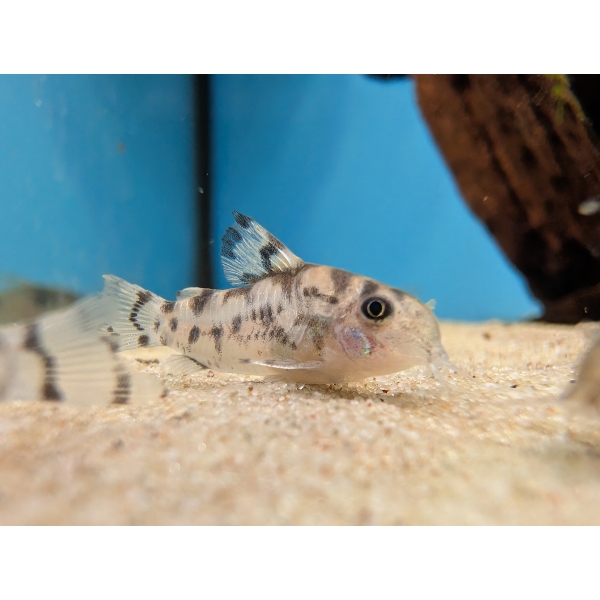



Cw111 Vulcan Catfish (Hoplosoma Cw111)
£85.00
Bulk Offer – 4 for £330.00
Discount will apply at checkout.
- Description
- Store Policies
- Enquiries
Description
Species Care Guide: CW111 Vulcan Catfish
Corydoras sp. CW111 (Vulcan Catfish, Orange Laser Cory)
The CW111 Vulcan Catfish is a highly prized but undescribed species of armoured catfish, known in the hobby as a ‘C-number’. It is instantly recognisable by the vibrant orange-red dorsal stripe that runs down its back and the distinct, dark lateral stripe. Originating from the Rio Negro basin in Brazil, this species thrives in environments that replicate the soft, warm, and acidic conditions of a blackwater river. They are peaceful, shoaling fish that bring colour and activity to the bottom of a community tank.
1. General Characteristics and Sizing
| Characteristic | Detail |
|---|---|
| Common Name | Vulcan Catfish, Orange Laser Cory |
| Origin | Rio Negro basin, Brazil (Blackwater environment) |
| Adult Size | Up to 5.5 cm (approx. 2.2 inches) |
| Temperament | Extremely Peaceful and highly social. |
| Lifespan | 8 – 10 years with excellent care. |
| Shoal Size | Minimum of 6 individuals, ideally 8 or more. They are reliant on their group for security and confidence. |
| Key Features | Striking orange/red lateral stripe and dorsal markings; requires specialised water conditions. |
2. Aquarium Requirements (Husbandry)
CW111 Catfish are active bottom-dwellers, making the quality and composition of the substrate the most crucial element of their habitat.
| Requirement | Recommendation |
|---|---|
| Minimum Volume | 75 Litres (approx. 16 Imperial Gallons). Prioritise a wide floor footprint over tank height. |
| Substrate (Critical) | Fine, non-sharp sand is essential. This allows them to sift and forage naturally without damaging their highly sensitive barbels. Never use coarse gravel. |
| Filtration | Excellent biological and mechanical filtration is required to maintain pristine water quality. A gentle flow is preferred, mimicking their slow-moving river habitat. |
| Lighting | Moderate to low. Providing dense cover and using floating plants will help dim the light, making them bolder and reducing stress. |
| Decoration | Use ample driftwood (such as bogwood or Mopani) to release beneficial tannins, which replicate the blackwater environment and slightly lower pH. Include leaf litter (e.g., catappa leaves) for natural foraging spots. |
| Plants | Dense planting, particularly around the edges, is highly recommended. Cryptocoryne, Anubias, and Java Moss are perfect choices. |
3. Water Quality and Parameters
Due to their blackwater origins, the CW111 Vulcan Catfish requires softer and slightly more acidic water than many other Corydoras species.
| Parameter | Optimal Range | Notes |
|---|---|---|
| Temperature | 22°C – 26°C (72°F – 79°F) | A stable temperature within this range is best. |
| pH | 6.0 – 7.0 (Acidic to Neutral) | They are sensitive to high pH. Use driftwood and peat moss in the filter to help lower and buffer the pH. |
| Hardness (dGH) | 2 – 10 dGH (Soft Water) | Avoid hard water at all costs. Regular top-ups with RO (reverse osmosis) water mixed with tap water can maintain the correct softness. |
| Maintenance | Strict weekly water changes (25%–30%) are vital. They are highly intolerant of nitrate build-up. |
4. Diet and Nutrition
Like all Corydoras, CW111 Catfish are opportunistic omnivores and must be provided with a dedicated, varied diet that reaches the tank floor.
- Primary Diet: High-quality, sinking pellets, wafers, or tablets designed for catfish.
- Meaty Foods: Supplement the diet 3–4 times a week with frozen or live protein-rich foods, such as bloodworms, grindal worms, or brine shrimp.
- Feeding Behaviour: Due to their shyness, feed them just before or after lights out to ensure competitive mid-water fish do not consume all their food. Scatter food across the substrate to encourage their natural foraging behaviour.
5. Compatibility and Social Behaviour
The Vulcan Catfish is an outstanding community fish, provided its tank mates are peaceful and do not interfere with its feeding.
- Shoaling: They are obligate shoalers and must be kept in groups. When kept alone or in too small a group, they become withdrawn, stressed, and prone to illness.
- Tank Mates: Ideal companions include peaceful Dwarf Cichlids (e.g., Apistogramma), small Tetras (e.g., Rummy Nose or Cardinal), and Rasboras.
- Avoid: Boisterous or semi-aggressive fish, or anything large enough to potentially ingest them. Ensure other bottom-dwellers (like large Plecos) do not dominate the food source.
Convenient nationwide delivery; you’re only a click away!
Our nationwide delivery service makes it easy to receive your fish directly at your door, anywhere in the UK, for a flat rate of just £30. This convenient service allows you to order up to 10kg of fish, with the assurance that they will arrive in excellent condition. To make the fishes journey as comfortable as possible we use Oxygen in the fish bags and heat packs in all the boxes of fish we send out.
Please put your desired delivery day in the Order Notes on the Checkout page.
General Enquiries
There are no enquiries yet.