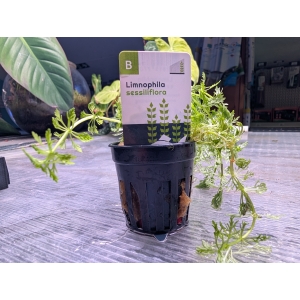
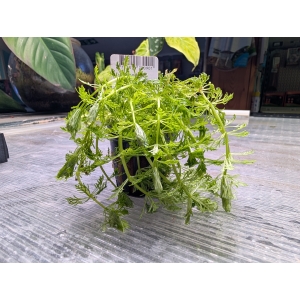


Limnophila sessiliflora
£4.50
Limnophila sessiliflora
Bulk Offer – 5 for £20.00
Discount will apply at checkout.
- Description
- Store Policies
- Enquiries
Description
Ambulia (Limnophila sessiliflora):
Species Profile:
Limnophila sessiliflora, commonly known in the aquarium industry as Dwarf Ambulia or Asian Marshweed, is a highly popular, fast-growing stem plant native to the tropical and subtropical regions of South and East Asia. Belonging to the family Plantaginaceae, this species is celebrated in the aquascaping hobby for its vibrant green coloration and delicate, needle-like foliage. It is frequently utilized as a hardier, less demanding alternative to the notoriously finicky Cabomba or Myriophyllum genera.
Natural Habitat and Origin
In the wild, Limnophila sessiliflora is widely distributed across countries such as India, Sri Lanka, China, Japan, and parts of Southeast Asia. It behaves as an opportunistic, amphibious weed, colonising a vast array of freshwater biotopes:
-
Stagnant and Flowing Waters: It populates sluggish rivers, clear streams, marshes, swamps, and seasonal floodplains.
-
Agricultural Infestation: It is a notorious weed in commercial rice paddies, where it thrives in shallow, nutrient-rich, warm water under intense, direct sunlight.
-
Invasive Potential: Due to its extreme rate of vegetative fragmentation, it has successfully naturalised in several non-native tropical zones globally, including parts of the United States (such as Florida). Consequently, possession or transport of this species is strictly regulated or prohibited in certain territories.
Morphology and Appearance
Limnophila sessiliflora is a classic, multi-node stem plant that exhibits a highly delicate and airy architectural structure when grown submerged.
Submerged Foliage
The underwater leaves are arranged in elegant, symmetrical whorls along a central, hollow stem. Each whorl typically consists of 6 to 11 deeply pinnatifid (divided), fine, needle-like segments. This creates a beautiful, plume-like or fan-like appearance.
The internodal spacing (the distance between leaf clusters on the stem) is highly dependent on light availability. The foliage color is typically a bright, translucent lime-green. However, under high-intensity lighting conditions, the crowns or terminal buds can take on attractive coppery-brown or reddish-pink overtones.
Emersed Foliage
When the plant breaches the water surface, its morphology transforms dramatically. The emersed leaves become much more rigid, compact, and lance-shaped with serrated margins, completely losing their delicate, feathery texture. Emersed stems are slightly hairy and, under long photoperiods, will produce small, solitary, pale purple or white flowers directly from the leaf axils.
Dimensions
Individual stems can easily achieve lengths of 30 to 50+ centimetres (12 to 20+ inches) in the aquarium, with a single stem whorl width expanding between 4 to 7 centimetres.
Aquarium Requirements and Water Parameters
Because of its rapid vertical growth and expansive leaf canopy, Limnophila sessiliflora is a quintessential background plant. It is highly effective at creating dense, soft screens along the rear glass of an aquarium.
Optimal Parameter Targets
Ambulia is remarkably hardy and can adapt to a broad spectrum of water chemistry, making it fully accessible to beginners.
| Parameter | Target Range |
| Water Temperature | 22°C to 28°C (72°F to 82°F) — Can tolerate 15°C to 30°C temporarily |
| pH Range | 5.5 to 7.5 (Prefers slightly acidic to neutral water) |
| General Hardness (dGH) | 3 to 15 dGH (Highly adaptable to soft or moderately hard water) |
| Carbonate Hardness (dKH) | 2 to 10 dKH |
| Water Flow | Gentle to moderate (High water flow can mechanically tear the fine leaves) |
Cultivation and Nutrition
Lighting Strategy
Lighting directly dictates the density and aesthetic form of Limnophila sessiliflora:
-
Low Light: The plant will survive and grow, but it will become “leggy”. The internodal spacing will widen dramatically as the stem rapidly stretches towards the surface, resulting in a sparse, less dense appearance.
-
Medium to High Light: Brighter lighting compresses the internodal gaps, creating an exceptionally bushy, compact, and plush appearance. High light also coaxes out the desired coppery highlights on the plant’s crowns.
Substrate and Nutrient Demands
While Ambulia can derive nutrients straight from the water column through its fine leaves, it forms an extensive root network once anchored.
-
Substrate Choice: A nutrient-rich aquasoil or fine sand supplemented with root tabs will accelerate its growth.
-
Liquid Fertilisation: As a fast-growing species, it acts as an excellent nutrient sponge, rapidly consuming excess nitrates and phosphates from the water column. Regular dosing of a comprehensive liquid macro-and-micro fertiliser prevents potassium or iron deficiencies (which manifest as pale, whitening tips or fragile, melting lower stems).
Carbon Dioxide (CO2) Requirements
Pressurized carbon dioxide injection is entirely optional for this species. It is one of the premier choices for low-tech layouts, where it will still grow at a very respectable pace. However, the introduction of even modest CO2 injection (10 to 15 ppm) will cause its growth rate to explode, increasing leaf width and triggering intense pearling (visible oxygen bubble production).
Pruning and Maintenance
⚠️ Pruning Caution
Due to its phenomenal growth rate under optimal conditions, Limnophila sessiliflora requires frequent, aggressive trimming. If left unmanaged, it will quickly reach the surface, canopy over, and completely block light from reaching smaller foreground plants beneath it.
The Correct Truning Protocol:
-
Do Not Simply “Mow”: To prevent a messy look, do not simply shear the tops off the plants indiscriminately.
-
Topping Method: Identify the stems that have grown too tall. Using sharp aquascaping scissors, cut the stem cleanly just above a leaf node, roughly midway down the column.
-
Regrowth: The rooted base portion left in the substrate will rapidly develop multiple side-shoots from the remaining node, resulting in an even bushier presentation.
-
Lower Stem Decay: Over time, if the top canopy becomes too dense, the lowest portions of the stems may lose their leaves due to self-shading. If this occurs, uproot the entire stem, cut off and discard the bare lower section, and replant the healthy, vibrant top cutting back into the substrate.
Aquascaping Application
-
The Soft Backdrop: Its feathery texture provides an excellent, highly contrasting backdrop when positioned behind rigid, dark hardscape elements like driftwood roots or large basalt rocks.
-
Algae Prevention: Because it grows so rapidly and absorbs dissolved nutrients aggressively, it is a premier “startup plant” for newly established aquaria. It effectively outcompetes primitive algae species for vital resources, helping to stabilize the tank’s ecosystem during its initial cycle.
-
Spawning & Shrimpery Cover: The dense, intricate maze of fine leaves provides an ideal physical refuge and foraging zone for dwarf shrimp, newborn fish fry, and vulnerable nano fish. It is also an exceptional spawning medium for egg-scattering fish species (such as tetras, barbs, and danios), who will readily deposit their eggs within its soft whorls.
Propagation
Propagating Limnophila sessiliflora is exceptionally straightforward and relies entirely on stem cuttings or the natural production of runner shoots.
To propagate manually, take a healthy top cutting (roughly 10 to 15 centimetres long) from a mature stem. Strip away the leaves from the bottom-most node to expose the bare stem. Using fine aquascaping tweezers, insert the stripped end firmly into the substrate. Within 48 to 72 hours, the buried node will begin pushing out new white anchor roots. Left to its own devices, the plant will also send out horizontal runners along the surface of the substrate, generating a dense forest of new vertical clones automatically.
General Enquiries
There are no enquiries yet.