

- Description
- Store Policies
- Enquiries
Description
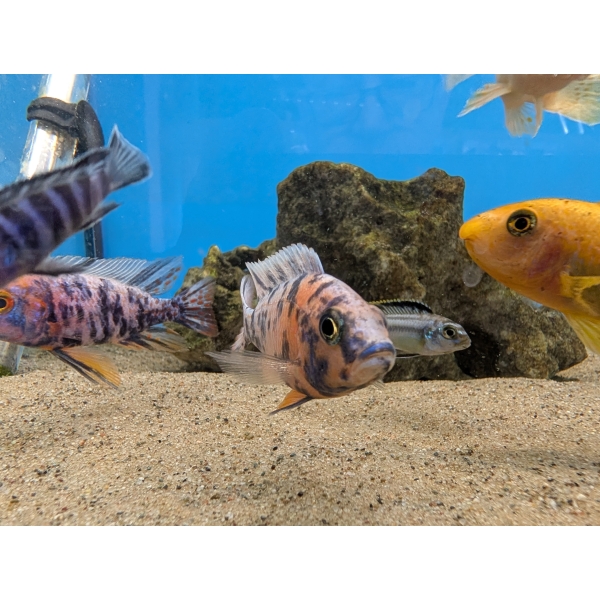
OB Peacock Cichlid (Aulonocara sp. “OB”)
Species Profile:
Common Names: OB Peacock, Orange Blotch Peacock Cichlid.
Scientific Name: Aulonocara sp. “OB” (The OB strain is a hybrid and/or artificially coloured line; it is not a naturally occurring pure species of Aulonocara).
Family: Cichlidae.
1. Introduction
The OB Peacock Cichlid is one of the most colourful and popular African cichlids in the aquarium hobby. The ‘OB’ stands for Orange Blotch, referring to its striking, irregular patterning of deep orange, yellow, red, and blue blotches overlaid on a metallic blue or purple base body.
Unlike most peacock cichlids (which are purebred Aulonocara species from Lake Malawi), the OB strain is a hybrid. It was originally created by crossing a blotched female cichlid (likely an OB Mbuna, such as an Labeotropheus or Metriaclima species) with a pure Aulonocara male. This hybrid status results in the unique, highly variable blotched colouration in males.
2. Natural Habitat and Origins
-
Natural Environment: The pure Aulonocara species originate from the clear, alkaline waters of Lake Malawi, Africa. They are found in sandy zones near rocky areas.
-
OB Strain Origin: The OB Peacock strain is man-made and does not exist in the wild. It is a product of selective cross-breeding within the aquarium trade, primarily in Asia and Europe.
-
Habitat Requirement: Despite its hybrid status, the OB Peacock requires the exact same highly specific water parameters as all cichlids from Lake Malawi.
3. Appearance and Identification
The OB Peacock is instantly recognisable by its bold, non-uniform patterning.
-
Body: Streamlined, elegant, and laterally compressed—the classic Aulonocara shape.
-
Colouration (Males): Males are famous for their iridescent, multi-coloured blotches. These blotches cover the entire body and fins, showcasing random mixtures of metallic blue, violet, crimson, yellow, and orange. No two males have the exact same pattern.
-
Colouration (Females): Females retain a more subdued, mottled grey or brownish-grey appearance, often with some dark vertical bars or minimal blotching. They do not possess the vibrant colours of the male.
-
Size: Adult males typically reach 12 cm to 15 cm (5 to 6 inches), while females remain slightly smaller.
4. Aquarium Requirements
OB Peacocks require a large aquarium setup that strictly adheres to the unique, hard-water conditions of Lake Malawi.
-
Tank Size: A minimum tank size of 240 litres (approximately 50 imperial gallons) is recommended for keeping a small group (a single male with multiple females). Tanks of 150 cm length are preferred for housing multiple males to disperse aggression.
-
Water Temperature: 24°C – 26°C (75°F – 79°F). Stability is key.
-
Filtration and Aeration: High-quality, robust external filtration is necessary, as they are large fish that are sensitive to poor water conditions. Excellent aeration is also mandatory.
-
Substrate: Fine, calcareous sand (e.g., coral sand or aragonite) is essential. Sand helps buffer the water, raising the hardness and pH, and allows the fish to engage in their natural sifting and nest-building behaviours.
-
Décor: Use smooth limestone or slate rockwork to create large stacks, caves, and crevices. The rockwork should reach the surface, providing visual barriers and territories. Do not use driftwood or peat, as these release tannins that lower the pH.
5. Water Parameters (Critical)
Lake Malawi cichlids require high pH and hardness—a crucial difference from most South American fish.
-
pH: 7.8 – 8.6 (Highly alkaline).
-
Hardness: Very hard water (10 – 20 dGH).
-
Maintenance: Strict weekly partial water changes (30%) are vital to control nitrates, which they tolerate poorly.
6. Diet and Feeding
Pure Aulonocara species are primarily piscivores/benthic feeders, sifting invertebrates from the sand. The OB hybrid is omnivorous but requires careful feeding.
-
Staple Diet: High-quality sinking pellets or flakes formulated specifically for African Cichlids.
-
Supplemental Foods: Supplement with frozen foods such as brine shrimp, Mysis shrimp, and krill.
-
Caution: Avoid feeding mammal protein (e.g., beef heart) and excessively fatty foods. A diet too high in fat or protein can lead to ‘Malawi bloat,’ a potentially fatal digestive condition common in these fish. Vegetable matter (e.g., spirulina) should be included.
7. Behaviour and Compatibility
-
Temperament: Peacocks are generally considered one of the less aggressive groups of African cichlids, but males are intensely territorial toward their own species and similar-looking fish.
-
Social Structure: They must be kept in a Harem structure: one male to at least three or four females. This spreads the male’s courtship and breeding aggression among multiple females, protecting the weaker individuals.
-
Tank Mates: Best kept in a species-only tank or with other peaceful Lake Malawi cichlids, such as certain Haplochromis species or other Aulonocara species (with caution regarding hybridisation).
-
Mbuna Compatibility: Avoid mixing OB Peacocks with very aggressive Mbuna (rock-dwelling cichlids), as the Mbuna may constantly harass the more placid Peacocks.
8. Breeding (Brief Overview)
OB Peacocks are paternal maternal mouthbrooders.
-
The Process: The male displays and cleans a patch of sand, enticing the female to lay eggs. After the female collects the eggs in her mouth, the male displays his egg-spots (ocelli) on his anal fin. The female mistakes these for eggs and attempts to pick them up, allowing the male to fertilise the eggs inside her mouth.
-
Brooding: The female holds the clutch in her mouth (broods) for approximately 21–28 days without eating, releasing fully formed fry.
9. Summary Checklist
| Requirement | Specification |
| Minimum Tank Size | 240 Litres (Large footprint) |
| Water Chemistry (CRITICAL) | pH 7.8 – 8.6, Hard Water |
| Social Structure | Harem (1 Male : 3+ Females) |
| Diet | Omnivore (Avoid excess fat/protein; include spirulina) |
| Décor | Calcareous Sand & Rock Structures |
| Temperament | Mildly Territorial Cichlid |
| Adult Size | 12–15 cm |
Convenient nationwide delivery; you’re only a click away!
Please put your desired delivery day in the Order Notes on the Checkout page.
General Enquiries
There are no enquiries yet.