
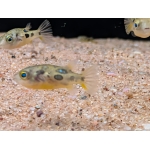
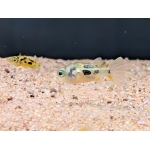

Pygmy Puffer Tetraodon travancoricus
£6.50
Pygmy Puffer
Bulk Offer – 6 for £35.00
Discount will apply at checkout.
- Description
- Store Policies
- Enquiries
Description
Pygmy Puffer (Tetraodon travancoricus)
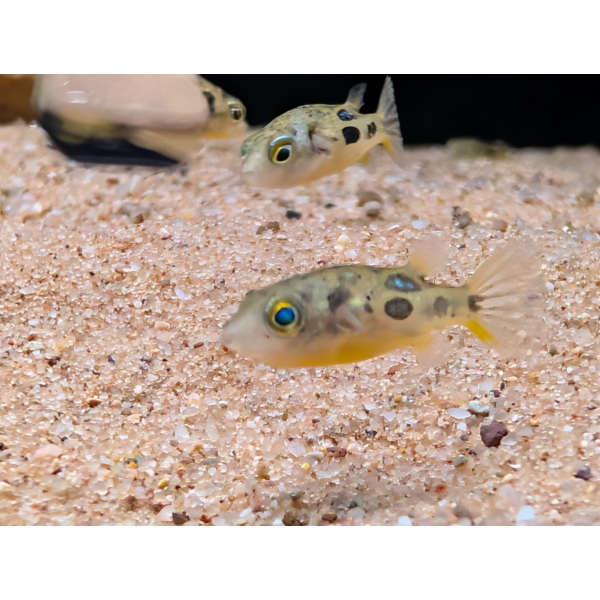
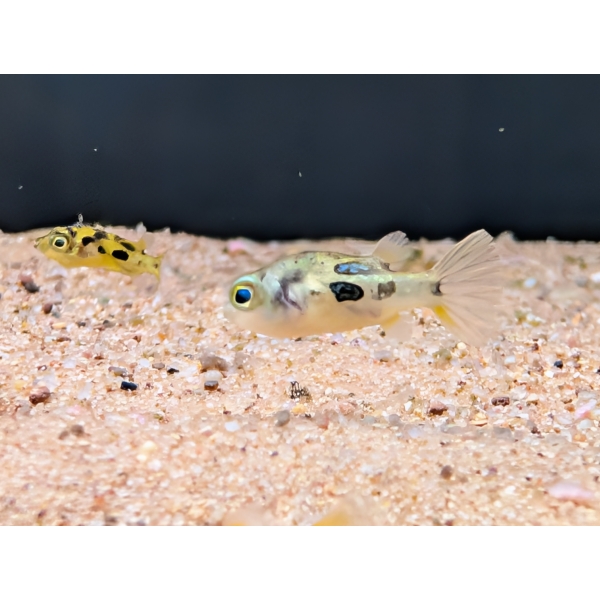
The Pygmy Puffer, also commonly known as the Dwarf Puffer or Malabar Puffer, is the smallest known species of pufferfish, reaching a maximum size of just over 2.5 centimetres. Originating from India, this tiny fish boasts a massive personality. They are inquisitive, highly intelligent, and exhibit fascinating predatory behaviour, making them a captivating subject for a species-only or carefully managed community aquarium. Note that while often sold under the name Tetraodon travancoricus, it is now scientifically classified within the genus Carinotetraodon.
Key Characteristics
- Size: Adults rarely exceed 2.5 to 3 centimetres (approximately 1 to 1.2 inches) in length.
- Lifespan: Can live for 4 to 5 years in optimal, stable conditions.
- Colouration: Typically a mottled pattern of olive green, yellow, and black spots. They can change the intensity of their colouration based on mood and environment.
- Temperament: While small, they are bold, highly predatory, and can be nippy towards the fins of slower-moving fish. Males are territorial towards each other.
- Special Note: As true pufferfish, they have fused teeth (a beak) which constantly grows. They require hard-shelled prey (snails) to keep their beak trimmed and prevent health issues.
Natural Habitat and Distribution
Tetraodon travancoricus is endemic to the Pamba River system in the state of Kerala, India. They inhabit clear, slow-moving streams, pools, and tributaries that are heavily vegetated, providing plenty of cover for hunting and refuge. They are strictly freshwater fish.
Aquarium Requirements
Tank Size
Despite their minute size, Pygmy Puffers require adequate space to establish territories and maintain pristine water quality.
- Minimum Tank Size: A 30 litre (approximately 8 US gallons) tank is the minimum for a single pair or a trio (one male, two females).
- Space: They require more floor space than height.
Water Parameters
Pygmy Puffers are sensitive to elevated nitrates and require exceptional water quality.
| Parameter | Recommended Range | Notes |
|---|---|---|
| Temperature | 24°C to 27°C (75°F to 80°F) | Standard tropical range. |
| pH Level | 6.5 to 7.5 | Neutral is acceptable, but slightly acidic is preferred. |
| Hardness (GH) | 5 to 15 dGH | Soft to moderately hard water. |
Décor and Furnishings
The environment must be heavily furnished to break up lines of sight and establish distinct territories, which is crucial for reducing aggression.
- Planting: Dense, live planting is mandatory. Use tall, bushy plants (e.g., Vallisneria, Amazon Swords) and heavy foreground cover (e.g., Cryptocoryne) to create numerous visual barriers.
- Hiding Places: Include pieces of driftwood and smooth, small rocks to provide caves and secure resting spots near the substrate.
- Filtration: A gentle filter (e.g., a sponge filter or a baffled hang-on-back) is best. Strong currents should be avoided. Perform weekly 25% water changes without fail.
Diet and Feeding (Crucial)
Pygmy Puffers are obligate carnivores and micropredators. They are one of the few fish that require specific hard-shelled foods.
- Snail Consumption (Mandatory): They must be regularly fed small, hard-shelled snails (e.g., bladder snails or ramshorn snails). The grinding action of cracking the shells is essential for naturally wearing down their constantly growing beak. Failure to do this will eventually result in the fish being unable to feed.
- Protein Foods: Supplement with small live or frozen foods such as bloodworms, white worms, daphnia, or brine shrimp. They often refuse flake or pellet foods.
- Feeding Schedule: Feed once daily, ensuring they are actively hunting and consuming their food.
Social Behaviour and Compatibility
The Pygmy Puffer is best kept in a species-only tank, or with carefully selected tankmates due to its predatory nature.
- Grouping: They should be kept in groups of three or more, with a ratio of one male to multiple females (e.g., 1 male, 2 females) to diffuse the male’s attention.
- Identifying Sex: Males are generally more slender and develop a dark line, or ‘seam,’ along their belly. Females are rounder, especially when gravid.
- Compatible Tankmates (Proceed with Caution): Only consider the following in a large, heavily planted tank where the puffer has its own space:
- Oto Catfish (fast, armoured, ignored by the puffer).
- Fast-moving, non-fin-nipping species (e.g., fast-moving Microrasboras).
- Note: They will almost certainly hunt and eat any shrimp or ornamental snails (other than large Nerites).
Fish to Avoid: Avoid all slow-moving fish, long-finned fish (Bettas, Guppies), large/aggressive fish that will stress the puffer, and any bottom-dwellers that might compete for food (e.g., Corydoras).
Convenient nationwide delivery; you’re only a click away!
Our nationwide delivery service makes it easy to receive your fish directly at your door, anywhere in the UK, for a flat rate of just £30. This convenient service allows you to order up to 10kg of fish, with the assurance that they will arrive in excellent condition. To make the fishes journey as comfortable as possible we use Oxygen in the fish bags and heat packs in all the boxes of fish we send out.
Please put your desired delivery day in the Order Notes on the Checkout page.
General Enquiries
There are no enquiries yet.