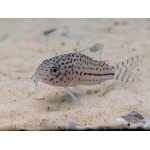


Three Lined Catfish (Hoplisoma trilineatus)
£8.00
Bulk Offer – 3 for £21.00
Discount will apply at checkout.
- Description
- Store Policies
- Enquiries
Description
Three Lined Catfish (Hoplisoma trilineatum)
A Comprehensive Overview
Three Lined Catfish (Hoplisoma trilineatum), traditionally known as Corydoras trilineatus, is a staple of the freshwater aquarium hobby. Often mislabelled as the “True Julii” (H. julii), this species is prized for its intricate, maze-like patterns and its energetic, peaceful nature.
Taxonomy and Nomenclature
As of 2024, a major scientific revision of the Corydoradinae subfamily has officially moved this species from the genus Corydoras to Hoplisoma.
- Scientific Name: Hoplisoma trilineatum.
- Common Names: Three-lined Cory, Leopard Cory, False Julii.
- Key Identification: Unlike the H. julii, which features distinct “leopard” spots on its head, H. trilineatum possesses a reticulated (net-like) pattern and a more pronounced horizontal stripe along its flank.
Aquarium Requirements
These catfish are hardy but sensitive to poor substrate hygiene.
- Tank Size: A minimum of 60 litres (approx. 15 gallons) is recommended for a small group.
- Substrate: Soft river sand is essential. Sharp gravel can erode their delicate barbels (whiskers), leading to infections.
- Decor: They appreciate a well-planted tank with plenty of driftwood and caves for shelter.
Water Parameters
- Temperature: 22°C to 26°C (72°F to 79°F).
- pH Level: 5.8 to 7.2 (slightly acidic to neutral).
- Hardness: 1 to 12° dH.
- Maintenance: Weekly water changes of 20-25% are vital to keep nitrate levels low, as they are sensitive to deteriorating water quality.
Diet and Nutrition
Though often sold as “cleaners”, they must not be forced to survive on scraps alone.
- Type: Omnivorous.
- Staple: High-quality sinking pellets or wafers.
- Treats: They relish live or frozen foods such as bloodworms, brine shrimp, and Daphnia.
Social Behaviour and Tank Mates
These are highly gregarious fish and should never be kept alone.
- Shoaling: Keep in groups of at least 6, though 8-10 is better for observing natural behaviour.
- Compatibility: Excellent with other peaceful community fish such as Tetras, Rasboras, and Dwarf Cichlids. Avoid large or aggressive tank mates that may see them as prey.
Breeding
They are considered one of the easier catfish to breed in captivity.
- Sexual Dimorphism: Females are noticeably broader and rounder when viewed from above.
- Spawning Trigger: A large water change (50-70%) with slightly cooler water can simulate the rainy season and trigger spawning.
- Egg Placement: Females carry eggs between their pelvic fins before sticking them to the glass or plant leaves.
Convenient nationwide delivery; you’re only a click away!
Our nationwide delivery service makes it easy to receive your fish directly at your door, anywhere in the UK, for a flat rate of just £30. This convenient service allows you to order up to 10kg of fish, with the assurance that they will arrive in excellent condition. To make the fishes journey as comfortable as possible we use Oxygen in the fish bags and heat packs in all the boxes of fish we send out.
For your peace of mind we enclose a slip which will explain what to do in the event of a fish not traveling too well.
We use a licensed courier to deliver your fish directly to you door and will be with you by 1pm the next day.
Our delivery days are as follows:
Tuesday for Wednesday delivery
Wednesday for Thursday delivery
Thursday for Friday delivery
Please put your desired delivery day in the Order Notes on the Checkout page.
General Enquiries
There are no enquiries yet.