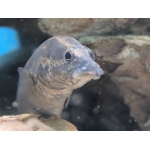
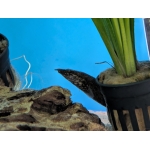


Tyre Track Eel Mastacemelus armatus
£25.00
- Description
- Store Policies
- Enquiries
Description
Tyre Track Eel (Mastacembelus armatus)
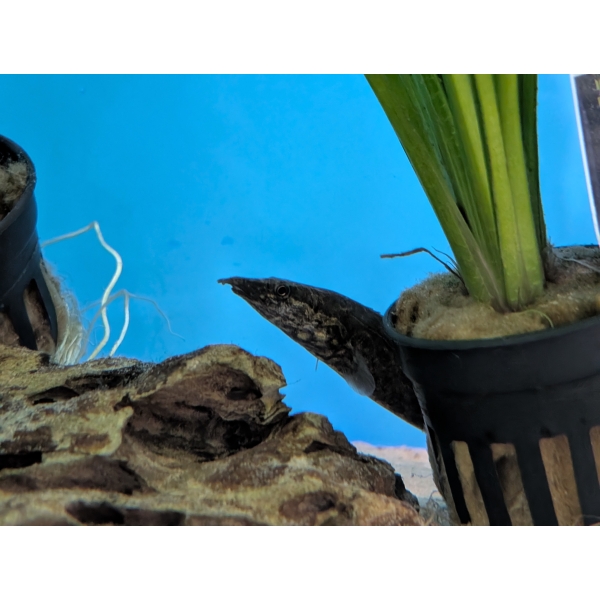
The Tyre Track Eel, scientifically known as Mastacembelus armatus, is a truly unique and fascinating freshwater fish in the aquarium hobby. Renowned for its elongated, snake-like body, distinctive “tyre track” or zigzag patterns, and often reclusive nature, this eel brings an intriguing and elegant presence to large, dedicated aquariums.
Origin and Habitat
Tyre Track Eels are native to the slow-moving rivers, swamps, and floodplains of Southeast Asia, particularly found in countries like India, Sri Lanka, Bangladesh, Thailand, and Indonesia. Their natural habitat is characterised by soft, muddy or sandy substrates, dense vegetation, and plenty of submerged roots and leaf litter, providing ample hiding spots. They are accustomed to soft to moderately hard, acidic to neutral water conditions.
Appearance and Characteristics
The Tyre Track Eel typically grows to a substantial size of 20-36 inches (50-90 cm) or even larger in very spacious aquariums, though they grow slowly. Its most distinctive features are:
- Body Shape: An elongated, snake-like, cylindrical body that tapers to a point at the tail.
- Colouration: A base colour ranging from light brown to olive green, adorned with a highly distinctive pattern of dark brown or black, irregular, interconnected zigzag lines or “tyre tracks” along its flanks. These markings are unique to each individual.
- Snout: A pointed snout with small, fleshy barbels, which they use to probe the substrate for food.
- Dorsal and Anal Fins: A long, continuous dorsal fin and anal fin that run along most of its back and underside, respectively, merging with the caudal (tail) fin.
Tyre Track Eels are incredibly long-lived fish, often surviving for 10-18 years or more in a well-maintained aquarium, making them a significant long-term commitment.
Behaviour and Temperament
Tyre Track Eels are generally peaceful but predatory fish. They are primarily nocturnal or crepuscular (most active during dusk and dawn), spending much of the day buried in the substrate or hiding among decor. They are bottom-dwellers, often seen burrowing or slowly moving along the tank bottom.
While not overtly aggressive, they will readily consume any fish small enough to fit into their mouths, making tank mate selection crucial. They are best kept individually or in a very large tank with other similarly sized or larger, robust, and peaceful to semi-aggressive fish. Good companions include large, peaceful South American cichlids (e.g., adult Oscars, Severums), large characins (e.g., Silver Dollars), larger gouramis, and various large, peaceful catfish (e.g., Plecos, Synodontis). Avoid housing them with very small fish, aggressive fish, or fin-nipping species.
Aquarium Requirements
Due to their large adult size, significant bioload, and burrowing habits, Tyre Track Eels require specific and spacious aquarium conditions:
- Tank Size: A minimum of 450 litres is recommended for a single adult Tyre Track Eel. For a pair or a small group, a tank of 750 litres or larger is highly recommended to ensure ample swimming space and prevent stunting. A longer tank footprint (e.g., 6ft or 8ft) is more beneficial than a tall one, as they are bottom-dwellers.
- Water Parameters:
- Temperature: 23-26°C (74-80°F) – consistent, warm temperatures are vital.
- pH: 6.5-7.2 (slightly acidic to neutral is preferred).
- Hardness: 5-15 dGH (soft to moderately hard water).
- Filtration: Excellent and robust filtration is paramount to manage their significant bioload. A powerful canister filter or multiple large hang-on-back filters providing strong mechanical, biological, and chemical filtration are necessary. Regular, large water changes (25-50% weekly) are also vital to maintain pristine water quality.
- Substrate: A deep layer (at least 3-4 inches / 7.5-10 cm) of fine sand is absolutely essential. Tyre Track Eels love to burrow and spend much of their time submerged in the substrate. Coarse or sharp gravel can injure their delicate skin.
- Lighting: Dim to moderate lighting is preferred, as they are naturally found in shaded, often murky environments and are primarily nocturnal. This encourages them to be more active.
- Decor: Provide plenty of hiding spots, caves, and tunnels using large pieces of driftwood, PVC pipes, and smooth rocks. Arrange decor to create numerous nooks and crannies where they can retreat and feel secure. Ensure all decor is securely placed and cannot fall over if the eel burrows beneath it. Live plants are generally not recommended as they may uproot them, but very hardy, robust species like Anubias or Java Fern attached to decor might survive. A tight-fitting, heavy lid is absolutely essential, as eels are notorious escape artists and can find their way through surprisingly small gaps.
Diet
Tyre Track Eels are carnivorous, primarily feeding on insects, crustaceans, and smaller fish in the wild. A high-quality, varied diet is essential for their health, growth, and vitality in the aquarium.
- Primary Diet: High-quality sinking pellets or wafers specifically formulated for carnivorous bottom-dwelling fish.
- Supplements: Offer a variety of live or frozen foods such as bloodworms, Mysis shrimp, brine shrimp, krill, chopped earthworms, and occasional pieces of lean fish (e.g., white fish fillets).
- Feeding Frequency: Feed them once a day, or small amounts twice a day, preferably after the main lights are off, as they are nocturnal feeders. Ensure food reaches the bottom where they can find it.
Breeding
Breeding Tyre Track Eels in a home aquarium is extremely challenging and rarely achieved. They are egg-layers, and their complex breeding habits in the wild, which involve specific environmental cues and large spaces, are very difficult to replicate in captivity. Most Tyre Track Eels available in the aquarium trade are wild-caught.
Common Health Issues
Tyre Track Eels are generally hardy once established but can be susceptible to common freshwater fish diseases, particularly if water quality is poor or they are stressed. They are sensitive to poor water parameters, especially high nitrates. Maintaining pristine water quality, stable parameters, a balanced diet, and a stress-free environment are key to preventing illness. Their scaleless (or very finely scaled) bodies make them sensitive to many medications, so always use half the recommended dose or seek specific “scaleless fish safe” treatments.
Conclusion
The Tyre Track Eel is a truly magnificent, intriguing, and captivating species that can bring an unparalleled sense of the exotic to a large, well-maintained aquarium. Its distinctive appearance, unique burrowing behaviour, and fascinating nocturnal habits make it a rewarding fish for the dedicated aquarist. With proper care, ample space, and diligent attention to their specific water parameter and dietary needs, these long-lived eels can thrive and become a cherished and intriguing inhabitant of your aquatic world for many years.
Convenient nationwide delivery; you’re only a click away!
General Enquiries
There are no enquiries yet.