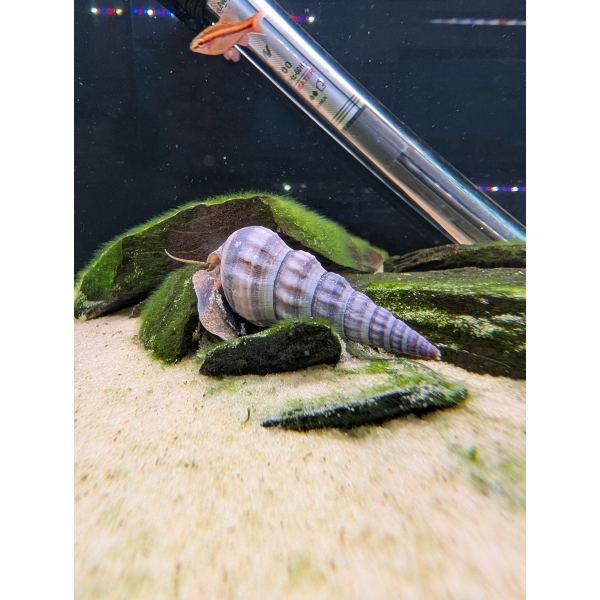


White Hercules Snail Brotia herculea
£6.50
Bulk Offer – 3 for £16.50
Discount will apply at checkout.
- Description
- Store Policies
- Enquiries
Description
White Hercules Snail:
A Comprehensive Care Guide
The White Hercules Snail (), also known as the White Giant Tower Cap Snail or White Herculean Snail, is a unique and captivating freshwater snail species originating from Southeast Asia. While often sold for its striking white shell, it’s important to note that the “white” colouration is often due to shell erosion or sanding, and new growth will typically revert to its natural beige or brown striped appearance. Despite this, they are a fascinating and beneficial addition to the aquarium, known for their peaceful nature and scavenging habits.
Scientific Classification
- Scientific Name: (Gould, 1846)
- Family: Pachychilidae
- Origin: Thailand and Myanmar (Burma). They are found in rivers with muddy or sandy substrates and decaying vegetation.
Appearance and Size
White Hercules Snails are large freshwater snails, capable of reaching up to 3-4 inches (7.5-10 cm) in length. Their shells are typically conical and spiral-shaped, tapering to a point. While often sold as “white,” their natural colouration ranges from beige to brown, sometimes with subtle stripes. The “white” appearance is usually due to the outer shell layer being removed, revealing the paler calcium-rich layer underneath. New shell growth will typically show their true, natural colour.
Temperament and Social Behavior
These snails are peaceful and non-aggressive, making them excellent inhabitants for community aquariums. They are primarily nocturnal, often becoming more active during the night as they forage for food. They are slow-moving and can be entertaining to observe as they glide along surfaces.
Tank Requirements
- Tank Size: A minimum tank size of 40 litres is recommended for one or more White Hercules Snails. Larger tanks (e.g., 80 litres or more) are beneficial for long-term health and stability, especially if keeping multiple snails or with fish.
- Substrate: A soft, fine sand substrate is ideal. This allows them to burrow comfortably and helps prevent damage to their shells.
- Decorations: Provide driftwood, rocks, and other smooth-edged decor. While they will graze on some plants, they are generally not considered “plant safe” as they may consume softer plant species if underfed. Hardy plants like Anubias and Java Fern may fare better.
- Lighting: Low to moderate lighting is suitable.
- Filtration: A reliable filtration system is essential to maintain clean water. They prefer gentle to moderate water flow.
- Lid: A tight-fitting lid is advisable to prevent accidental escapes, though snails are not known jumpers.
Water Parameters
White Hercules Snails are relatively hardy but thrive in stable water conditions, particularly those that support healthy shell growth.
- Temperature: to ( to ). They exhibit accelerated growth rates in higher temperatures.
- pH: Slightly acidic to neutral, with a pH range of 6.8 to 7.8. Some sources indicate tolerance up to 8.0.
- Hardness (GH): Moderate to hard water is preferred, with a general hardness (GH) of 5-20 dGH. Sufficient calcium in the water is crucial for shell integrity. Excessively acidic water can detrimentally affect their shells.
- Carbonate Hardness (KH): An ideal range for KH is 5-20 dKH.
- Water Quality: Ammonia and nitrite levels must always be zero. Nitrate levels should be kept low through regular partial water changes (20-25% weekly).
Diet and Feeding
White Hercules Snails are omnivores and voracious eaters. They are primarily scavengers and grazers.
- Primary Diet: They will graze on filamentous and diatom algae, biofilm, and detritus found on surfaces within the tank.
- Supplements: Supplement their diet with high-quality sinking pellets, algae wafers, and blanched vegetables such as zucchini, spinach, or kale.
- Calcium Supplementation: Providing calcium-rich foods or supplements (e.g., cuttlebone in the filter, crushed coral in the substrate) is crucial for maintaining strong, healthy shells.
- Feeding Frequency: They will scavenge on leftover fish food, but ensure they receive enough food to prevent them from consuming live aquarium plants.
Tankmates
White Hercules Snails are peaceful and compatible with a wide variety of non-aggressive tankmates.
- Compatible Tankmates: Peaceful fish species such as tetras, rasboras, guppies, corydoras catfish, and most shrimp species.
- Avoid: Aggressive fish that may harass or injure snails (e.g., some cichlids), and snail-eating fish like loaches (e.g., Clown Loaches, Yoyo Loaches) or Assassin Snails.
Breeding
White Hercules Snails are livebearers, meaning females give birth to fully formed miniature snails. They are not hermaphroditic; both males and females must be present for reproduction.
- Sexual Maturity: Typically reached around two years of age or when they are about 6 cm long.
- Reproduction Rate: They reproduce infrequently in captivity, usually two to three times a year, with offspring numbers ranging from 60 to 100 babies per birth. This helps prevent overpopulation.
- Fry Care: Newborn snails are very tiny. For optimal survival, a well-established, “dirty” tank with plenty of biofilm and detritus is often recommended for rearing youngsters, as excessively pristine conditions can lead to high losses. No parental care is provided.
Special Considerations
- Shell Health: Due to their large shells and the importance of calcium, monitor their shell condition. Pitting or erosion can indicate a lack of calcium or overly acidic water.
- Slow Growth: They are relatively slow-growing for an invertebrate.
- Lifespan: With proper care, White Hercules Snails can live for 2-4 years, with some reports of up to 5-10 years.
- Copper Sensitivity: Like all snails, they are highly sensitive to copper. Avoid any medications or plant fertilizers containing copper in an aquarium housing these snails.
By understanding and providing for the specific needs of the White Hercules Snail, you can enjoy this unique and beneficial invertebrate in your freshwater aquarium.
Convenient nationwide delivery; you’re only a click away!
General Enquiries
There are no enquiries yet.