

- Description
- Store Policies
- Enquiries
Description
Macrognathus pancalus:
A Comprehensive Overview
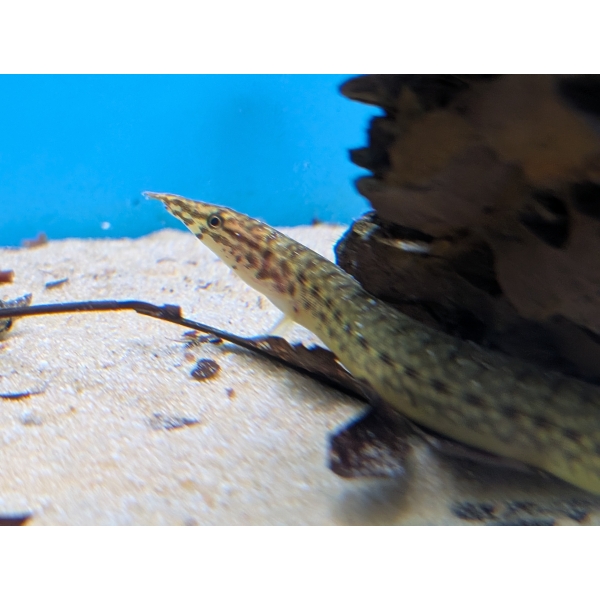
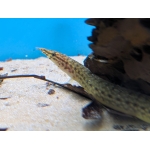
Macrognathus pancalus, commonly known as the Yellow Fin Spiny Eel, Striped Spiny Eel, or sometimes the Barred Spiny Eel, is an intriguing and distinctive species of freshwater fish belonging to the family Mastacembelidae. Native to South Asia, particularly India, Bangladesh, and Nepal, this elongated and somewhat secretive fish is admired for its unique eel-like body, subtle patterns, and engaging burrowing behaviour. It makes an interesting addition to a well-suited aquarium, appealing to aquarists looking for something out of the ordinary.
Taxonomy and Classification
- Kingdom: Animalia
- Phylum: Chordata
- Class: Actinopterygii
- Order: Synbranchiformes
- Family: Mastacembelidae (Spiny Eels)
- Genus: Macrognathus
- Species: Macrognathus pancalus
The family Mastacembelidae is characterised by its elongated, eel-like body shape and a distinctive pointed snout. M. pancalus is often confused with M. siamensis (Peacock Eel), but has distinct morphological differences and a different native range.
Habitat and Distribution
Macrognathus pancalus is widely distributed across various freshwater habitats in South Asia, including the Ganges, Brahmaputra, and Mahanadi river systems. Its natural habitat typically consists of slow-moving rivers, streams, canals, ponds, and floodplains with soft, muddy, or sandy substrates. These environments often feature dense vegetation, submerged roots, and leaf litter, which provide ample hiding spots for burrowing. The water parameters are generally neutral to slightly alkaline, with temperatures ranging from 22-28°C (72-82°F).
Physical Characteristics
The Yellow Fin Spiny Eel (M. pancalus) is an elongated, eel-like fish, usually reaching an adult size of approximately 18-25 cm (7-10 inches) in total length. Its most distinctive features are its body shape, pointed snout, and unique colouration.
Key physical characteristics include:
- Body Shape: Very elongated and cylindrical, resembling an eel, tapering towards the tail.
- Colouration: A base colour of light brown, tan, or olive, often with a series of irregular, dark blotches or faint vertical bars along the flanks. The dorsal and anal fins are typically yellowish or orange-tinged, sometimes with small, dark spots, though these are generally less pronounced and less “eye-like” than those seen on M. siamensis.
- Snout: A distinctive, elongated, and pointed snout with a small mouth, used for probing the substrate.
- Fins: Dorsal and anal fins are long and continuous with the caudal fin, giving a smooth, flowing appearance.
Diet and Feeding
In its natural habitat, Macrognathus pancalus is a nocturnal predator, feeding on small invertebrates, insect larvae, worms, and small fish found in the substrate. In an aquarium setting, they are carnivorous and require a diet rich in protein.
Suitable foods include:
- Frozen Foods: Frozen bloodworms, brine shrimp, tubifex worms, and chopped earthworms are excellent staples.
- Live Foods: Live blackworms, tubifex worms, and small feeder shrimp are eagerly accepted and can encourage natural foraging behaviour.
- Sinking Pellets: High-quality sinking pellets or granules designed for carnivorous bottom-feeders can be offered, but ensure they are consumed.
They are often shy feeders, especially when newly introduced, and may require food to be dropped near their hiding spots or offered after lights out.
Behaviour and Temperament
The Yellow Fin Spiny Eel (M. pancalus) is generally a peaceful and shy species, though it is a predator to very small fish or invertebrates. They are primarily nocturnal and spend much of the day buried in the substrate or hidden among decor. When active, they are graceful swimmers, gliding through the water. They are best kept individually or in groups if the tank is very large and offers ample hiding spots, as some territoriality can occur between conspecifics. They are not typically aggressive towards other similarly sized, peaceful fish that occupy the mid to upper water columns.
Reproduction
Breeding Macrognathus pancalus in captivity is rarely achieved by hobbyists. Information on their natural breeding habits is limited, but they are believed to be egg-layers. Commercial breeding often involves hormone induction.
- Spawning: In the wild, they are thought to spawn among dense vegetation or in soft substrate.
- Parental Care: There is no parental care.
- Fry Care: Information on fry care in a home aquarium setting is limited due to the difficulty of breeding.
Conservation Status
The conservation status of Macrognathus pancalus has not been extensively evaluated by international bodies like the IUCN. However, like many freshwater species in South Asia, its natural habitats can be affected by pollution, habitat degradation due to agriculture and urbanisation, and over-collection for the aquarium trade. Sustainable collection practices and the development of aquaculture are important for its long-term viability.
Aquarium Care
For aquarists interested in keeping Yellow Fin Spiny Eels (M. pancalus), here are some essential care guidelines:
- Tank Size: A minimum of 120 litres (30 gallons) for a single adult. Due to their length and need for soft substrate, longer tanks are preferred over taller ones.
- Water Parameters:
- Temperature: 22-28°C (72-82°F)
- pH: 6.5-7.5 (neutral to slightly alkaline)
- Hardness: 5-15 dGH (soft to moderately hard)
- Filtration: Good filtration is essential to maintain high water quality, but strong currents should be avoided as they prefer calmer waters.
- Substrate: A deep (at least 5-8 cm or 2-3 inches), fine, soft sand substrate is absolutely crucial. This allows them to burrow completely, which is vital for their well-being and to prevent stress and injury to their delicate skin. Avoid sharp gravel.
- Decor: Provide plenty of hiding spots in the form of driftwood, smooth rocks, ceramic caves, and dense planting. Ensure decor is stable and does not have sharp edges.
- Lighting: Moderate to dim lighting is generally preferred, especially during the day, as they are nocturnal.
- Tank Mates: Best kept with other similarly sized, peaceful to semi-aggressive fish that occupy the mid to upper water columns. Avoid very small fish (e.g., small tetras, fry) or small invertebrates (e.g., shrimp, snails) as they may be seen as food. Also avoid aggressive or nippy species that might harass the eel. Good tank mates include larger rasboras, gouramis, peaceful barbs, and some larger tetras.
- Maintenance: Regular weekly water changes (25-30%) are crucial for maintaining pristine water quality, which is vital for their health and to prevent skin issues.
By providing a spacious, well-filtered, and appropriately decorated environment with a deep, soft sand substrate, the Yellow Fin Spiny Eel (M. pancalus) can be a captivating and unique addition to a freshwater aquarium.
Convenient nationwide delivery; you’re only a click away!
General Enquiries
There are no enquiries yet.