

- Description
- Store Policies
- Enquiries
Description
Yellow OB Peacock Cichlid (Aulonocara sp. “Yellow OB”)
Species Profile:
Common Names: Yellow OB Peacock, Orange Blotch Yellow Peacock, Sunshine OB Peacock.
Scientific Name: Aulonocara sp. “Yellow OB” (A colour morph of the hybrid Aulonocara OB strain; it is not a pure, naturally occurring species).
Family: Cichlidae.
1. Introduction
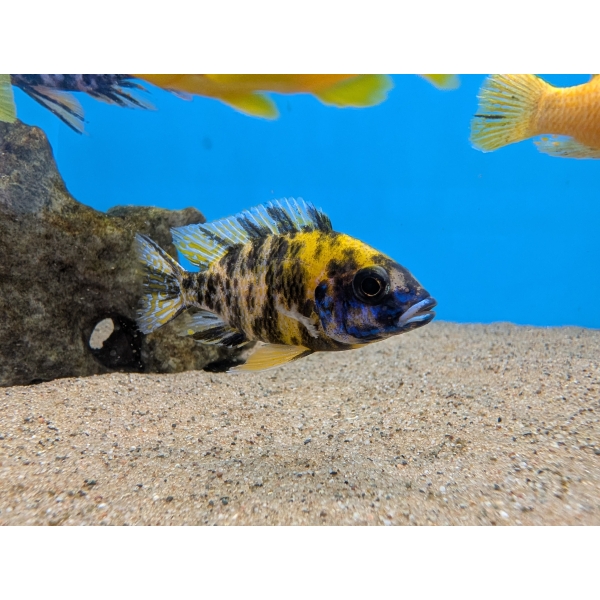
The Yellow OB Peacock Cichlid is a highly popular and visually striking colour variation of the hybrid Orange Blotch (OB) Peacock. While the standard OB Peacock features random splotches of various colours (red, blue, yellow), the Yellow OB strain is selectively bred to emphasise and intensify the yellow, gold, and orange pigments across its body.
Like all OB Peacocks, this fish is a man-made hybrid created by crossing a blotched female cichlid (likely an OB Mbuna) with a pure Aulonocara male. This hybridisation is responsible for the unique, irregularly blotched pattern that does not occur in pure Aulonocara species in the wild.
2. Natural Habitat and Origins
-
Natural Environment: The pure Aulonocara species are endemic to Lake Malawi, Africa, where they inhabit sandy areas near rocky outcrops.
-
Yellow OB Origin: This specific strain is a domestic development. It is selectively bred in the aquarium trade to maximise the expression of xanthic (yellow) and erythristic (red/orange) colouration within the classic OB mottled pattern.
-
Habitat Requirement: Despite being a captive-developed strain, the Yellow OB Peacock requires the exact same hard, alkaline water conditions as all Lake Malawi cichlids.
3. Appearance and Identification
The Yellow OB Peacock is instantly recognisable by its dominant bright yellow, gold, and orange hues.
-
Body: Streamlined and laterally compressed, characteristic of the Aulonocara genus.
-
Colouration (Males): The males display a metallic base colour (often light blue, gold, or purple) overlaid with a dense, irregular pattern of bright yellow and deep orange blotches. The intensity and randomness of the blotches are the signature of the OB strain. A high-quality specimen will glow with sunshine yellow and orange pigments.
-
Colouration (Females): Females are much less colourful, typically exhibiting a muted, mottled grey or yellowish-tan appearance, often showing some dark, irregular barring. They lack the intense blotched colour of the male.
-
Size: Adult males typically reach 12 cm to 15 cm (5 to 6 inches), with females slightly smaller.
4. Aquarium Requirements
Yellow OB Peacocks are large, active cichlids and require a specialist setup that replicates the unique water chemistry of Lake Malawi.
-
Tank Size: A minimum tank size of 240 litres (approximately 50 imperial gallons) is recommended for a small group (a single male with multiple females). A longer tank (120 cm minimum) is crucial for managing territories.
-
Water Temperature: 24°C – 26°C (75°F – 79°F). Consistent temperature is vital.
-
Filtration and Aeration: High-capacity external filtration is necessary to handle their bioload. Excellent aeration is mandatory to ensure high dissolved oxygen levels.
-
Substrate (Essential): Use calcareous sand (such as coral sand or aragonite). This sand acts as a natural buffer, helping to maintain the high pH and hardness required by Lake Malawi cichlids. It also facilitates their natural sifting behaviour.
-
Décor: Use smooth limestone or slate rockwork to create large stacks, caves, and visual barriers. The rockwork should allow for the establishment of individual territories to minimise male aggression. Avoid materials that lower pH, such as driftwood or peat.
5. Water Parameters (Crucial for Health)
Lake Malawi cichlids require extremely hard and alkaline water.
-
pH: 7.8 – 8.6 (Highly alkaline).
-
Hardness: Very hard water (10 – 20 dGH).
-
Maintenance: Strict weekly partial water changes (30%) are mandatory. Cichlids are intolerant of high nitrate levels.
6. Diet and Feeding
While pure Aulonocara are sifting insectivores, the Yellow OB hybrid is omnivorous but requires careful feeding to prevent digestive issues.
-
Staple Diet: High-quality sinking pellets or flakes formulated for African Cichlids, rich in spirulina or other colour-enhancing vegetable matter (which helps maintain the yellow/orange hues).
-
Supplemental Foods: Offer frozen foods like brine shrimp, Mysis shrimp, and krill.
-
Caution (Malawi Bloat): Do not feed mammal proteins (e.g., beef heart) or excessively fatty foods. A diet too high in non-aquatic protein or fat is strongly linked to Malawi bloat, a fatal intestinal condition. Ensure a high vegetable content in the diet.
7. Behaviour and Compatibility
-
Temperament: Peacocks are considered one of the milder groups of African cichlids, but males are fiercely territorial toward each other, especially when breeding.
-
Social Structure: They must be kept in a Harem structure: one male to at least three or four females. This dilutes aggression and prevents the male from harassing a single female.
-
Tank Mates: Best kept with other peaceful Lake Malawi cichlids (e.g., other Aulonocara or some Haplochromis species).
-
Avoid: Mixing them with aggressive Mbuna (rock-dwelling cichlids) who will often dominate and stress the Peacocks. Also, avoid other Aulonocara species if you wish to prevent further hybridisation.
8. Summary Checklist
| Requirement | Specification |
| Minimum Tank Size | 240 Litres (Large footprint) |
| Water Chemistry (CRITICAL) | pH 7.8 – 8.6, Very Hard Water |
| Social Structure | Harem (1 Male : 3+ Females) |
| Diet | Omnivore (High-quality cichlid pellet/flake + spirulina) |
| Décor | Calcareous Sand & Rock Structures |
| Temperament | Mildly Territorial Cichlid |
| Adult Size | 12–15 cm |
Convenient nationwide delivery; you’re only a click away!
Please put your desired delivery day in the Order Notes on the Checkout page.
General Enquiries
There are no enquiries yet.