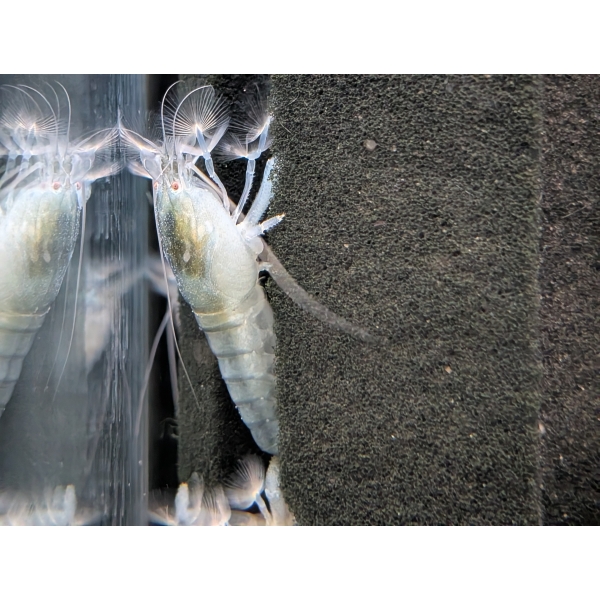
Armoured Shrimp (Atya gabonensis)
£15.00
Bulk Offer – 3 for £42.00
Discount will apply at checkout.
- Description
- Store Policies
- Enquiries
Description
Armoured Shrimp (Atya gabonensis)
Species Profile:
Common Names: Armoured Shrimp, Vampire Shrimp, African Filter Shrimp, Blue Filter Shrimp, Gabon Shrimp.
Scientific Name: Atya gabonensis.
Family: Atyidae.
1. Introduction
Despite its formidable appearance and the slightly intimidating nickname “Vampire Shrimp,” the Armoured Shrimp is one of the most peaceful and fascinating inhabitants of the freshwater aquarium. Unlike most shrimp that scavenge on the substrate, these are specialised filter feeders.
They possess fans (modified pincers) instead of claws, which they use to catch microscopic food particles drifting in the water current. They are significantly larger and more robust than the popular Neocaridina species, making them a stunning “centrepiece” invertebrate for a well-established aquarium.
2. Natural Habitat and Distribution
-
Geography: Native to West Africa (from Senegal to the Democratic Republic of the Congo) and South America.
-
Environment: They are found in fast-flowing rivers and streams, often tucked into crevices, under rocks, or behind driftwood where the current is strongest.
-
Water: They inhabit clear, oxygen-rich waters with a steady flow that brings a constant supply of planktonic food.
3. Appearance and Identification
-
Body: They have a thick, heavy-set exoskeleton that looks like a suit of armour. The third pair of legs is particularly thick and “spiny,” though these are used for anchoring in the current, not for defense or aggression.
-
Colouration: Most commonly seen in a striking powdery blue, but they can change colour after moulting. Depending on their diet and substrate, they may appear creamy white, grey, or even rusty pink.
-
The “Fans”: Their first two pairs of legs end in feather-like fans. These are delicate and highly efficient at trapping debris.
-
Size: They are a large species, typically reaching 10 cm to 15 cm (4 to 6 inches) in length.
4. Aquarium Requirements
The Armoured Shrimp has very specific needs regarding water flow and feeding.
-
Tank Size: A minimum of 80–100 litres (approx. 18–22 gallons) is required to provide enough space and stable water parameters.
-
Water Flow (Essential): You must provide a moderate to strong current. This is usually achieved with a powerhead or by positioning driftwood directly in front of the filter outlet. The shrimp will sit in the flow with its fans open.
-
Hiding Places: They are shy and nocturnal. They require large caves, PVC pipes, or gaps between rocks where they can hide during the day and during the vulnerable period after moulting.
-
Substrate: Sand or smooth gravel is preferred to prevent damage to their delicate fans if they attempt to sweep the bottom.
5. Water Parameters
-
Temperature: 23°C – 28°C (73°F – 82°F).
-
pH: 6.5 – 7.5.
-
Hardness: Moderate to hard water (6 – 15 dGH) is necessary to provide the minerals needed for their thick shells.
-
Nitrogen Cycle: They are highly sensitive to Ammonia and Nitrite. They should only be added to mature, well-oxygenated aquariums.
6. Diet and Feeding
The most common cause of death for these shrimp in captivity is starvation. Because they filter-feed, they cannot eat standard pellets easily.
-
Primary Food: Microscopic organisms, powdered fry food, and specialised “shrimp dust.”
-
Target Feeding: Use a pipette or syringe to release liquid or powdered food (like Phytoplankton, Spirulina powder, or crushed flake) upstream from the shrimp so the current carries it into their fans.
-
Warning Sign: If you see your Armoured Shrimp “scavenging” on the substrate with its fans, it is usually a sign that there is not enough food in the water column and the shrimp is starving.
7. Behaviour and Compatibility
-
Temperament: Completely harmless. They cannot nip or bite other fish.
-
Social Structure: They are peaceful and can be kept in groups if there are enough high-flow spots for everyone.
-
Tank Mates:
-
Ideal: Peaceful, medium-sized fish like Congo Tetras, Rainbowfish, Corydoras, and other filter shrimp (like Bamboo Shrimp).
-
Avoid: Large or aggressive cichlids, Loaches (which may try to eat them), and fin-nippers that might pester the shrimp’s delicate fans.
-
8. Breeding
-
Difficulty: Extremely difficult.
-
The Larval Stage: Like many Atya species, the adults live in freshwater, but the larvae require brackish or saltwater to develop before migrating back to freshwater as juveniles. Breeding in a home aquarium is almost never successful without specialised equipment.
9. Summary Checklist
| Requirement | Specification |
| Minimum Tank Size | 80–100 Litres |
| Diet | Filter Feeder (Needs powdered/micro food) |
| Current | Strong flow required |
| pH | 6.5 – 7.5 |
| Adult Size | 10–15 cm |
| Temperament | Peaceful Giant |
| Vulnerability | Sensitive to Ammonia/Copper |
| Primary Feature | Specialised feeding “fans” |
Convenient nationwide delivery; you’re only a click away!
Please put your desired delivery day in the Order Notes on the Checkout page.
General Enquiries
There are no enquiries yet.