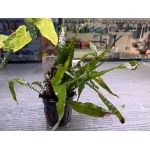
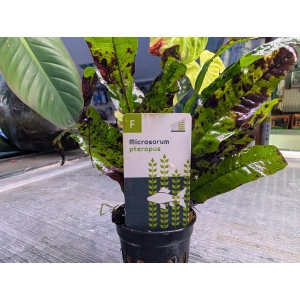
Microsorum narrow leaf
£7.50
Microsorum narrow leaf
Bulk Offer – 3 for £18.00
Discount will apply at checkout.
- Description
- Store Policies
- Enquiries
Description
Narrow-Leaf Java Fern (Microsorum pteropus ‘Narrow’):
Species Profile:
Microsorum pteropus ‘Narrow’—universally designated within the trade as Narrow-Leaf Java Fern—is a highly refined, elegant, and stable cultivation variant of the classic Southeast Asian aquatic fern. While the standard wild-type Java Fern dominates riverbanks with broad, heavy foliage, the ‘Narrow’ cultivar is selectively isolated for its sleek, elongated lines and graceful hydro-dynamic profile.
Belonging to the family Polypodiaceae, this slow-growing epiphyte is tailored specifically for an attached lifestyle along fast-flowing tropical jungle streams. In modern aquascaping, it has emerged as an indispensable master-tool, celebrated for its ability to introduce dense, fine texture, deep movement, and a sense of wild, mature age into both high-tech competition layouts and low-energy nano systems.
Morphology and Aesthetic Architecture
The defining appeal of Microsorum pteropus ‘Narrow’ lies entirely in its dramatically reduced leaf width, which it maintains consistently across successive generations of clonal propagation.
-
The Slender Foliage Silhouette: Unlike the standard variety, which can produce leaves up to 8 centimetres wide, the ‘Narrow’ variant features strictly linear, lance-shaped leaves that rarely exceed 1 to 2 centimetres in width. The leaf blades grow gracefully upright before arching elegantly downward at their tips.
-
Dimensional Scale: Individual leaf blades typically achieve a vertical length of 10 to 20 centimetres (4 to 8 inches), though under high-energy systems with optimal water column dosing, mature specimens can stretch up to 30 centimetres. The entire plant expands horizontally as its tightly clustered creeping stem advances.
-
Textural and Dermal Traits: The foliage is exceptionally tough, fibrous, and leathery to the touch, carrying a beautiful olivaceous-to-forest green colouration. Under focused full-spectrum lighting, a distinct, intricate net-like venation pattern can be seen running across the blade surface, adding immense texturing detail to the midground of an aquascape.
-
The Rhizome Core: The plant creeps via a horizontal, fuzzy, dark-green to dark-brown modified stem known as the rhizome. vertical leaves sprout from its upper side, while a dense, felt-like network of dark brown, hair-covered anchor roots extends downwards to clamp onto solid surfaces.
Aquarium Requirements and Water Parameters
Narrow-Leaf Java Fern is a masterclass in environmental plasticity. It is highly resilient, thriving across a vast spectrum of water parameters, making it equally suited for unheated indoor tanks, tropical setups, and mineral-rich cichlid habitats.
Optimal Hydrochemical Targets
| Parameter | Target Range |
| Water Temperature | 20°C to 28°C (68°F to 82°F) — Exhibits excellent thermal tolerance |
| pH Range | 6.0 to 7.8 (Highly tolerant of mild acidic to moderately alkaline loops) |
| General Hardness (dGH) | 2 to 18 dGH (Performs flawlessly in soft or hard water) |
| Carbonate Hardness (dKH) | 1 to 14 dKH |
| Water Circulation | Moderate to High (Good current prevents organic waste from pooling) |
Cultivation, Mounting, and the Rhizome Directive
⚠️ The Critical Rhizome Directive
Under no circumstances must the horizontal creeping green rhizome of Microsorum pteropus ‘Narrow’ be buried beneath the substrate (such as aqua-soil, sand, or gravel). The rhizome requires direct, unhindered access to fresh, oxygenated water flow. If buried, anaerobic bacteria will quickly suffocate the tissue, causing the stem to blacken, rot, and trigger complete leaf drop and plant death. Only the fine root tips may venture into the ground.
Advanced Fixing Techniques:
To grow this epiphyte successfully, treat it strictly as an attached asset and mount it directly onto your hardscape layout:
-
Cyanoacrylate Gel Bonding: Apply tiny, strategic dots of hobby-safe superglue gel directly to a bare section of the roots or the underside of the woody rhizome. Press the plant firmly onto a section of driftwood, bogwood, or a porous rock (such as volcanic lava rock or slate) for 15 seconds. This can be done completely out of water.
-
Thread or Monofilament Tying: Wrap fine, dark cotton sewing thread or clear nylon fishing line carefully around the rhizome and the target hardscape asset. Over a period of several months, the fuzzy root system will organically wrap around the microscopic crevices of the wood or stone to form a permanent physical bond, at which stage the thread can be cut away.
-
Mechanical Wedging: Thanks to its rigid, springy root matrix, clumps can simply be gently slid directly into natural cracks, forks, or splits within your hardscape design.
Nutrition, Light, and Physiological Phenomena
Lighting Strategy
Microsorum pteropus ‘Narrow’ is an obligate low-light specialist, making it a fantastic choice for low-energy layouts.
-
Low to Moderate Light: This is the target sweet spot. Under modest illumination, the leaves remain deep green, clean, and entirely spotless.
-
High Light Hazards: Exposure to intense, unshaded full-spectrum lighting will cause the narrow leaves to turn translucent, develop scorched yellow tips, and quickly burn out. If high-powered lighting is required for neighboring carpet plants, always position your Narrow-Leaf Java Fern in partial shade—such as beneath the shadow of large driftwood branches or under tall stem plants.
Carbon Dioxide (CO2) and Nutrient Intake
While pressurized carbon dioxide injection is entirely optional and the plant handles low-tech setups with ease, supplying a modest dose of CO2 (5 to 12 mg/L) noticeably improves leaf density and structural sheen. Because it lacks a standard root network in nutrient-rich soil, it pulls 100% of its food straight from the passing water column. Regular dosing with a high-quality liquid macro and micro fertiliser is highly beneficial. It prevents common Potassium (K) deficiencies, which characteristically manifest as tiny, dark pinholes across older leaf blades.
The “Black Spots” Reproductive Cycle
Hobbyists often panic when they notice rows of dark brown or black circular spots developing on the undersides of mature narrow leaves. This is not a disease or a sign of decay. Java Ferns are true spore-bearing ferns; these dark spots are Sori (clusters of reproductive sporangia). They are a natural sign of structural maturity and reproductive health.
Vegetative Propagation Modes
Narrow-Leaf Java Fern exhibits two remarkably distinct and efficient methods of reproduction:
1. Rhizome Division (Manual)
The most straightforward propagation method involves manual fragmentation. Using a razor-sharp, sterile pair of aquascaping scissors or a scalpel, cleanly cut the horizontal creeping rhizome into two or more pieces. Ensure each separated cutting retains at least 3 to 4 healthy leaves and a small cluster of roots to guarantee rapid, stress-free independent recovery.
2. Adventitious Plantlet Generation (Spontaneous)
When an individual leaf blade reaches the end of its life cycle, or when the plant experiences an environmental shift, it will automatically initiate a survival mechanism. Dozens of miniature, fully formed baby plantlets will spontaneously sprout straight out of the margins and tips of the older narrow leaves. These tiny plantlets will grow their own micro-rhizomes and hair-like brown root networks while still attached to the mother leaf. Once they reach a few centimetres in size, they can be gently plucked away and glued elsewhere.
Aquascaping Application and Livestock Compatibility
-
The Forced Perspective Tool: Aquascapers look to the ‘Narrow’ cultivar specifically to create texture and depth. Because the leaves are so slim, replacing standard Java Fern with the ‘Narrow’ variant tricks the human eye into perceiving the aquarium as significantly larger and deeper than it actually is. It looks spectacular when positioned at the base of driftwood roots or clustered tightly in the midground corners.
-
100% Herbivore Proof: Due to the presence of bitter secondary metabolic compounds within the leaf tissue, Narrow-Leaf Java Fern tastes highly unpalatable to fish. Destructive diggers and notorious plant-eating species—such as Goldfish, African Rift Lake Cichlids, Silver Dollars, and large Barbs—will leave the foliage completely untouched. Furthermore, because it is glued securely to rocks or roots, it is fully immune to being uprooted by fish that love to rearrange the substrate.
General Enquiries
There are no enquiries yet.