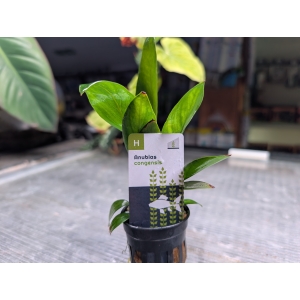


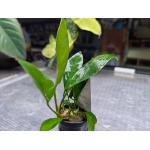


Anubias congensis
£7.50
Anubias congensis
Bulk Offer – 3 for £18.00
Discount will apply at checkout.
- Description
- Store Policies
- Enquiries
Description
The Congo Anubias (Anubias barteri var. congensis):
Species Profile:
Anubias barteri var. congensis—synonymously known within the international trade as Anubias congensis or simply the Congo Anubias—is a stately, magnificent, and uniquely architectural rheophytic perennial belonging to the arum family Araceae. Native to the densely shaded tropical riverbanks, swamps, and forest streams of Western and Central Africa (with notable abundance across regions like Cameroon and the Congo basin), this robust cultivar stands out as a true giant among the traditionally low-slung Anubias genus.
While varieties like Anubias Nana present compact, creeping, heart-shaped configurations, the Congo Anubias exhibits an elegant, strictly upright vertical profile. It features sweeping, spear-shaped foliage designed to withstand turbulent water currents in the wild, providing modern aquascapers with an indestructible, structurally imposing specimen ideal for anchoring larger layouts.
Morphology and Aesthetic Architecture
The structural blueprint of Anubias barteri var. congensis is perfectly adapted for a high-impact, low-maintenance lifestyle.
- The Elongated Rhizome Core: The backbone of the plant is its heavy, creeping green horizontal stem structure known as the rhizome. Leaves sprout vertically upward from this core on remarkably long, rigid, and flexible petioles (leaf stems), while an expansive network of thick, cord-like white anchor roots extends downward to grip smooth surfaces.
- Lanceolate Foliage Profile: Unlike the rounded or cordate leaves of its smaller relatives, the foliage of the Congo Anubias is distinctly lanceolate (spear- or arrowhead-shaped), terminating in a sharp, elegant point. The leaves possess an incredibly thick, leather-like cellular texture and a subtle, glossy satin finish that actively shrugs off detritus.
- The Emerald-to-Olive Palette: Newly emerged submersed leaves typically express a bright, vibrant, crisp green tone. As the individual leaf blades mature over several months, they deepen into a rich, commanding forest- or olive-green shade, introducing profound visual contrast to an enclosure.
- Impressive Scale: Under proper care, this variety easily outgrows smaller nano enclosures. It can achieve a mature vertical height of 30 to 45 centimetres (12 to 18 inches), with individual leaf blades stretching up to 15–20 centimetres in length, making it a powerful midground-to-background focal point.
Aquarium Requirements and Water Parameters
The Congo Anubias is widely regarded as a bulletproof, highly beginner-friendly species. Possessing remarkable metabolic plasticity, it effortlessly tolerates varying degrees of water chemistry and thrives across standard hard or soft British tap water loops.
Optimal Hydrochemical Targets
| Parameter | Target Range |
| Water Temperature | 22°C to 28°C (71.6°F to 82.4°F) — Reliably tolerates up to 30°C |
| pH Range | 6.0 to 8.0 (Demonstrates phenomenal stability across wide pH spans) |
| General Hardness (dGH) | 4 to 20 dGH (Absorbs mineral-heavy hard water variations seamlessly) |
| Carbonate Hardness (dKH) | 2 to 14 dKH |
| Lighting Intensity | Low to Medium ( Thrives comfortably in shaded, low-energy configurations) |
| Tank Placement | Highly suited for Midground focal spaces or Background structural walls |
Cultivation, Mounting, and the Rhizome Directive
⚠️ The Epiphytic Planting Rule
Exactly like its smaller cousin Anubias nana, the creeping horizontal green rhizome of Anubias barteri var. congensis must never be completely buried beneath the substrate (such as aqua-soil, sand, or gravel). The rhizome requires direct exposure to oxygenated water currents. If buried, anaerobic bacteria will quickly suffocate the tissue, causing the central stem to blacken, turn mushy, and disintegrate. This triggers catastrophic leaf drop and kills the entire specimen.
Advanced Fixing Guidelines:
To ensure the long-term vitality of the Congo Anubias, treat it primarily as a majestic epiphyte and affix it directly to your hardscape elements:
- Hobby-Safe Superglue (Cyanoacrylate Gel): Apply a few sparse, controlled dots of a cyanoacrylate-based gel glue directly to the root matrix or an inactive lower section of the rhizome. Press the plant firmly against a chosen piece of bogwood, driftwood, or porous hardscape (such as lava rock or slate) for roughly 15 to 30 seconds. This bonding process can safely be performed entirely out of the water.
- Thread, Monofilament, or Zip-Ties: Secure the horizontal rhizome to the hardscape asset by loosely wrapping clear nylon fishing line, dark cotton sewing thread, or a plastic zip-tie around the anchor points. Over a period of 6 to 10 weeks, the coarse roots will naturally etch themselves into the structural grooves of the wood or stone, creating a permanent bond. Once fixed, the temporary ties can be trimmed away.
- Substrate Crevice Accommodation: If you prefer to locate this large plant directly on the aquarium floor, you may gently wiggle the lower trailing root system into a loose gravel or sand bed. However, you must carefully pull the plant slightly upward to verify that the entirety of the horizontal green rhizome rests completely flush with or above the substrate line.
Lighting Dynamics and Algae Management
The Congo Anubias is an obligate, deeply resilient low-light specialist.
- The Light Balance: In its native African biotopes, this species grows under dense jungle canopies. In an aquarium, it performs flawlessly under low-to-moderate ambient lighting (15–35 PAR). Under these conditions, its leaves stay immaculate, and the plant maintains a clean, balanced look.
- The High-Light Algae Hazard: Exposure to strong, unshaded high-tech lighting will not speed up its very slow growth rate (which averages just one new leaf every 3 to 6 weeks). Instead, because the tough leaves can persist for years without dropping, they are prime real estate for stubborn Green Spot Algae (GSA) and Black Beard Algae (BBA) if light levels are too high.
- Shading Strategies: If keeping Anubias congensis in an aquarium with high-powered lighting, always plant it in partial shade. Position it directly under the canopy of large driftwood branches, or beneath tall, fast-growing floating canopy plants like Frogbit or Water Wisteria.
Nutrition, Carbon Dioxide (CO2), and Grooming
- Water Column Fertilisation: Because it is an epiphyte that does not rely on nutrient-rich soil, the Congo Anubias absorbs its nutrition directly from the passing water column via its roots and leaves. It is a moderate consumer, but it benefits significantly from regular dosing of a comprehensive liquid all-in-one fertiliser.
- The Iron Factor: Its native habitats feature exceptionally iron-rich soils and waters. To maintain its intense, dark emerald-to-olive sheen and prevent chlorosis (yellowing of the leaves), supplement the tank with a high-quality liquid chelated iron supplement.
- Carbon Dioxide (CO2) Dynamics: Pressurised CO2 injection is entirely optional; this plant is a legendary performer in low-tech setups. However, adding a modest carbon source (5–10 mg/L) will visibly improve its leaf thickness, strengthen its immunity against algae, and slightly boost its leisurely growth pace.
- Pruning and Cleaning: Over time, older outer leaves may collect algae or show signs of wear. Use an ultra-sharp pair of straight-blade aquascaping scissors to cut the leaf petiole cleanly and flush with the main rhizome. This routine grooming keeps the bunch looking pristine and encourages the rhizome to push out fresh new growth heads.
Rhizome Fragmentation and Propagation
Propagating Anubias barteri var. congensis is an effortless process of manual division:
- Once the mother plant is mature and has formed an elongated rhizome with several distinct leaf clusters, carefully lift the hardscape asset out of the water.
- Using a sterile, ultra-sharp scalpel or micro-scissors, make a clean vertical cut straight through the woody green rhizome.
- The Viability Rule: To guarantee rapid, shock-free independent recovery, ensure each separated fragment retains at least 3 to 4 healthy leaves and a few developed white anchor roots.
- Remount the newly divided segments back onto your rocks or wood. Within a few weeks, the cut nodes will break dormancy and begin growing out as entirely new, independent colonies.
Aquascaping Application and Livestock Compatibility
- The Ultimate Midground-to-Background Anchor: Thanks to its tall, lanceolate, upright posture, the Congo Anubias is an elite tool for framing large-scale aquascapes. It can be grouped closely together to mask ugly heater or filter intake pipes, or wedged into the midground to transition smoothly from lower foreground plants to tall background stems.
- 100% Cichlid, Goldfish, and Herbivore Proof: Due to the dense, leather-like cell structure of its mature leaves and the presence of bitter calcium oxalate crystals within its tissues, the Congo Anubias is completely unpalatable to fish. Large, aggressive, substrate-digging African Rift Lake Cichlids, Central American Cichlids, Silver Dollars, and fancy Goldfish will leave this sturdy plant entirely unbothered.
- Spawning Sanctuary: The broad, rigid, vertical spear-shaped leaves form an excellent, highly stable natural spawning shelf and calming shield for breeding pairs of large showpiece fish, such as Discus and Angelfish.
General Enquiries
There are no enquiries yet.