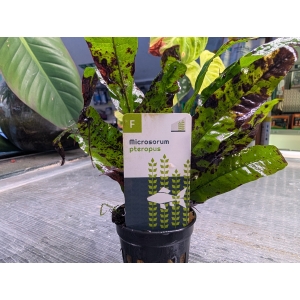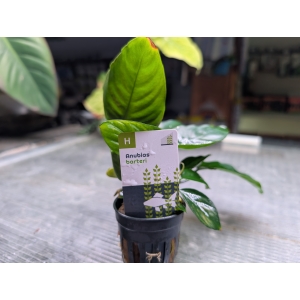



Anubias barteri
£7.50
Anubias barteri
Bulk Offer – 3 for £18.00
Discount will apply at checkout.
- Description
- Store Policies
- Enquiries
Description
The Barter Anubias (Anubias barteri):
Species Profile:
Anubias barteri—commonly known as the Barter Anubias or Broad-Leaf Anubias—is an iconic, slow-growing epiphytic plant native to the shaded, tropical rainforest rivers, marshes, and fast-flowing streams of West Africa (predominantly ranging from Guinea to Cameroon). Belonging to the arum family Araceae, it stands as one of the most culturally significant and anatomically resilient plants in the history of the aquarium hobby.
Celebrated for its thick, leathery, dark-green foliage and its nearly indestructible nature, this species is uniquely adapted to grow attached to solid hardscape rather than rooted in the soil. It is an absolute staple for aquascapers of all experience levels, thriving effortlessly in low-energy systems and high-tech displays alike.
Taxonomic Varieties and Cultivars
Anubias barteri is a highly polymorphic species, meaning it naturally exhibits several distinct geographical varieties. In the aquarium trade, these are treated as separate plants due to their differing sizes and leaf shapes:
-
Anubias barteri var. barteri: The nominate wild type, characterized by broad, upward-arching, heart-shaped leaves.
-
Anubias barteri var. nana: The highly popular dwarf variant, remaining compact with smaller, tightly packed, ovate leaves.
-
Anubias barteri var. caladiifolia: A giant variety featuring beautiful, sweeping, teardrop-shaped leaves that resemble the terrestrial Caladium plant.
-
Anubias barteri var. glabra (often sold as lanceolata): Displays narrow, elegant, spear-shaped leaves with an elongated lanceolate silhouette.
-
Anubias barteri var. coffeefolia: Features deeply ribbed, dark-brownish-red new foliage that matures into a rich green, mimicking the appearance of a coffee plant leaf.
Morphology and Appearance
The Barter Anubias is a creeping, rhizomatous perennial that maintains an exceptionally low, horizontal growth profile.
-
The Rhizome: The central structural anchor of the plant is a thick, fleshy, modified green stem known as the rhizome. From the upper surface of this rhizome, leaves emerge on stiff, vertical petioles. From its lower surface, thick, wire-like, adhesive anchor roots snake downwards to lock the plant onto rugged surfaces.
-
Leaf Structure and Texture: The leaf blades of the standard variety are broadly ovate to cordate (heart-shaped), boasting a smooth, glossy, deep forest-green colouration. The leaf tissue is exceptionally thick, fibrous, and leathery to the touch. This evolutionary adaptation protects the plant from being torn by torrential river currents in the wild.
-
Dimensions: Depending heavily on the specific variety, the standard Anubias barteri var. barteri typically achieves a height of 15 to 30 centimetres (6 to 12 inches), with an individual leaf blade length spanning 10 to 20 centimetres. The entire plant expands horizontally as the rhizome creeps forward over time.
Aquarium Requirements and Water Parameters
Because of its unique attachment mechanics and low vertical profile, Anubias barteri is a masterfully versatile tool, suited for midground placement in large aquaria, or as a striking foreground-to-midground structural piece in medium layouts.
Optimal Parameter Targets
Reflecting its origins in pristine yet highly variable jungle watercourses, this species is incredibly plastic, tolerating vast shifts in water chemistry without melting.
| Parameter | Target Range |
| Water Temperature | 22°C to 28°C (72°F to 82°F) — Can tolerate 20°C to 30°C comfortably |
| pH Range | 6.0 to 7.5 (Prefers slightly acidic to neutral water, but tolerates up to 8.0) |
| General Hardness (dGH) | 3 to 15 dGH (Thrives in both soft and moderately hard water) |
| Carbonate Hardness (dKH) | 2 to 12 dKH |
| Water Flow | Moderate to strong (Current keeps debris from settling on the slow-growing leaves) |
Cultivation and Planting Technique
⚠️ The Critical Rhizome Rule
Under no circumstances should the thick, horizontal rhizome of Anubias barteri be buried beneath the substrate (sand, soil, or gravel). The rhizome requires constant exposure to fresh, oxygenated water column flow. If buried, anaerobic bacteria will quickly suffocate the tissue, leading to complete rhizome rot, leaf drop, and the ultimate death of the plant.
Correct Hardscape Fixing Methods:
Instead of planting it into the ground, Anubias should be treated as an epiphyte and secured directly onto aquarium hardscape (driftwood, bogwood, or porous rocks like lava rock):
-
Cyanoacrylate Gel (Superglue): Apply a few small dabs of hobby-safe, gel-based superglue directly to the bare wood or rock face. Press the roots or a woody section of the rhizome firmly against the glue for 15 seconds. This can be done completely out of water, and the glue will cure safely upon submergence.
-
Thread or Fishing Line: Wrap fine dark cotton thread or clear monofilament fishing line around the rhizome and the hardscape piece to tie it securely. Over several months, the plant’s natural adventitious roots will creep into the microscopic crevices of the wood or stone, anchoring itself permanently. At this stage, the thread can be snipped away.
-
Wedging: Simply slide the root matrix into natural cracks, forks, or holes within your wood layout, ensuring the main green rhizome remains fully visible and unobstructed in the open water.
Nutrition, Light, and Algae Management
Lighting Strategy
Anubias barteri is an obligate low-light specialist. In nature, it grows under the dense, unbroken canopies of West African rainforests.
-
Low Light: This is the ideal environment. Under low-to-moderate lighting, the plant will grow slowly but steadily, producing deep green, clean, healthy leaves.
-
High Light Danger: Exposure to intense, unshaded full-spectrum lighting will not kill the plant, but it will cause a significant operational headache. Because Anubias grows so slowly, its older leaves are highly susceptible to becoming a host colony for Green Spot Algae (GSA) and Black Beard Algae (BBA). If high light is mandatory for neighboring plants, always position Anubias directly beneath the shadow of large hardscape structures or under the canopy of tall floating plants.
Carbon Dioxide (CO2) and Fertilisation
Pressurized carbon dioxide injection is entirely optional. The plant handles low-tech setups perfectly, taking up carbon dynamically from dissolved ambient gases. However, introducing even a low dose ofCO2 (10 to 15 ppm) paired with regular water column dosing of a liquid macro/micro fertiliser will noticeably accelerate its slow growth rate, increase leaf thickness, and help the plant outcompete surface algae.
Maintenance, Pruning, and Emergent Cultivation
-
Algae and Leaf Trimming: Older leaves that have become heavily covered in stubborn Green Spot Algae or have frayed over time should be removed to keep the plant looking immaculate. Use sharp aquascaping scissors to cut the leaf’s vertical petiole as close to the main horizontal rhizome as possible.
-
Propagating via Rhizome Splitting: If the rhizome becomes exceptionally long and outgrows its hardscape feature, it can be split. Ensure the section you plan to cut has at least 3 to 4 healthy leaves and a small cluster of developed roots. Snip the rhizome cleanly with sharp scissors. The newly separated piece can be glued elsewhere, while the original mother plant will rapidly respond by pushing out a new growth point from the cut node.
-
Emersed Paludarium Integration: Anubias barteri is an amphibious marsh plant. It transitions beautifully into high-humidity emersed setups (Paludariums, Ripariums, or terrariums). When grown emersed, the leaves become slightly more rigid and matte. Under these conditions, if the plant is mature and well-nourished, it will regularly throw up a beautiful, white, arum-like inflorescence consisting of a protective spathe wrapping around a central spadix (flower spike).
Aquascaping Application
-
The Hardscape Softener: Anubias barteri is unparalleled at softening harsh transitions in an aquascape. Placing clusters of these deep-green leaves at the exact junction where thick bogwood roots emerge from the substrate effortlessly mimics a mature, natural riverbank.
-
Herbivore-Safe Architecture: Due to the dense, fibrous, leathery texture of the leaves, this plant is 100% safe from herbivorous fish. Destructive diggers or plant-eaters, such as African Cichlids, Silver Dollars, and large tinfoil barbs, will find the leaves far too tough to chew or damage. Furthermore, because it is glued to rocks or wood, it cannot be uprooted by cichlids that like to rearrange the substrate.
-
Sturdy Spawning Platform: The wide, horizontal, completely rigid leaf blades serve as a premier, elevated platform for egg-depositing fish, notably Discus, Angelfish, and various dwarf cichlids, who will meticulously clean the smooth leaf surface before laying their clutch.
General Enquiries
There are no enquiries yet.