
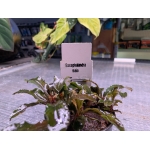
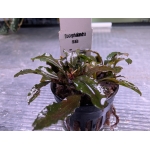
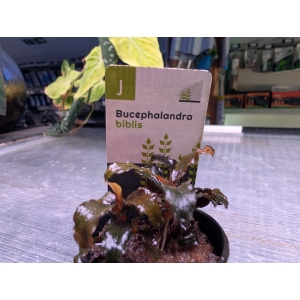
Bucephalandra maia
£7.50
Bucephalandra maia
Bulk Offer – 3 for £18.00
Discount will apply at checkout.
- Description
- Store Policies
- Enquiries
Description
Bucephalandra sp. ‘Maia’:
Species Profile:
Bucephalandra sp. ‘Maia’ (frequently spelt ‘Maya’ within the hobby) is a highly exclusive, rare, and captivating rheophytic plant endemic to the dense rainforest streams of Borneo. As an undescribed geographical variant, its formal species identity remains a mystery, making it a highly prized collector’s piece for discerning aquascapers.
Belonging to the arum family Araceae, ‘Maia’ has evolved to withstand the torrential water currents of its native habitat by anchoring itself directly to solid hardscape. It is highly celebrated for its distinctive narrow-leaf architecture and a dramatic, multi-chromatic colour spectrum that introduces rich, moody depth to any aquatic display.
Morphology and Aesthetic Architecture
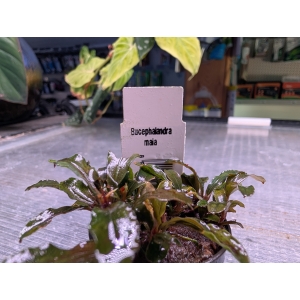
Bucephalandra ‘Maia’ showcases a compact yet elegant growth profile, making it a stellar structural accent.
-
Foliage Spectrum: Under submersed conditions, the leaves undergo a spectacular transformation. Emerging leaves present a lighter, coppery-bronze or warm red tint, which gradually matures into a magnificent, deep copper-red to near-black hue.
-
Leaf Shape and Surface Texture: The foliage is characterised by an elongate-elliptic or narrowly elliptic silhouette with smooth, clean lines. True to the genus, the glossy leaf surfaces are peppered with tiny, reflective silvery-white dots (stomata cell structures) that create a shimmering, iridescent sheen when hit by targeted light.
-
The Rhizome and Roots: The structural backbone of ‘Maia’ is its creeping horizontal rhizome. From this horizontal stem, thick, wire-like anchor roots emerge, designed to latch onto rough surfaces with remarkable tenacity.
-
Dimensions: ‘Maia’ maintains a tight and orderly growth habit, with mature specimens topping out at a maximum vertical height of 8 to 10 centimetres (approx. 3 to 4 inches).
Aquarium Requirements and Water Parameters
Despite its rarity, Bucephalandra ‘Maia’ is incredibly resilient and adaptable, making it equally suited for low-tech layouts and high-energy competition displays.
Optimal Hydrochemical Targets
| Parameter | Target Range |
| Water Temperature | 20°C to 28°C (68°F to 82°F) |
| pH Range | 5.0 to 8.0 (Prefers a slightly acidic environment of 6.0 to 7.0) |
| General Hardness (dGH) | 5 to 15 dGH (Thrives in soft to moderately hard water) |
| Carbonate Hardness (dKH) | 1 to 8 dKH |
| Water Circulation | Moderate to high (Mimics natural rapids and prevents detritus build-up) |
Cultivation, Fixation, and Placement
⚠️ The Epiphytic Rhizome Rule
Under no circumstances should the creeping horizontal rhizome of Bucephalandra ‘Maia’ be buried beneath aquarium substrates such as aqua-soil, sand, or gravel. The rhizome must remain fully exposed to the water column to ensure oxygen circulation. If buried, anaerobic bacteria will rapidly suffocate the stem, triggering catastrophic rhizome rot and complete plant collapse.
Preferred Mounting Methods:
To integrate ‘Maia’ into an aquascape, treat it entirely as an epiphyte and fix it onto hardscape elements:
-
Cyanoacrylate Gel (Superglue): Apply a tiny, sparse dot of hobby-safe superglue gel directly to the root matrix or the underside of the rhizome. Press the plant firmly onto lava rock, dragon stone, or driftwood for 15 seconds. Porous stones are ideal as they offer immediate grip for the roots.
-
Thread or Monofilament Tying: Wrap fine, dark cotton sewing thread or clear fishing line gently around the rhizome and the hardscape asset. Over a couple of months, the plant will naturally anchor itself, allowing the thread to safely dissolve or be snipped away.
-
Mechanical Wedging: Small clumps can simply be gently wedged into natural splits, knots, or crevices within your wood layouts, provided the central growing crown is unobstructed.
Lighting, Nutrition, and Algae Management
The Spectrum and Light Strategy
Bucephalandra ‘Maia’ is highly adaptable to lighting variations, but light levels directly dictate its visual output:
-
Low to Moderate Light: This is the safest environment. The plant will remain perfectly healthy and require minimal maintenance, though the foliage will lean toward a more understated olivaceous green with subtle copper tones.
-
Optimised Medium-High Light: Providing moderate lighting under specialised RGB LED fixtures is highly recommended to unlock its deepest copper-red, violet, and near-black coloration.
-
Algae Mitigation: Because ‘Maia’ grows at a slow pace, its leaves are highly susceptible to hosting stubborn Green Spot Algae (GSA) and Black Beard Algae (BBA) if light levels are uncomfortably high. Ensure adequate water flow sweeps across the foliage to prevent detritus from settling, and deploy Caridina shrimp (Amano Shrimp) to graze on the leaf surfaces.
Nutrient and CO2 Supplementation
While carbon dioxide injection is not strictly necessary, supplying a low-to-moderate dose of pressurized CO2 (5 to 15 mg/L) completely transforms the plant’s vitality. CO2 noticeably accelerates its slow growth habits and results in sturdier leaf nodes. Since it absorbs nutrients directly from the water column, it benefits significantly from regular liquid micro and macro fertilisation, with an emphasis on Iron (Fe) dosing to sustain its dark metallic hues.
Maintenance, Propagation, and Melt Recovery
-
Rhizome Propagation: Propagating ‘Maia’ is easily achieved via simple rhizome division. Using an ultra-sharp, sterile aquascaping scalpel or micro-scissors, cleanly slice the horizontal stem. Ensure each separated portion retains at least 3 to 4 healthy leaves and a small cluster of roots to ensure a successful recovery.
-
Pruning Protocols: Systematically clip away older, damaged, or algae-covered leaves by cutting the petiole flush with the main rhizome line. This directs vital energy toward pushing out fresh, vibrant growth points.
-
Managing Transition Shock: Like all Bucephalandra varieties, ‘Maia’ can experience temporary leaf melt when introduced to a new environment or subjected to sudden parameter shifts. The leaves may soften, turn clear, and drop away. Do not discard the plant if this occurs. As long as the central horizontal rhizome remains firm, solid, and green, the plant is completely alive. Maintain consistent water parameters, and the resilient rhizome will soon generate pristine, fully acclimated submersed leaves.
Aquascaping Application
Anubias and Cryptocoryne look fantastic, but Bucephalandra ‘Maia’ injects unparalleled texture and high-contrast luxury into a layout. Position it in the foreground to midground transitions, highlighting the borders where rocks meet wood. Its deep copper-red tones serve as the perfect visual foil against light green mosses and bright carpeting plants, effortlessly drawing the eye to the finer details of the aquascape.
General Enquiries
There are no enquiries yet.