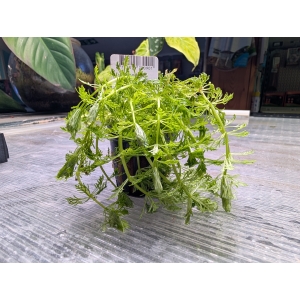


Cryptocoryne retrospiralis
£4.50
Cryptocoryne retrospiralis
Bulk Offer – 5 for £20.00
Discount will apply at checkout.
- Description
- Store Policies
- Enquiries
Description
Spiral Water Trumpet (Cryptocoryne retrospiralis):
Species Profile:
Cryptocoryne retrospiralis, commonly known as the Spiral Water Trumpet, is an elegant and structurally unique aquatic plant native to the Indian subcontinent. Belonging to the family Araceae, this species is highly regarded by advanced aquascapers for its distinct, narrow, grass-like leaves and its fascinating twisted morphology. While less ubiquitous in local fish shops than broader-leaved species like Cryptocoryne wendtii, it serves as an exceptional background or accent plant, offering a striking vertical contrast in mature, low-to-medium-tech aquaria.
Natural Habitat and Origin
In the wild, Cryptocoryne retrospiralis is primarily distributed across India, with notable populations found throughout the fast-flowing river systems and monsoon-driven streams of the Western Ghats and seasonal floodplains.
The natural ecology of this species is highly dynamic:
-
Limestone Channels: It often populates sandy, gravelly riverbeds that are heavily enriched with limestone, adapting the plant to harder, alkaline water parameters.
-
Amphibious Lifecycle: During the high-water monsoon season, the plants grow completely submerged, subjected to strong currents. In the dry season, as water levels drop dramatically, they transition to an emersed state on exposed muddy banks, which triggers their reproductive cycle and the development of their signature spiral spathes (flowers).
Morphology and Appearance
Cryptocoryne retrospiralis is a robust rosette-forming plant that commands significant vertical presence, though its footprint remains relatively compact.
-
Leaf Structure: The leaves are strictly linear and strap-like (ensiform), typically measuring between 15 to 40 centimetres (6 to 16 inches) in length, while remaining exceptionally narrow at just 0.5 to 1.5 centimetres wide. The margins of the leaves are typically wavy or undulating.
-
The “Retrospiralis” Trait: The species derives its botanical name from the unique way its leaves or spathe display spiral contortions. Under optimal conditions and moderate current, the narrow leaves twist and curl along their length, creating a dynamic, corkscrew-like vertical texture.
-
Colouration: The foliage is predominantly a clean, bright olive-green to a rich jade-green. Under high-intensity lighting or when grown emersed, the upper leaf surfaces can develop subtle brownish-bronze overtones, while the undersides remain a lighter, pale green.
Aquarium Requirements and Water Parameters
Due to its impressive height, Cryptocoryne retrospiralis is an ideal candidate for the background of medium-sized tanks or a striking midground accent in large, deep aquaria.
Optimal Parameter Targets
Reflecting its native Indian river habitats, this species thrives best in stable water chemistry and uniquely appreciates a higher mineral content than many of its rainforest-dwelling relatives.
| Parameter | Target Range |
| Water Temperature | 22°C to 28°C (72°F to 82°F) |
| pH Range | 6.5 to 8.0 (Prefers neutral to slightly alkaline water) |
| General Hardness (dGH) | 6 to 18 dGH (Moderately soft to hard water) |
| Carbonate Hardness (dKH) | 3 to 12 dKH |
| Water Flow | Moderate to strong (Mimics its riverine origin) |
Cultivation and Nutrition
Substrate and Root Feeding
⚠️ Root Nutrition Note
Cryptocoryne retrospiralis develops an incredibly deep, tenacious root network. It relies almost exclusively on absorbing nutrients through its root base rather than from the open water column.
-
Preferred Medium: To achieve maximum height and leaf twisting, plant it into a nutrient-rich, clay-based aquasoil.
-
Inert Substrates: If housing this species in inert sand or gravel, the addition of iron-rich root tabs is essential. Without adequate substrate nutrition, the plant will remain severely stunted, and the leaves will fail to develop their characteristic length.
-
Root Disruption: Because it establishes such an extensive anchorage system, it is highly sensitive to being moved. Select its planting location carefully; uprooting a mature specimen will likely stall its growth for several months or trigger a severe foliage melt.
Lighting Strategy
This species is remarkably versatile regarding light availability:
-
Low to Moderate Light: The plant will grow reliably but slowly. The leaves will appear flatter, smoother, and stretch vertically to capture light.
-
High Light: Brighter, full-spectrum lighting encourages a more compact rosette base, intensifies the undulating waviness of the margins, and coaxes out subtle bronze hues.
Carbon Dioxide (CO2) and Fertilisation
While Cryptocoryne retrospiralis is perfectly suited for low-tech layouts and does not require pressurized carbon dioxide, the introduction of 15 to 20 ppm of CO2 yields a noticeable transformation. It significantly speeds up its naturally slow growth rate and coaxes the leaves into a tighter, more pronounced spiral form. Regular dosing of liquid iron and potassium ensures the leaves maintain a healthy, vibrant coloration.
Managing “Crypt Melt”
As with all members of the Cryptocoryne genus, C. retrospiralis is susceptible to Crypt Melt when introduced to a new environment or when water parameters shift drastically.
If the long, narrow leaves begin to liquefy and dissolve into translucent mush, do not panic or pull the plant out. Carefully siphon away the decaying organic material to protect water quality, and ensure the tank parameters remain stable. The thick, energy-dense underground rhizome will safely weather the transition shock, and new, fully adapted leaves will begin spiking out of the substrate within a few weeks.
Aquascaping Application and Placement
-
Textural Contrast: The fine, grass-like texture of C. retrospiralis provides a brilliant visual break when planted alongside broad-leaved species like Anubias, Vallisneria, or large Amazon Sword plants (Echinodorus).
-
The Moving Backdrop: When placed in the path of a filter return or powerhead, its long, narrow leaves sway gracefully in the current, adding a sense of natural movement and flow to the aquascape.
-
Equipment Concealment: Because it grows tall and dense over time, a row of these plants is highly effective for masking unsightly aquarium hardware, such as heaters, lily pipes, and internal filters.
Propagation
Propagation of Cryptocoryne retrospiralis is a slow but straightforward process achieved via underground runners.
Once the primary rosette has matured and adapted to its setting, it will send out thick horizontal runners beneath the substrate. New daughter plants will eventually breach the sand a few centimetres away. Allow these young plantlets to grow until they stand at least 10 to 15 centimetres tall and have established their own root systems. At this stage, you can use a sharp pair of aquascaping scissors to sever the underground runner connecting them to the parent plant, allowing the new specimen to be relocated or left to form a thick, grassy forest.
General Enquiries
There are no enquiries yet.