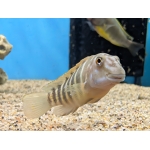


Eretmodus marksmithi Kigoma Wild Caught
£30.00
Eretmodus marksmithi Kigoma
- Description
- Store Policies
- Enquiries
Description
Species Profile: Eretmodus marksmithi ‘Kigoma’
Introduction: The Goby Cichlids
The genus Eretmodus belongs to a group often referred to as “Goby Cichlids” due to their unique, elongated body shape and peculiar mode of locomotion—they use their ventral fins like stilts to hop or perch on rocks rather than swimming continuously. This adaptation allows them to withstand the heavy surge and turbulent waters of the rocky shallow zones of Lake Tanganyika.
The Eretmodus marksmithi ‘Kigoma’ variant is collected near the port town of Kigoma, Tanzania.
Key Characteristics and Appearance
Origin and Habitat
- Origin: Lake Tanganyika, East Africa.
- Habitat: They are typically found in the high-energy surf zones (wave-exposed, rocky shallows). They graze on the tough, fibrous algae (aufwuchs) growing on the rocks, which is constantly agitated by the wave action.
Appearance
- Body Shape: Distinctive, elongated, and slightly compressed body, reminiscent of a marine goby.
- Colouration: The ‘Kigoma’ variant typically exhibits a base colour ranging from greyish-tan to light brown.
- They possess striking vertical barring (4 to 8 bars) across the body, often dark grey or black.
- The head and cheek area are usually decorated with iridescent blue or turquoise spots and markings.
- The fins often have blue or white trim, highlighting their unique shapes.
- Locomotion: They possess an inferior mouth (underslung) for grazing, and modified ventral fins that act as supports for perching on the rocks.
- Size: Adults are relatively small for cichlids, reaching approximately 7-9 cm (3-3.5 inches).
Aquarium Requirements and Water Parameters
To keep Eretmodus marksmithi healthy, their aquarium must replicate the turbulent, highly oxygenated environment of the surge zone.
Tank Size
Due to their territorial nature, a minimum tank size of 200 litres (approx. 45 UK Gallons) is recommended. Longer tanks are better than tall ones.
Water Chemistry
Stability and high alkalinity are vital, reflecting the Rift Lake environment.
- Temperature: 24C – 27C (75F – 81F).
- pH: 8.0 – 9.0 (High pH is essential).
- Hardness: Very hard water (gH and kH must be high).
Decor and Environment
- Rockwork: Extensive, stable rockwork is mandatory. Rocks should be stacked to create numerous small caves, hiding spots, and territorial boundaries. They require surfaces to graze on and perch upon.
- Water Movement: Unlike many cichlids, Goby Cichlids thrive in strong water flow. Use powerheads or highly-rated filters to create significant water agitation and oxygenation, simulating their natural habitat.
- Substrate: Fine sand or crushed coral is suitable.
Diet and Nutrition (Herbivore Specialisation)
Like Tropheus, Eretmodus are primarily herbivores, and their diet must be carefully managed to prevent intestinal issues.
Primary Diet
The majority of their diet should be high-quality vegetable matter.
- Recommended Foods:
- High-quality, sinking pellets or flakes that are spirulina-based.
- They readily accept and should be fed blanched greens like spinach, courgette, and shelled peas.
- Dried, unseasoned nori seaweed is an excellent supplement that encourages their natural grazing behaviour.
Crucial Warning
- Avoid High Protein: Do not feed foods high in animal protein or fat (such as tubifex, bloodworms, or beef heart). Their long digestive tracts are designed for tough plant matter, and rich foods can quickly lead to potentially fatal Malawi Bloat.
- Grazing: As they are constant grazers in nature, feed small amounts two to three times per day rather than one large meal.
Social Behaviour and Compatibility
Eretmodus exhibit unique social traits, often preferring to be kept in specific arrangements.
Pair or Group Housing
- Monogamy: In the wild, they often form stable, monogamous pairs.
- Aquarium Housing: They are best kept either as a single, established breeding pair or in a large tank in a group of 5 or more individuals to spread aggression. Keeping them in groups of 2 or 3 is highly discouraged, as the dominant fish will likely bully the others relentlessly.
- Territoriality: They are fiercely territorial, especially during breeding. Their aggression is usually directed towards their own kind or similarly shaped species.
Compatibility
- Tank Mates: Best kept with other Tanganyikan cichlids that share the same dietary needs and water preferences, such as Julidochromis, Altolamprologus, or Tropheus (if the tank is large enough to manage both highly territorial groups).
- Incompatibility: Avoid slow-moving or timid fish, as the constant aggression and activity of the Eretmodus will stress them.
Breeding: Bi-Parental Mouthbrooders
Eretmodus are one of the few cichlids that practice bi-parental mouthbrooding, an unusual characteristic:
- Maternal Phase: The female initially holds the eggs in her mouth for the first 1-2 weeks.
- Paternal Transfer: She then transfers the eggs or newly hatched fry to the male, who finishes the incubation period.
- Hatch Time: The total brooding time is typically 3-4 weeks, with the male usually holding the fry for the longest duration. This joint effort often results in successful rearing of the young.
Convenient nationwide delivery; you’re only a click away!
Our nationwide delivery service makes it easy to receive your fish directly at your door, anywhere in the UK, for a flat rate of just £30. This convenient service allows you to order up to 10kg of fish, with the assurance that they will arrive in excellent condition. To make the fishes journey as comfortable as possible we use Oxygen in the fish bags and heat packs in all the boxes of fish we send out.
Please put your desired delivery day in the Order Notes on the Checkout page.
General Enquiries
There are no enquiries yet.