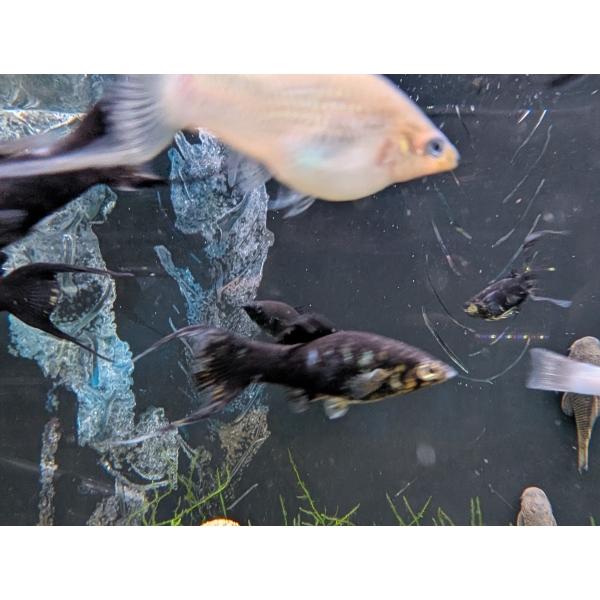




Large Assorted Molly
£5.00
Bulk Offer – 6 for £27.00
Discount will apply at checkout.
Large Assorted Molly
- Description
- Store Policies
- Enquiries
Description
The Molly (Poecilia sphenops):
A Guide for the Hobbyist
The Molly is a staple of the UK aquatic trade, beloved for its hardy nature, active personality, and the wide array of colourmorphs available in local fish shops (LFS). While often sold as a “beginner fish,” the Molly has specific physiological needs—particularly regarding water hardness—that must be met for it to thrive.
Quick Statistics
| Attribute | Requirement |
|---|---|
| Scientific Name | Poecilia sphenops |
| Origin | Central and South America |
| Adult Size | 6 cm to 10 cm (Females are generally larger) |
| Typical Lifespan | 3 to 5 years |
| Ideal Temperature | 24C to 28C |
| Minimum Tank Size | 60 to 90 litres |
Water Chemistry: The Critical Factor
In the UK, water hardness varies wildly by region. Mollies are hard-water specialists.
- Hard Water (South & East England): If you live in London, East Anglia, or the South East, your tap water is likely perfect for Mollies. They thrive in the high mineral content found in these regions.
- Soft Water (Scotland, Wales, & Northern England): If your water is soft, you must buffer it. Mollies kept in soft water often suffer from “the shimmies” (a neurological rocking motion) and a suppressed immune system. Use crushed coral in the filter or specialized mineral salts to keep the dGH above 12.
- Salinity: While often kept in pure freshwater, Mollies are euryhaline, meaning they can tolerate (and often prefer) brackish conditions. Adding aquarium salt (1- 3 grams per litre) can significantly improve their health.
Popular Varieties in the UK
- Black Molly: The classic melanistic variety. They are prized for their deep, velvet-black scales.
- Dalmatian Molly: A striking white fish with irregular black spots.
- Lyretail Molly: Known for the elegant, elongated “U” shape of the caudal (tail) fin.
- Balloon Molly: A controversial variety bred for a rounded, shortened spine. These require extra care as their internal organs are compressed, making them more susceptible to digestive issues.
Diet and Nutrition
Mollies are primarily aufwuchs feeders, meaning they spend their time grazing on algae and the tiny organisms within it.
- Greens are Essential: A standard tropical flake is not enough. Ensure you provide a food with high vegetable content, such as Spirulina flakes or blanched garden peas (with the skins removed).
- Live/Frozen Food: Supplement with bloodworms, daphnia, or brine shrimp once or twice a week to provide necessary protein.
- Algae Control: While they will graze on algae in your tank, they should not be viewed as a “cleanup crew” in the same way as snails or certain catfish; they still require dedicated feeding.
Social Behaviour and Tank Mates
The Harem Rule
Mollies are social but can be boisterous. Males are constantly interested in mating, which can exhaust the females. Always aim for a ratio of one male to every two or three females. This ensures the male’s attention is divided, allowing individual females time to rest.
Suitable Tank Mates
Choose companions that also enjoy hard, alkaline water:
- Other Livebearers: Guppies, Platies, and Swordtails.
- Bottom Dwellers: Corydoras (though check the specific species pH tolerance) or Bristlenose Plecos.
- Tetras: Larger, hardier species like the Buenos Aires Tetra or X-Ray Tetra.
Breeding
Mollies are ovoviviparous (livebearers). Instead of laying eggs, the female carries the fry inside her and gives birth to fully formed, free-swimming young.
- Gestation: Usually lasts 28 to 35 days.
- The “Gravid Spot”: On lighter-coloured females, a dark spot will appear near the anal fin as the pregnancy progresses.
- Fry Care: Adult mollies may eat their young. To ensure survival, provide plenty of fine-leaved plants (like Java Moss) for the fry to hide in, or move the female to a dedicated breeding trap shortly before she gives birth.
Common Health Issues
- The Shimmies: As mentioned, this is usually caused by water that is too soft or cold. Correcting the water chemistry is the only cure.
- White Spot (Ich): Small white grains appearing on the body. This is often triggered by temperature fluctuations during water changes. Ensure replacement water is dechlorinated and matches the tank temperature exactly.
Convenient nationwide delivery; you’re only a click away!
Please put your desired delivery day in the Order Notes on the Checkout page.
General Enquiries
There are no enquiries yet.