


Moema rubrocaudata
£16.00
Prices are £16.00 Per Pair
Only 2 x females available
- Description
- Store Policies
- Enquiries
Description
Moema rubrocaudata:
A Comprehensive Overview
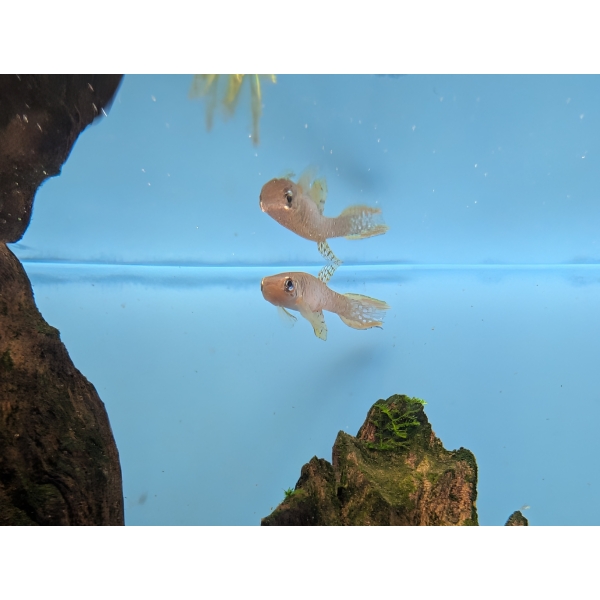
Moema rubrocaudata, commonly known as the Red-tailed Moema, is a captivating and relatively rare species of annual killifish belonging to the family Rivulidae. Native to seasonal pools and temporary streams in South America, particularly the Amazon basin, this fascinating fish is admired for its vibrant colouration and unique life cycle adapted to ephemeral habitats. It makes a highly specialised and rewarding addition for experienced aquarists interested in killifish.
Taxonomy and Classification
- Kingdom: Animalia
- Phylum: Chordata
- Class: Actinopterygii
- Order: Cyprinodontiformes
- Family: Rivulidae (New World Rivulid Killifishes)
- Genus: Moema
- Species: Moema rubrocaudata
The genus Moema comprises several species of annual killifish, characterised by their adaptation to habitats that dry up seasonally. The species name “rubrocaudata” is Latin for “red-tailed,” referring to its distinctive caudal fin colouration.
Habitat and Distribution
Moema rubrocaudata is endemic to the Amazon basin in Brazil, specifically found in the states of Rondônia and Acre. Its natural habitat consists of temporary pools, ditches, and slow-moving streams that form during the rainy season and completely dry up during the dry season. These environments are typically characterised by a substrate of mud or fine silt, often with abundant leaf litter and decaying vegetation, which contributes to soft, acidic, and tannin-stained blackwater conditions. The water temperature in these areas can fluctuate but is generally warm, ranging from 24-28°C (75-82°F).
Physical Characteristics
The Red-tailed Moema is a small to medium-sized killifish, usually reaching an adult size of approximately 6-8 cm (2.4-3.2 inches) in total length. Its most distinctive feature is its vibrant colouration, particularly the males.
Key physical characteristics include:
- Body Shape: Elongated and cylindrical, with a somewhat robust build.
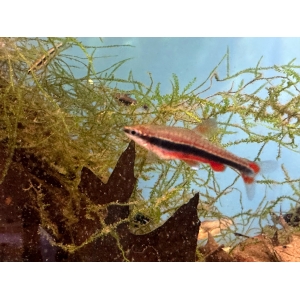
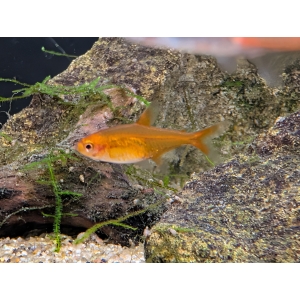
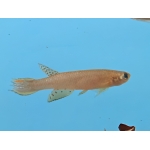
- Colouration: Males are strikingly colourful, often displaying a base colour of iridescent blue, green, or gold, adorned with numerous bright red spots or streaks across the body and fins. The caudal (tail) fin is notably bright red or orange, sometimes with a dark margin. Females are generally smaller and have a more subdued, brownish or greyish body colour with fainter markings.
- Fins: Males possess large, flowing dorsal and anal fins, which are often tinged with red and patterned with spots. The caudal fin is spade-shaped and prominently red.
- Eyes: Relatively large.
Diet and Feeding
In its natural habitat, Moema rubrocaudata is a carnivorous micropredator, feeding primarily on small invertebrates, insect larvae, and zooplankton found in the water column and on the substrate. In an aquarium setting, they require a diet rich in protein.
Suitable foods include:
- Frozen Foods: Frozen bloodworms, brine shrimp, daphnia, and mysis shrimp are excellent staples.
- Live Foods: Live daphnia, brine shrimp, microworms, and small insect larvae are eagerly accepted and crucial for conditioning them for breeding and maintaining their health.
- High-Quality Pellets/Flakes: They may accept small, high-protein pellets or flakes, but these should not form the sole basis of their diet.
Due to their active nature and predatory instincts, a varied and high-quality diet is essential.
Behaviour and Temperament
The Red-tailed Moema is generally a peaceful fish, but males can be territorial towards each other, especially if space is limited. They are active swimmers, particularly in the mid to upper water column, and are constantly on the lookout for food. They are best kept in species-specific tanks or with other very peaceful, similarly sized fish that are not overly boisterous. Due to their annual life cycle, their lifespan in an aquarium is typically around 6-12 months.
Reproduction
Moema rubrocaudata are annual killifish, meaning they are adapted to reproduce before their habitat dries up. They are substrate spawners, laying their eggs in the mud or peat. Breeding in captivity is a primary goal for many killifish enthusiasts and involves a specific process.
- Spawning: The fish will dive into a soft substrate (like peat moss or coco fibre) to lay and fertilise their eggs. Spawning can occur daily for several weeks.
- Egg Collection: Eggs are collected from the substrate, partially dried, and then stored in a slightly damp medium (e.g., peat) for a specific incubation period (typically 3-6 months, but variable) before being re-wetted to simulate the return of the rainy season.
- Parental Care: There is no parental care; eggs are buried to survive the dry season.
- Fry Care: Fry are relatively large upon hatching and can immediately consume newly hatched brine shrimp.
Conservation Status
The conservation status of Moema rubrocaudata is not extensively evaluated by international bodies like the IUCN. However, like many annual killifish species, their natural habitats are highly vulnerable to deforestation, agricultural development, and climate change, which can alter rainfall patterns and destroy their temporary pools. Captive breeding by hobbyists is crucial for the survival of many killifish species and plays a significant role in their long-term viability.
Aquarium Care
For aquarists interested in keeping Red-tailed Moemas, here are some essential care guidelines:
- Tank Size: A minimum of 40 litres (10 gallons) for a pair or a small group. Larger tanks are beneficial for stability and to accommodate multiple males if attempting to keep a group.
- Water Parameters:
- Temperature: 24-28°C (75-82°F)
- pH: 5.0-6.5 (acidic, mimicking blackwater conditions)
- Hardness: 0-5 dGH (very soft)
- Filtration: Gentle filtration is crucial; sponge filters or small hang-on-back filters with a low flow rate are ideal. Strong currents should be avoided.
- Substrate: A deep layer (at least 5-8 cm or 2-3 inches) of fine peat moss or coco fibre is essential for breeding and for the fish’s natural behaviour of occasionally burying themselves.
- Decor: Provide plenty of hiding spots in the form of dense planting (e.g., Java Moss, floating plants), driftwood, and Indian almond leaves (to release tannins and create a blackwater environment).
- Lighting: Moderate to dim lighting is generally preferred.
- Tank Mates: Best kept in a species-specific tank. If a community tank is desired, choose only very small, exceptionally peaceful, and non-competitive species that thrive in similar soft, acidic, blackwater conditions (e.g., certain nano tetras, dwarf corydoras). Avoid anything large, aggressive, or overly boisterous.
- Maintenance: Regular small water changes (10-15% weekly) are essential to maintain pristine water quality without causing drastic parameter shifts. Ensure replacement water is conditioned to match tank parameters.
By providing a stable, well-maintained environment with specific water parameters and a varied diet, Moema rubrocaudata can be a fascinating and rewarding species for the dedicated killifish enthusiast.
Convenient nationwide delivery; you’re only a click away!
General Enquiries
There are no enquiries yet.