


Pterophyllum scalare (Zebra Angelfish)
£18.00
- Description
- Additional information
- Store Policies
- Enquiries
Description
Pterophyllum scalare (Zebra Angelfish):
A Comprehensive Overview
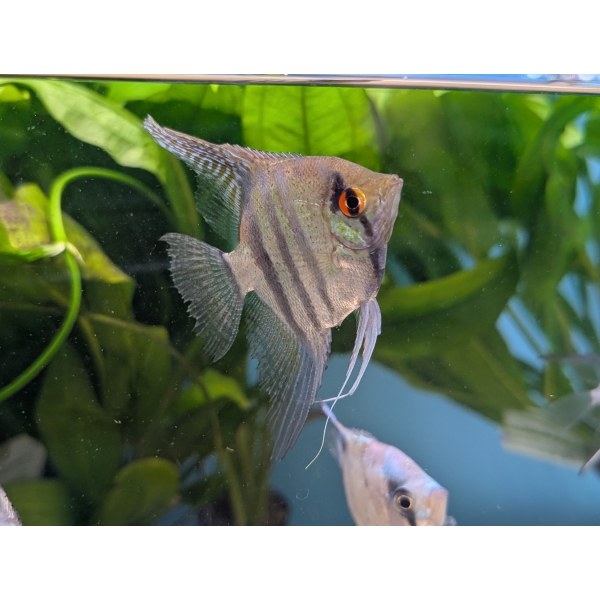
The Zebra Angelfish (Pterophyllum scalare var. ‘Zebra’) is a popular and visually distinct variant of the freshwater Angelfish, belonging to the family Cichlidae. While the wild species (Pterophyllum scalare) is native to the Amazon basin in South America, the ‘Zebra’ is a selectively bred strain admired for its pronounced black vertical stripes, which are typically more numerous and bolder than those found on the wild type. Its graceful swimming and majestic appearance make it a captivating centrepiece in larger community aquariums.
Taxonomy and Classification
- Kingdom: Animalia
- Phylum: Chordata
- Class: Actinopterygii
- Order: Cichliformes
- Family: Cichlidae
- Genus: Pterophyllum
- Species: Pterophyllum scalare (‘Zebra’ is a cultivated strain)
The genus Pterophyllum is well-known for its distinctive disc-shaped body and long, flowing fins, with P. scalare being the most commonly kept species in the aquarium hobby. The ‘Zebra’ is a result of selective breeding to enhance specific colour and pattern traits, particularly the number and intensity of its vertical bars.
Habitat and Distribution
As a selectively bred variant, the Zebra Angelfish does not have a specific natural habitat in the wild. Its wild ancestors, Pterophyllum scalare, are native to the slow-moving, warm, and often densely vegetated waters of the Amazon River basin, including its tributaries and floodplains, in countries such as Peru, Colombia, and Brazil. These environments typically feature submerged roots, driftwood, and abundant aquatic plants, which provide shelter and territorial boundaries. The water parameters are generally soft and acidic to neutral, with temperatures ranging from 24-30°C (75-86°F).
Physical Characteristics
The Zebra Angelfish is a medium to large-sized cichlid, usually reaching an adult size of approximately 15-20 cm (6-8 inches) in height (from dorsal to anal fin tip) and 10-15 cm (4-6 inches) in length. Its most distinctive feature is its unique colouration and finnage.
Key physical characteristics include:
- Body Shape: Classic disc-shaped, laterally compressed body with elongated, triangular dorsal and anal fins, and long, flowing ventral fins.
- Colouration: A silvery or light grey body base with numerous distinct, bold black vertical stripes. While the wild type typically has four main stripes, the ‘Zebra’ variant can have 5-7 or more, giving it a striking banded appearance. The intensity of these stripes can vary with mood and lighting.
- Eyes: Often dark, blending with the body, or sometimes with a subtle reflective quality.
- Fins: Long and flowing, enhancing their graceful swimming motion.
Diet and Feeding
In its natural habitat, Pterophyllum scalare is an omnivorous micropredator, feeding on small invertebrates, insect larvae, and some plant matter. In an aquarium setting, Zebra Angelfish are generally unfussy eaters and will readily accept a variety of high-quality foods.
Suitable foods include:
- High-Quality Flake Food & Pellets: A good quality flake food or small pellets designed for cichlids should form the staple of their diet.
- Frozen Foods: Frozen bloodworms, brine shrimp, mysis shrimp, and daphnia are excellent protein supplements and eagerly accepted.
- Live Foods: Live brine shrimp, daphnia, and small insect larvae can be offered as occasional treats.
- Vegetables: Spirulina-based foods and occasional blanched vegetables (e.g., peas, zucchini) can be included for a balanced diet.
A varied diet is crucial for maintaining their vibrant colouration, health, and to prevent nutritional deficiencies.
Behaviour and Temperament
The Zebra Angelfish is generally a peaceful to semi-aggressive cichlid. They are highly social and thrive when kept in groups of at least 5-6 individuals, which encourages their natural schooling behaviour and helps to diffuse aggression, particularly as they mature and pair off. While generally peaceful towards other species, they can become territorial, especially during breeding, and may harass smaller, slower-moving, or fin-nipping fish. They are intelligent and can become quite interactive with their owners.
Reproduction
Pterophyllum scalare are open spawners and can be bred in captivity, provided a compatible pair is formed and suitable conditions are met.
- Spawning: The pair will clean a vertical surface (e.g., broad plant leaf, slate, PVC pipe) where the female will lay adhesive eggs in rows, which the male then fertilises.
- Parental Care: Both parents exhibit strong parental care, diligently guarding the eggs and fry, often fanning them to ensure oxygenation and removing unfertilised eggs.
- Fry Care: Eggs usually hatch within 2-3 days, and the fry become free-swimming after another 5-7 days. Fry are tiny and initially require infusoria or liquid fry food, gradually moving to newly hatched brine shrimp as they grow. Parents can be left with the fry for a period, but may need to be removed if they start to predate on them.
Conservation Status
As a selectively bred aquarium strain, the Zebra Angelfish does not have a wild conservation status. Its wild counterpart, Pterophyllum scalare, is widely distributed and commonly found in its native range, and is not currently listed as endangered by the IUCN. However, like many freshwater species in the Amazon basin, its natural habitats are susceptible to threats such as deforestation, agricultural runoff, and pollution. Captive breeding plays a significant role in meeting the demand for this popular aquarium fish.
Aquarium Care
For aquarists interested in keeping Zebra Angelfish, here are some essential care guidelines:
- Tank Size: A minimum of 120 litres (30 gallons) for a small group (5-6 fish). Larger tanks (200+ litres / 50+ gallons) are highly recommended to provide ample vertical swimming space and maintain stable water parameters, especially as they grow.
- Water Parameters:
- Temperature: 24-30°C (75-86°F)
- pH: 6.0-7.5 (slightly acidic to neutral)
- Hardness: 5-15 dGH (soft to moderately hard)
- Filtration: Excellent filtration is crucial to handle their bioload and maintain high water quality. Canister filters or large hang-on-back filters are recommended, with a moderate flow rate.
- Decor: Provide plenty of tall, dense live plants (e.g., Amazon Swords, Vallisneria), driftwood, and vertical slate or rocks to offer hiding spots and establish territories. Open swimming areas are also essential.
- Substrate: Fine gravel or sand is suitable.
- Lighting: Moderate lighting is generally suitable.
- Tank Mates: Excellent tank mates include other peaceful, similarly sized community fish such as larger tetras (e.g., Congo Tetras, Lemon Tetras), peaceful rasboras, gouramis, peaceful bottom-dwellers like corydoras, and some peaceful plecos. Avoid housing them with very small fish (e.g., Neon Tetras, Ember Tetras) which they may see as food, or fin-nipping species (e.g., Tiger Barbs, Serpae Tetras) which can damage their long fins.
- Maintenance: Regular weekly water changes (25-30%) are crucial for maintaining pristine water quality, which is vital for their health and fin integrity.
By providing a spacious, well-filtered, and appropriately decorated environment, the Zebra Angelfish can be a magnificent, graceful, and engaging addition to a freshwater aquarium.
Convenient nationwide delivery; you’re only a click away!
Additional information
| Weight | 18.00 kg |
|---|
General Enquiries
There are no enquiries yet.