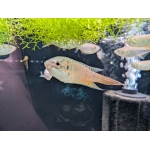
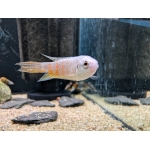
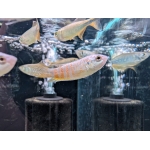

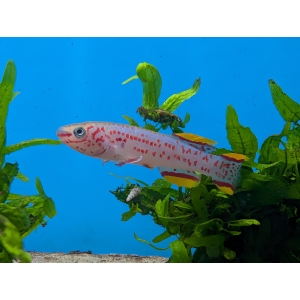
Paradise Fish Macropodus opercularis
£5.00
Paradise Fish
- Description
- Store Policies
- Enquiries
Description
Paradise Fish (Macropodus opercularis):
Species Profile:
The Paradise Fish (Macropodus opercularis) occupies a unique and significant place in aquarium history. First imported to Europe in 1869, it is widely acknowledged as one of the first tropical ornamental fish ever introduced to the Western hobby. A member of the Osphronemidae family (the labyrinth fish, which includes Gouramis and Betta splendens), the Paradise Fish is celebrated for its stunning, vivid colouration, robust constitution, and notably feisty temperament.
Native to a vast range across East Asia—including Korea, China, Vietnam, and Taiwan—this species is exceptionally adaptable, thriving in stagnant, oxygen-poor marshes, irrigation ditches, and slow-moving rice paddies.
Morphology and Aesthetic Architecture
The Paradise Fish is a visual spectacle, particularly when displaying.
-
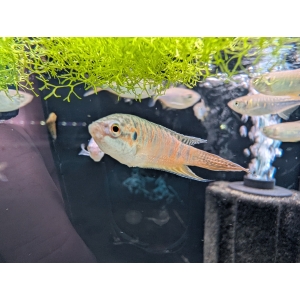
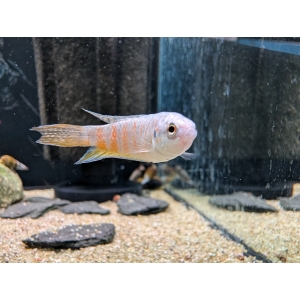
Size and Silhouette: Adults generally reach between 7 and 10 centimetres (3 to 4 inches). They possess a moderately elongated, compressed body.
-
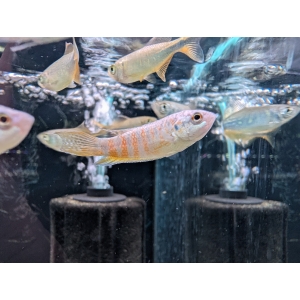
The Colour Palette: Their body is adorned with bold, alternating vertical bands of vibrant orange and shimmering, electric blue. This intensity deepens significantly when males are displaying or protecting territory.
-
Finnage: Both sexes possess pointed, extended fins; however, in dominant males, the dorsal, anal, and caudal fins grow exceptionally long, flowing, and filamentous, creating a dramatic, sweeping silhouette.
-
Labyrinth Organ: Like other gouramis, they possess a labyrinth organ—a specialized, auxiliary breathing apparatus located behind the gills. This evolutionary marvel allows them to gulp atmospheric air directly from the surface, enabling them to survive in water with extremely low dissolved oxygen concentrations.
Aquarium Requirements and Water Parameters
One of the greatest attributes of the Paradise Fish is its tolerance for fluctuating conditions, making it arguably the hardiest member of the labyrinth family.
Optimal Hydrochemical Targets
| Parameter | Target Range |
| Water Temperature | 10°C to 25°C (50°F to 77°F). (Note: They prefer cooler water than most tropicals; 18°C–22°C is excellent) |
| pH Range | 6.0 to 8.0 (Highly adaptable to most UK water supplies) |
| General Hardness (dGH) | 5 to 20 dGH (Thrives in both soft and hard water) |
| Minimum Enclosure | 90 Litres for a single specimen or a established pair |
Important Thermal Note: Unlike many tropical fish that require constant heating, Paradise Fish are essentially temperate. They do not require a heater in most British homes, provided the room temperature does not drop below 15°C. In fact, keeping them in constantly high-temperature water (above 26°C) can actually shorten their lifespan.
Behaviour and Community Synergy
The Temperament Warning
While breathtakingly beautiful, the Paradise Fish is famous for its assertive, and often aggressive, nature. They are not a “community” fish in the traditional sense. Males are highly territorial and will vigorously defend their space against conspecifics and other fish that share a similar colour or body shape.
-
Social Grouping: They are best kept individually or as a stable, bonded pair. Trying to keep two adult males in anything less than a massive, heavily planted aquarium will almost certainly lead to constant, violent fighting.
-
Tank Mate Selection: Choose only fast-swimming, robust species that are not long-finned or shy. Avoid delicate species (like Guppies or long-finned tetras) that will easily become victims of fin-nipping. Better choices include large, hardy barbs, fast-moving danios, or larger catfish species.
-
Planting Density: To minimize aggression, the aquarium must be heavily planted with tall, dense vegetation (e.g., Vallisneria, Cryptocoryne, or Java Fern) and broken up with plenty of bogwood. This creates clear sightlines and allows the fish to establish distinct territories.
Dietary Regime
Paradise Fish are opportunistic omnivores with a hearty appetite. They are not fussy eaters and will readily accept a wide variety of foods.
-
Staple Rations: Provide high-quality, high-protein flakes or slow-sinking pellets.
-
Live and Frozen Treats: To maintain peak colouration and reproductive health, provide regular feeds of frozen bloodworms, brine shrimp, daphnia, and mosquito larvae.
-
Feeding Habits: They are aggressive feeders and will quickly learn to take food directly from their keeper’s hand. Because of their voracious nature, ensure they do not outcompete other tank inhabitants for food.
Breeding Protocols: The Bubble-Nester
Paradise Fish are classic “bubble-nesters.” Breeding them is a fascinating, highly visible process.
-
Triggering: Conditioning a pair with frequent live foods and maintaining slightly warmer water (approx. 24°C) will stimulate spawning.
-
The Bubble Nest: The male will construct a floating nest of air bubbles, often reinforced with pieces of floating plant matter, directly at the water’s surface.
-
The Spawning Embrace: When the female is ready, the male will wrap his body around her, squeezing eggs from her body. As they fall, he catches the eggs in his mouth and spits them into the bubble nest.
-
Parental Duty: After spawning, the male becomes highly protective. The female must be removed immediately after egg-laying, as the male will view her as a threat to the nest and may kill her. The male will guard the nest until the fry hatch and become free-swimming (usually 3–5 days).
Convenient nationwide delivery; you’re only a click away!
Our nationwide delivery service makes it easy to receive your fish directly at your door, anywhere in the UK, for a flat rate of just £30. This convenient service allows you to order up to 10kg of fish, with the assurance that they will arrive in excellent condition. To make the fishes journey as comfortable as possible we use Oxygen in the fish bags and heat packs in all the boxes of fish we send out.
Please put your desired delivery day in the Order Notes on the Checkout page.
General Enquiries
There are no enquiries yet.