

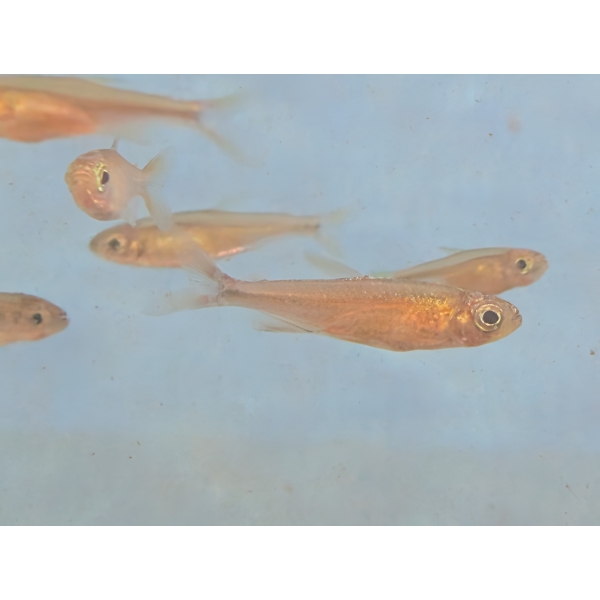

Spot Tail Robber Tetra Brycinus imberi:
£20.00
Spot Tail Robber Tetra
Price is for both fish.
- Description
- Store Policies
- Enquiries
Description
Brycinus imberi:
Spot Tail Robber Tetra Care Guide
Common Names: , , Scientific Name: Brycinus imberi Family: (African ) Origin: Widespread across Sub-Saharan Africa, found in the Congo, Zambezi, and Nile river systems.
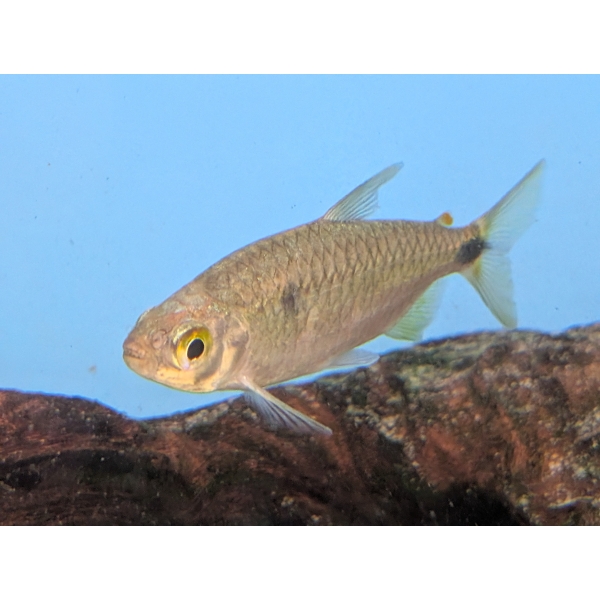
Brycinus imberi is a large, imposing, and active species, known for its deep, silvery body and the distinctive dark spot on its caudal (the area just before the tail). While striking, the “Robber Tetra” moniker is a serious warning: this fish is a predatory piscivore that views small fish and the fins of slow-moving, long-finned species as food. It requires a dedicated, large aquarium and careful selection of robust tank mates.
Key Characteristics and Temperament
- Size: This is a large , reaching an impressive to (6 to 7 inches) in adulthood, which requires significant space.
- Appearance: They have a muscular, laterally compressed body, typically a silvery or metallic gold . The key identifying feature is a distinct, vertically elongated black spot located where the body meets the caudal fin.
- Temperament: Semi-aggressive and predatory. Although they are schooling fish and benefit from groups, their interactions within the school are often competitive, establishing a . They are notorious for fin-nipping and consuming any fish small enough to fit in their mouth.
- Activity: Highly active, fast swimmers, occupying the mid-to-upper water levels.
Aquarium Setup and Environment
Given their large adult size, high activity level, and schooling , tank volume is non-negotiable for the .
Tank Size and Group Structure
- Minimum Tank Size: A tank of at least () is the absolute minimum for a small group. A tank of or more is strongly recommended to house a healthy, stable school.
- School Size: A minimum school of 5 to 6 individuals is necessary. Keeping them in a large school helps aggression, directing any amongst themselves rather than at other species.
Substrate and ![]()
- Substrate: Fine sand or smooth gravel is suitable, though the substrate is not critical as they rarely spend time at the bottom.
- Layout: The tank must provide extensive open swimming space in the centre. Avoid cluttering the middle water column.
- Plants and Hiding Spots: Use robust, tall plants (like or ) around the periphery. and large stones can be used to create visual barriers and hiding places, which can help subordinate individuals escape the attention of dominant fish.
- Lighting: Standard aquarium lighting is fine, but they look best under slightly subdued or diffused light.
Water Parameters
B. imberi is hardy and tolerant of a wide range of water conditions, but prefers clean, well-oxygenated water.
| Parameter | Recommended Range |
|---|---|
| Temperature | to ( to ) |
| to (Neutral is ideal) | |
| Hardness () | Soft to Moderately Hard () |
Filtration and Water Flow
- Filtration: Excellent filtration is essential due to their high metabolism and messy feeding. Use a powerful that provides high flow and capacity.
- Water Flow: They prefer strong water movement, mimicking their natural river habitat. A powerhead or high-output filter outlet can be used to create a strong current, which encourages natural .
- Maintenance: Weekly water changes of are mandatory to keep nitrate levels low and maintain pristine water quality.
Diet and Community Life
Dietary Needs
As their name suggests, they are and require a high-protein diet.
- Staple: High-quality, meaty pellets or sticks designed for medium-to-large tropical fish.
- Protein: Their diet must be heavily supplemented with or , such as and .
- Feeding Frequency: Feed once or twice daily, only what they can consume in a few minutes. A well-fed is slightly less likely to hunt tank mates, though the instinct remains.
Compatibility
Careful selection of tank mates is crucial. Never house B. imberi with peaceful, slow-moving, or small fish.
- Suitable Tank Mates: Robust, fast-swimming, and medium-to-large species that cannot be easily swallowed and possess short, durable fins. Examples include:
- (e.g., , species)
- (e.g., species)
- Incompatible Tank Mates: , , , , , and any or that is significantly smaller than the .
Convenient nationwide delivery; you’re only a click away!
General Enquiries
There are no enquiries yet.