



Sterbai Catfish
£14.00
Bulk Offer – 3 for £39.00
Discount will apply at checkout.
- Description
- Store Policies
- Enquiries
Description
Species Care Guide: Sterbai Catfish
Corydoras sterbai (Sterba’s Cory, Sterba’s Catfish)
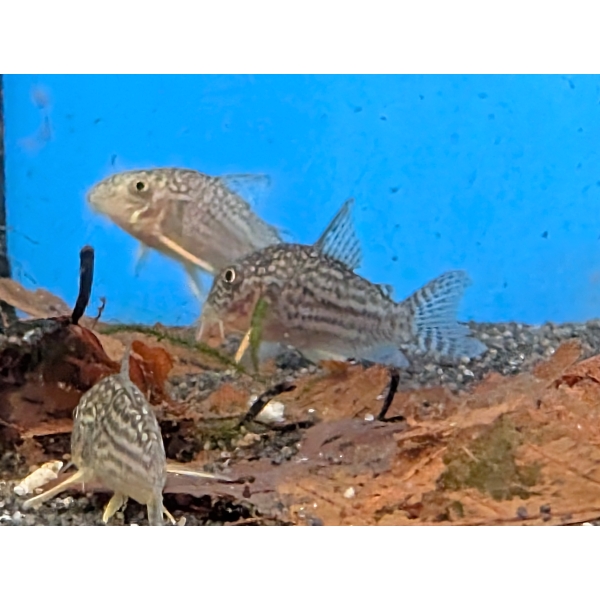
The Sterbai Catfish, often referred to as Sterba’s Cory, is a highly desirable and peaceful armoured catfish native to the Guaporé River basin in Brazil and Bolivia. These social fish are instantly recognisable by their intricate black and white spotting and striking, brilliant orange pectoral fin rays, setting them apart from other Corydoras species. They are excellent additions to a peaceful community tank, especially one that simulates a South American river environment.
1. General Characteristics and Sizing
| Characteristic | Detail |
|---|---|
| Common Name | Sterbai Catfish, Sterba’s Cory |
| Origin | Brazil (Mato Grosso), Bolivia |
| Adult Size | Up to 6.5 cm (approx. 2.5 inches) |
| Temperament | Extremely Peaceful and highly social. |
| Lifespan | 8 – 10 years with exceptional care. |
| Shoal Size | Minimum of 6 individuals, ideally 8 or more. They thrive in large groups. |
| Key Features | Black body covered in white/gold spots; vivid orange pectoral fin spines; rely on sensitive barbels for foraging. |
2. Aquarium Requirements (Husbandry)
As bottom-dwelling fish, the Sterbai Catfish requires meticulous attention to the tank floor, where they spend all their time actively searching for food.
| Requirement | Recommendation |
|---|---|
| Minimum Volume | 75 Litres (approx. 16 Imperial Gallons). Focus on floor space rather than height. |
| Substrate (Critical) | Fine sand is mandatory. Sharp or coarse gravel can permanently damage their delicate barbels, which they use to root around for food. |
| Filtration | Robust filtration is required to keep the water crystal clear and free of waste, which is particularly important for bottom-dwellers. They prefer gentle flow. |
| Lighting | Moderate to low. The fish are more active and less shy under subdued lighting. |
| Decoration | Provide ample cover using smooth river rocks, driftwood, and dense planting. Ensure there are shady areas for resting. Avoid decorations with sharp edges. |
| Plants | Hardy plants such as Anubias, Java Fern, and Cryptocoryne are perfect, as they can withstand the constant activity of the Corydoras. |
3. Water Quality and Parameters
Sterbai Catfish prefer slightly warmer temperatures than many other Corydoras species, making them ideal companions for Discus or warmer-water Tetras.
| Parameter | Optimal Range | Notes |
|---|---|---|
| Temperature | 25°C – 28°C (77°F – 82°F) | They tolerate warmer temperatures better than most other Corydoras. |
| pH | 6.0 – 7.5 (Slightly Acidic to Neutral) | Stability is more important than exact pH. Avoid sudden swings. |
| Hardness (dGH) | 5 – 15 dGH (Soft to Medium) | They are adaptable but thrive best in softer water. |
| Maintenance | Perform routine weekly water changes (25%). This species is sensitive to poorly maintained substrate and high nitrate levels. |
4. Diet and Nutrition
Despite their scavenging nature, Corydoras should never be expected to live off tank scraps. They require a dedicated, balanced diet of sinking foods.
- Primary Diet: High-quality, sinking pellets or tablets formulated for bottom-feeding fish. Ensure the food reaches the bottom before it is consumed by faster-swimming mid-water fish.
- Meaty Foods: Supplement 2–3 times a week with live or frozen foods, such as bloodworms, Tubifex worms, brine shrimp, and daphnia.
- Feeding Method: Feed them once or twice a day, preferably after the main aquarium lights are dimmed or turned off, to ensure they get enough to eat without competition.
5. Compatibility and Behaviour
The Sterbai Catfish is perhaps the most peaceful of all community fish and must be kept in a shoal.
- Shoaling Behaviour: They are constantly interacting with each other, often resting together or foraging as a group. Keeping fewer than six individuals will result in stress, shyness, and a weakened immune system.
- Tank Mates: Excellent with almost all peaceful fish, including Tetras (Neon, Cardinal, Ember), Rasboras, Dwarf Cichlids (Apistogramma), and Plecos (small, peaceful species).
- Avoid: Large, aggressive cichlids or boisterous fish that might outcompete them for food or cause them undue stress. Ensure all inhabitants are safe and gentle on the substrate.
Convenient nationwide delivery; you’re only a click away!
Please put your desired delivery day in the Order Notes on the Checkout page.
General Enquiries
There are no enquiries yet.