
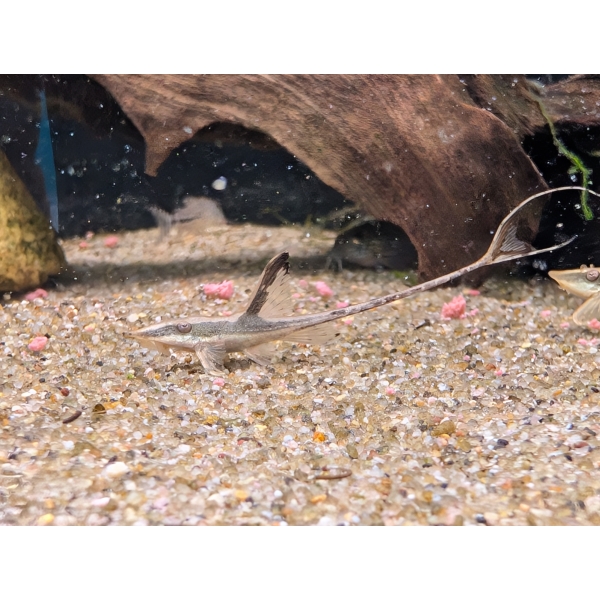
- Description
- Store Policies
- Enquiries
Description
Species Care Guide: Schoutedeni Synodontis Catfish
Synodontis schoutedeni (Marbled Synodontis / Schouteden’s Catfish)
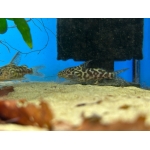
The Schoutedeni Synodontis (Synodontis schoutedeni) is a distinctive and highly desirable member of the Mochokidae family (Squeaker Catfishes), native to Central Africa. Known for its beautiful marbled or spotted pattern and its active, often upside-down swimming behaviour, this species is one of the more moderately sized and peaceful Synodontis, making it an excellent addition to large community aquariums.
I. General Characteristics and Sizing
| Characteristic | Detail |
|---|---|
| Common Name | Marbled Synodontis, Schoutedeni Catfish, Schouteden’s Catfish |
| Origin | Congo River basin, Democratic Republic of the Congo (DRC) |
| Adult Size | Up to 15 cm (approx. 6 inches) |
| Temperament | Peaceful, hardy, and active; best housed in groups |
| Lifespan | 8 – 15 years with appropriate care |
| Housing | Must be kept in a shoal of 3–5 or more individuals. |
II. Aquarium Requirements (Husbandry)
As active, bottom-dwelling fish, S. schoutedeni requires significant space to forage and swim. They are more visible and active than many of their nocturnal relatives.
| Requirement | Recommendation |
|---|---|
| Minimum Volume | 200 Litres (approx. 44 Imperial Gallons). A tank length of at least 120 cm (4 feet) is highly recommended to provide ample floor space. |
| Filtration | Highly efficient biological and mechanical filtration is necessary as they are robust feeders. They enjoy a moderate to strong water flow, similar to a riverine environment. |
| Lighting | Moderate to low. While they are active during the day, they appreciate subdued lighting. Use floating plants or dense décor to create shaded areas. |
| Substrate | Fine, smooth sand or very fine, rounded gravel is essential to protect their sensitive barbels (whiskers), which they use constantly for foraging. |
| Decoration | Abundant driftwood and rock formations are crucial, creating caves, crevices, and dark recesses for resting and hiding. They love to wedge themselves between décor. |
III. Water Quality and Parameters
This catfish is hardy but requires pristine water conditions and stability to prevent stress and disease.
| Parameter | Optimal Range | Notes |
|---|---|---|
| Temperature | 23°C – 27°C (73°F – 81°F) | Typical tropical aquarium range. Avoid rapid temperature drops. |
| pH | 6.5 – 7.5 | Tolerates a wide range but prefers neutral to slightly acidic water. |
| Hardness (dGH) | 5 – 20 dGH (Soft to Medium-Hard) | Highly adaptable, making them suitable for most standard UK tap water mixes. |
| Maintenance | Regular weekly water changes of 25–30% are essential. Pay close attention to substrate cleaning to remove uneaten food and waste. |
IV. Diet and Nutrition
The Schoutedeni Synodontis is an omnivorous scavenger. A varied diet is crucial for maintaining their robust health and growth.
- Staple Diet: High-quality sinking catfish pellets, wafers, or tablets.
- Meaty Foods: Offer frozen foods such as bloodworms, brine shrimp, and chopped earthworms regularly (2–3 times per week). They also enjoy small pieces of prawn.
- Vegetable Matter: Ensure a vegetable component is included, such as spirulina-enriched flakes or blanched soft vegetables like shelled peas or courgette slices.
- Feeding Time: They are semi-nocturnal, so feeding them just before or after the tank lights go out ensures they get enough food without surface fish stealing it all.
V. Compatibility and Shoaling Behaviour
This species is an excellent community fish. While they are bottom-dwellers, they often swim throughout the tank, including upside-down near the surface.
- Shoaling: They are social and must be kept in groups (shoals) of at least three, but ideally five or more. When kept alone, they become timid, stressed, and inactive.
- Tank Mates: Excellent companions include medium to large, peaceful mid-water fish like Congo Tetras, larger Rainbowfish, peaceful Loricariidae (Plecos), and robust, non-aggressive Cichlids.
- Avoid: Very small fish (e.g., small Tetras, Guppies) might be consumed if the catfish is hungry and fully grown, though this is rare. Do not house them with overly aggressive Cichlids or predatory fish.
The Marbled Synodontis is a charming and durable fish that offers a lot of personality. Providing them with a social group and plenty of intricate hiding spots is the key to seeing them thrive.
Convenient nationwide delivery; you’re only a click away!
Please put your desired delivery day in the Order Notes on the Checkout page.
General Enquiries
There are no enquiries yet.