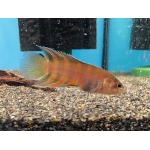
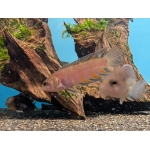
Ornate Ctenopoma ansorgii
£12.00
Bulk Offer – 3 for £33.00
Discount will apply at checkout.
Ornate Ctenopoma ansorgii
- Description
- Store Policies
- Enquiries
Description
Ornate Ctenopoma (Microctenopoma ansorgii)
Species Profile:
Common Names: Ornate Ctenopoma, Orange Ctenopoma, Ansorge’s Ctenopoma.
Scientific Name: Microctenopoma ansorgii (Note: Frequently found in older literature and trade lists as Ctenopoma ansorgii).
Family: Anabantidae (Climbing Gouramis / Labyrinth Fishes).
1. Introduction
The Ornate Ctenopoma is a stunning, relatively small freshwater fish native to Central Africa. It belongs to the Anabantoid group, meaning it possesses a labyrinth organ that allows it to breathe atmospheric air—a trait it shares with Bettas and Gouramis.
While often overshadowed by its larger cousin, the Leopard Bushfish (Ctenopoma acutirostre), the Ornate Ctenopoma is far more colourful and stays much smaller, making it an excellent candidate for planted community aquariums. It is known for the spectacular colour changes males undergo during courtship, displaying vibrant orange and dark vertical bars.
2. Natural Habitat and Distribution
-
Geography: Native to the Congo River basin in Central Africa, specifically found in regions of the Democratic Republic of the Congo and Angola.
-
Environment: They inhabit slow-moving rainforest streams, swamps, and the margins of rivers. These habitats are typically choked with dense vegetation and submerged roots.
-
Water Conditions: The water in their natural habitat is typically “blackwater”—soft, acidic, and stained tea-brown by decaying organic matter (tannins).
3. Appearance and Identification
-
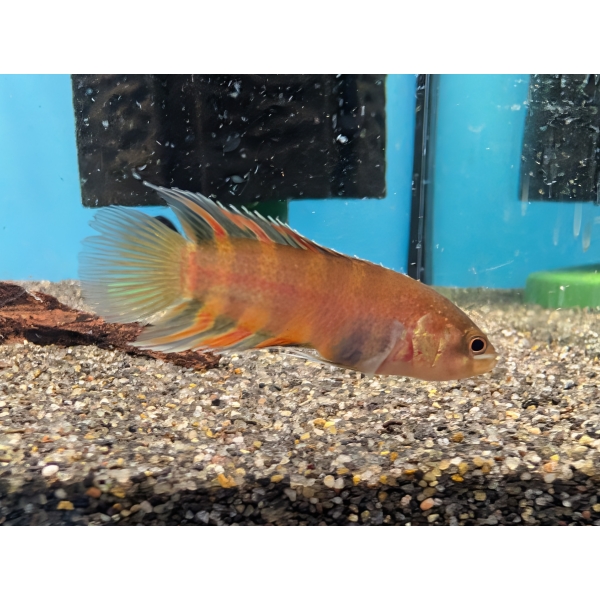
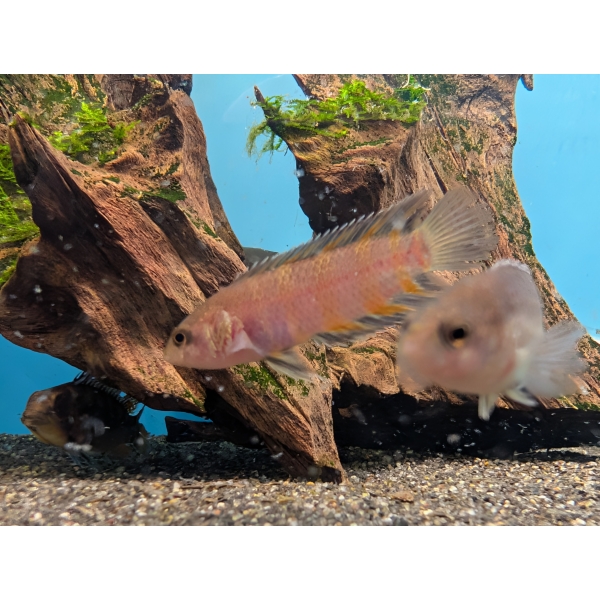
Body: The body is elongated and laterally compressed with extended dorsal and anal fins, giving it a somewhat leaf-like silhouette.
-
Colouration: In its resting state, the fish is a subtle brownish-beige with faint vertical banding. However, breeding males are breathtaking; they develop distinct, dark metallic blue-black vertical bars alternating with bright orange or reddish-brown gaps. The fins often feature white margins.
-
Size: A manageable species, reaching an adult length of approximately 7 cm to 8 cm (2.8 to 3.2 inches).
4. Aquarium Requirements
The Ornate Ctenopoma is a shy fish that requires a well-structured environment to feel secure.
-
Tank Size: A minimum tank size of 60–80 litres (approximately 15–18 imperial gallons) is suitable for a pair or small trio.
-
Lid (Critical): As a labyrinth fish, they access the surface to breathe. You must have a tight-fitting lid for two reasons: firstly, they are excellent jumpers; secondly, they require a layer of warm, humid air above the water surface to breathe safely.
-
Décor: They require a “jungle” setup. Heavy planting (including floating plants like Salvinia or Amazon Frogbit) is essential to dim the light and provide cover. Driftwood and caves should be used to create hiding spots.
-
Filtration and Flow: Water flow should be gentle. Strong currents will stress them and make it difficult for them to build their bubble nests.
5. Water Parameters
-
pH: 5.0 – 7.0 (They prefer acidic conditions but can adapt to neutral water).
-
Hardness: Soft to moderately soft water (2 – 12 dGH).
-
Temperature: 24°C – 28°C (75°F – 82°F). They are tropical fish and do not tolerate cold water.
6. Diet and Feeding
The Ornate Ctenopoma is a micropredator/insectivore. They can be finicky eaters, especially when first introduced.
-
Preferred Food: They thrive on small live or frozen meaty foods. Bloodworm, brine shrimp (Artemia), Daphnia, and mosquito larvae are ideal.
-
Dry Food: Some individuals may accept high-quality granules or flakes, but this should not be relied upon as the sole diet.
-
Feeding Style: They are stalkers. They will slowly approach food before snapping it up. Ensure fast-moving tank mates do not steal all the food before the Ctenopoma can eat.
7. Behaviour and Compatibility
-
Temperament: generally peaceful but predatory towards very small items. They are shy and retiring, often spending the day hiding among plants and becoming more active in the evening.
-
Social Structure: Males can be territorial towards one another, especially when breeding. It is best to keep one male with a female or a pair in a smaller tank.
-
Tank Mates:
-
Suitable: Peaceful, similarly sized fish. Good choices include Congo Tetras (if the tank is large enough), African Butterfly Barbs, Corydoras, and Synodontis catfish.
-
Avoid: Fin-nippers (like Tiger Barbs), large aggressive cichlids, or incredibly tiny fry/shrimp which might be viewed as a snack.
-
8. Breeding (Brief Overview)
Like Bettas, the Ornate Ctenopoma is a bubble nester.
-
The Nest: The male builds a floating nest of bubbles, usually anchored to floating plants.
-
Spawning: The male embraces the female (similar to Gouramis) beneath the nest. The eggs float up into the bubbles.
-
Parental Care: The male guards the nest until the fry hatch (approx. 24–48 hours) and become free-swimming. At this point, the parents should be removed to prevent predation.
9. Summary Checklist
| Requirement | Specification |
| Minimum Tank Size | 60 Litres |
| Temperature | 24°C – 28°C |
| pH | 5.0 – 7.0 (Acidic preferred) |
| Diet | Carnivore (Live/Frozen foods preferred) |
| Décor | Dense plants, Floating plants, Driftwood |
| Special Requirement | Tight-fitting Lid (Jumper/Labyrinth breather) |
| Temperament | Shy, Peaceful Micropredator |
| Adult Size | 7–8 cm |
Convenient nationwide delivery; you’re only a click away!
Please put your desired delivery day in the Order Notes on the Checkout page.
General Enquiries
There are no enquiries yet.