

Coffee Bean Tetra (Hyphessobrycon takasei)
£12.00
Coffee Bean Tetra (Hyphessobrycon takasei)
Bulk Offer – 3 for £16.50
Discount will apply at checkout.
- Description
- Store Policies
- Enquiries
Description
Coffee Bean Tetra (Hyphessobrycon takasei):
Species Profile:
Common Names: Coffee Bean Tetra, Takase’s Tetra
Scientific Name: Hyphessobrycon takasei
Family: Characidae
Origin: Brazil (Lower Amazon basin, specifically the Amapá river basin)
1. Overview and Natural Habitat
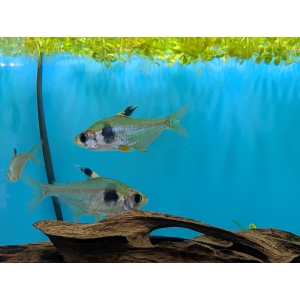
Hyphessobrycon takasei is a small, highly distinctive characin native to the slow-moving rivers, flooded forests, and blackwater tributaries of northern Brazil. The common name, Coffee Bean Tetra, is derived from the prominent, dark, oval-shaped humeral spot on the side of its body, which closely resembles a coffee bean.
Despite its charming appearance and peaceful nature, it remains relatively uncommon in the mainstream aquarium hobby. It is highly sought after by biotope enthusiasts who appreciate its subtle, warm coloration and classic schooling behaviour.
2. Appearance and Size
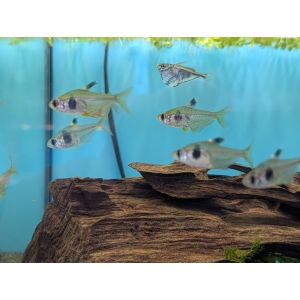
This species is elegant and streamlined, boasting a translucent, amber-to-silvery body that catches the light with a soft golden hue.
- The “Coffee Bean” Spot: The defining feature is a large, dark brown or black spot located just behind the gill cover, bordered by a faint yellowish ring.
- Fin Coloration: The dorsal fin is typically bold, featuring a distinct black patch contrasted with white or cream tips. The tail fin often displays a soft red or orange tint when the fish is in peak condition.
- Size: This is a compact species, with adults reaching an average size of 3.0 to 3.5 cm (approx. 1.2 to 1.4 inches).
- Dimorphism: Sexing can be difficult. Mature females are generally more robust and noticeably rounder-bellied than males, particularly when conditioned for breeding. Males may exhibit slightly more intense coloration in their fins.
3. Aquarium Requirements
Tank Size
Because they are an active, obligate schooling species, they must be kept in groups. A minimum tank size of 60 litres (approx. 60 cm in length) is recommended for a standard shoal. A larger tank is always preferred to give them adequate horizontal swimming space.
Décor and Substrate
To see this species display its natural, confident behaviour, its habitat should mimic a shady forest stream:
- Substrate: A dark sand or fine gravel substrate helps the fish feel secure and makes their coloration pop.
- Leaf Litter: Adding dried leaves (such as Indian Almond leaves or beech leaves) releases beneficial tannins, tints the water a natural tea colour, and provides foraging opportunities.
- Lighting: Dim or dappled lighting is essential. Use floating plants (such as Limnobium laevigatum or Salvinia) to diffuse the light.
- Structure: Arrange twisted bogwood, driftwood branches, and hardy, low-light plants (like Cryptocoryne or Anubias species) around the edges, leaving the centre open for swimming.
4. Water Parameters
The Coffee Bean Tetra originates from soft, acidic environments. While captive-bred specimens are somewhat adaptable, they will not thrive or show their best colours in hard, alkaline water.
| Parameter | Recommended Range | Notes |
|---|---|---|
| Temperature | 22°C – 27°C | Avoid sudden temperature fluctuations. |
| pH | 5.5 – 7.0 | Acidic water is highly preferred; soft water is critical. |
| Hardness | 1 – 8 dGH | Keep general hardness low. |
Maintenance: They are sensitive to accumulating organic waste. Weekly partial water changes of 20–25% are necessary to keep nitrates at a minimum.
5. Diet and Feeding
In the wild, Hyphessobrycon takasei is a micro-predator feeding on small invertebrates, insect larvae, and zooplankton. In the aquarium, they are eager feeders but have small mouths:
- Staple: High-quality, crushed tropical flakes or micro-pellets.
- Live/Frozen: They thrive on a regular rotation of live or frozen foods such as baby brine shrimp (Artemia), daphnia, cyclops, and finely chopped bloodworms.
- Coloration Booster: Feeding foods rich in carotenoids (like cyclops or specialized colour flakes) will intensify the warm amber tones of their bodies.
6. Behaviour and Compatibility
The Coffee Bean Tetra is exceptionally peaceful and completely harmless to other tank inhabitants. However, it can be timid if kept in numbers that are too small.
- Shoaling Requirement: They must be kept in a group of at least 6 to 8 individuals, though a group of 10 or more is highly recommended. Larger shoals dramatically reduce stress, prevent shyness, and encourage tight, synchronized swimming.
- Tank Mates: They are perfect for a quiet community aquarium. Ideal companions include:
- Other peaceful dwarf cichlids (such as the Laetacara araguiae or Apistogramma species)
- Small corydoras catfish and Otocinclus
- Other small, peaceful characins or pencilfish
- Avoid: Large, boisterous, or predatory tank mates (such as large angelfish or aggressive barbs) that might easily outcompete or intimidate them.
7. Breeding
Breeding Hyphessobrycon takasei follows the typical pattern of most small characins, though it is rarely documented in home aquaria due to their scarcity in the trade.
- Setup: A separate, small breeding tank is required with very soft, highly acidic water (pH 5.5–6.0). Use a mesh matrix or clumps of Java moss on the bottom to catch the eggs.
- Conditioning: Separate the males and females and feed them heavily with live foods for a week.
- Spawning: Introduce a choice pair or a small group into the breeding tank in the evening. Spawning typically occurs at dawn. They are egg-scatterers and exhibit no parental care.
- Post-Spawning: Remove the adults immediately after spawning to prevent them from eating the eggs. The eggs are light-sensitive and will hatch in 24 to 36 hours. The tiny fry will require infusoria or liquid fry food until they are large enough to accept newly hatched brine shrimp.
Convenient nationwide delivery; you’re only a click away!
Our nationwide delivery service makes it easy to receive your fish directly at your door, anywhere in the UK, for a flat rate of just £30. This convenient service allows you to order up to 10kg of fish, with the assurance that they will arrive in excellent condition. To make the fishes journey as comfortable as possible we use Oxygen in the fish bags and heat packs in all the boxes of fish we send out.
For your peace of mind we enclose a slip which will explain what to do in the event of a fish not traveling too well.
We use a licensed courier to deliver your fish directly to you door and will be with you by 1pm the next day.
Our delivery days are as follows:
Tuesday for Wednesday delivery
Wednesday for Thursday delivery
Thursday for Friday delivery
Please put your desired delivery day in the Order Notes on the Checkout page.
General Enquiries
There are no enquiries yet.