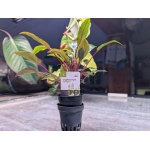


Crypotocoryne beckettii
£4.50
Crypotocoryne beckettii
Bulk Offer – 5 for £20.00
Discount will apply at checkout.
- Description
- Store Policies
- Enquiries
Description
Beckett’s Water Trumpet (Cryptocoryne beckettii):
Species Profile:
Cryptocoryne beckettii, commonly known as Beckett’s Water Trumpet, is an enduringly popular and highly resilient aquatic plant native to the tropical island of Sri Lanka. First introduced to the aquarium hobby in the mid-20th century, it has remained a staple flora choice for both novice and master aquascapers. This popularity stems from its robust nature, adaptability to varying light levels, and beautiful, earth-toned foliage that provides an excellent contrast to standard green aquatic plants.
Natural Habitat and Origin
In its native habitat, Cryptocoryne beckettii is found exclusively in the shaded streams, riverbanks, and marshy wetlands of Sri Lanka. It thrives in areas that experience dramatic seasonal water fluctuations. During the wet season, the plant grows completely submerged in fast-flowing water, while the dry season leaves it exposed to humid air, prompting emersed growth on muddy riverbeds. These wild environments are typically shaded by dense jungle canopies, meaning the plant has evolved to utilise low levels of filtered sunlight efficiently.
Morphology and Appearance
Beckett’s Water Trumpet is a classic rosette-forming plant that expands horizontally by developing a compact cluster of leaf stems from a central underground rhizome.
-
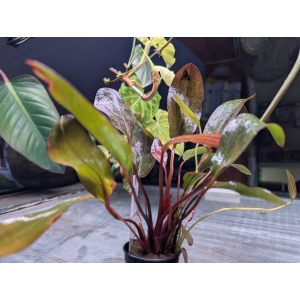
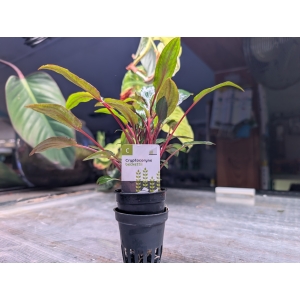
Leaf Structure: The leaf blades are lanceolate (lance-shaped) to narrowly ovate, featuring slightly wavy or undulating margins. The texture is smooth and slightly satiny compared to more deeply puckered species like Cryptocoryne balansae.
-
Colouration: The colouration of C. beckettii is highly variable and depends greatly on environmental conditions. The upper surface of the leaves ranges from an attractive olive-green to a deep, rich bronze-brown. The undersides of the leaves are particularly striking, often displaying a pale purple, wine-red, or brownish-pink hue.
-
Dimensions: It is a moderate-sized dwarf-to-medium plant, typically reaching a height of 10 to 15 centimetres (4 to 6 inches), though it can grow up to 20 centimetres in low-light environments as it stretches toward the water surface.
Aquarium Requirements and Water Parameters
Because of its modest height and spread, Cryptocoryne beckettii is exceptionally versatile. It is perfectly suited for foreground placement in large aquaria or midground placement in smaller nano tanks.
Optimal Parameter Targets
This species is incredibly hardy and tolerates a wide array of water conditions, making it an excellent choice for low-maintenance or high-tech setups alike.
| Parameter | Target Range |
| Water Temperature | 22°C to 28°C (72°F to 82°F) |
| pH Range | 6.0 to 7.5 (Slightly acidic to slightly alkaline) |
| General Hardness (dGH) | 4 to 15 dGH (Soft to moderately hard water) |
| Carbonate Hardness (dKH) | 2 to 10 dKH |
| Water Flow | Gentle to moderate |
Cultivation and Nutrition
Substrate and Root Feeding
⚠️ Root Nutrition Note
Like the vast majority of the Cryptocoryne genus, Cryptocoryne beckettii draws the vast majority of its nutrients from its root system rather than the water column.
-
Substrate Choice: It will grow most vigorously when planted in a nutrient-rich aquasoil. However, because of its hardy nature, it can easily adapt to an inert sand or fine gravel bed, provided the substrate is supplemented with high-quality root tabs containing iron and potassium.
-
Root Structure: Once planted, it establishes an extensive network of white, fleshy roots that anchor it deeply. Avoid moving the plant once it has settled, as uprooting it can damage these delicate structures and stall its growth for several weeks.
Lighting Strategy
-
Low Light: C. beckettii will survive and grow perfectly well under low light conditions. The leaves will tend to be greener, slightly longer, and more upright as the plant reaches for light.
-
Moderate to High Light: Under brighter conditions, the growth habit becomes much more compact, dense, and low-slung. Higher light intensity triggers the production of darker bronze tones and a deeper purple coloration on the leaf undersides.
Carbon Dioxide (CO2) and Fertilisation
This plant is a quintessential “low-tech” species and absolutely does not require pressurized carbon dioxide to thrive. It will simply grow at a slow, manageable pace. If $CO_2$ is injected (at roughly 10 to 15 ppm), the growth rate will accelerate significantly, and the plant will form a much denser, bushier rosette.
Managing “Crypt Melt”
While Cryptocoryne beckettii is more resilient to “Crypt Melt” than more sensitive cultivars like ‘Flamingo’, it can still shed its leaves when introduced to a new aquarium or subjected to a sudden environmental shock (such as moving the tank or a sudden swing in temperature).
If the leaves begin to turn translucent and dissolve into mush, resist the urge to discard the plant. Prune away the decaying leaves to avoid polluting the water and leave the root base undisturbed. As long as the underground rhizome remains firm and healthy, it will acclimatize to the new environment and produce fresh, adapted leaves within a few weeks.
Aquascaping Use and Placement
-
Midground Transition: C. beckettii is outstanding when used to transition the eye between low foreground carpet plants (like Hairgrass) and tall background structures.
-
Shade Companion: Because it thrives in shade, it is ideal for planting directly beneath tall driftwood branches or under the canopy of larger plants like Amazon Swords, where other light-demanding flora would perish.
-
Colour Contrast: Its earthy brown and bronze tones provide a stark, visually pleasing contrast when planted next to bright green mosses or fine-textured stem plants.
Propagation
Propagation of Cryptocoryne beckettii is straightforward and occurs naturally through the production of underground runners.
As the mother plant matures, it will send out small horizontal stems just beneath the substrate. New, genetically identical daughter plants will begin to sprout from these runners nearby. To manually propagate, wait until a daughter plant has grown a few leaves and its own small root system. Unearth the connecting runner, clip it cleanly with sharp aquascaping scissors, and gently set the new plantlet into its new location using tweezers.
General Enquiries
There are no enquiries yet.