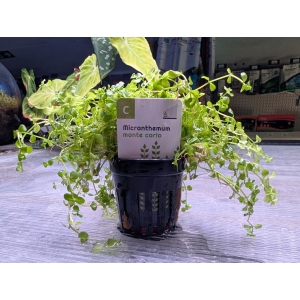
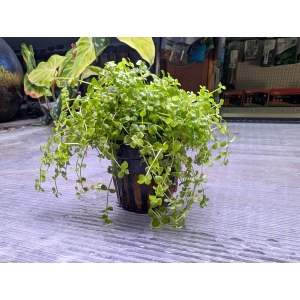


Micranthemum monte carlo
£4.50
Micranthemum monte carlo
Bulk Offer – 5 for £20.00
Discount will apply at checkout.
- Description
- Store Policies
- Enquiries
Description
Monte Carlo (Micranthemum tweediei ‘Monte Carlo’):
Species Profile:
Micranthemum tweediei ‘Monte Carlo’—universally known within the aquarium hobby simply as Monte Carlo or New Large Pearl Grass—is a premier, low-growing carpeting plant native to South America. Belonging to the family Phrymaceae, this species has completely revolutionised the aquascaping world since its widespread introduction in the early 2010s. It offers a far hardier, more forgiving alternative to the notoriously finicky Dwarf Baby Tears (Hemianthus callitrichoides ‘Cuba’), allowing hobbyists to achieve a lush, vibrant green foreground lawn with significantly less difficulty.
Natural Habitat and Origin
In the wild, Micranthemum tweediei is predominantly found across the temperate and subtropical regions of South America, with dense populations recorded in Argentina, Brazil, Uruguay, and Paraguay.
It behaves as an amphibious helophyte, thriving in transitional zones where land meets water:
-
Riverbanks and Stream Margins: It colonises the muddy, sandy banks of slow-moving streams, rivers, and waterfalls.
-
The Splash Zone: It is frequently found growing emersed on wet rocks and damp soil interfaces where it is constantly sprayed by highly oxygenated water. This natural exposure to both fully submerged and high-humidity emersed states makes it exceptionally adaptable to different cultivation methods in captivity.
Morphology and Appearance
Monte Carlo is a classic creeping, prostrate stem plant that exhibits a highly compact, carpeting growth habit when cultivated under water.
Foliage and Stem Structure
The plant produces delicate, highly branched, trailing stems that creep horizontally along or slightly beneath the substrate surface. The leaves are arranged oppositely along the stem and are distinctly rounded, obovate, and fleshy, measuring roughly 3 to 5 millimetres in diameter.
The foliage possesses a brilliant, clean, light jade-to-lime green colouration. Under water, a healthy carpet develops a beautiful, dense, uniform appearance that perfectly mimics a manicured rolling lawn.
Root System
Unlike Hemianthus callitrichoides ‘Cuba’, which possesses an incredibly shallow and fragile root structure, Monte Carlo develops a surprisingly robust, deep, and tenacious network of fine white anchor roots. This comprehensive root structure allows it to bind tightly to the substrate, making it far less likely to float to the surface or be uprooted by curious bottom-dwelling fish or shrimp.
Aquarium Requirements and Water Parameters
Because of its low-slung, creeping growth habit, Monte Carlo is strictly utilized as a foreground carpeting plant. It is highly effective at covering large expanses of the foreground with a seamless green mat.
Optimal Parameter Targets
Monte Carlo is remarkably hardy and can tolerate a wide variety of water conditions, thriving in both soft tropical setups and moderately hard water parameters.
| Parameter | Target Range |
| Water Temperature | 20°C to 26°C (68°F to 79°F) — Prefers slightly cooler water |
| pH Range | 6.0 to 7.5 (Prefers slightly acidic to neutral profiles) |
| General Hardness (dGH) | 3 to 15 dGH (Highly adaptable to soft or moderately hard water) |
| Carbonate Hardness (dKH) | 2 to 10 dKH |
| Water Flow | Moderate (Good circulation ensures nutrients reach the dense carpet) |
Cultivation and Nutrition
The Role of Substrate
While Monte Carlo can survive in plain sand or fine gravel if heavily supplemented, it performs at its absolute best when planted into a premium, nutrient-rich, clay-based aquasoil. The porous nature of aquasoil allows its fine roots to penetrate deeply, accessing vital macro-and-micro nutrients that fuel its horizontal expansion.
Lighting Strategy
Lighting is the primary trigger that dictates whether Monte Carlo will carpet or grow vertically:
-
Low Light: The plant will survive, but it will lose its carpet form. The stems will stretch upwards toward the light source, creating a sparse, leggy, and unattractive midground bunch rather than a tight lawn.
-
Medium to High Light: Providing moderate to high full-spectrum LED lighting (50+ PAR at the substrate level) forces the plant to hug the substrate, encouraging rapid horizontal branching and a dense, overlapping leaf structure.
Carbon Dioxide (CO2) and Fertilisation
⚠️ The CO2 Misconception
One of the greatest advantages of Monte Carlo is that it can be grown without pressurized carbon dioxide injection in a low-tech setup, provided lighting is moderate and water changes are regular.
However, a strict distinction must be made regarding its performance:
-
In a Low-Tech Setup: Growth is exceptionally slow. It can take several months to form a complete carpet, and the lawn will be thinner and more susceptible to collecting debris or hair algae.
-
In a High-Tech Setup: Introducing 15 to 30 ppm of pressurized $CO_2$ acts as a massive catalyst. Growth shifts from slow to rapid, the leaves pearl continuously (releasing strings of oxygen bubbles), and it forms a thick, dense, multi-layered green mat within a matter of weeks. Regular water column dosing of a comprehensive liquid fertiliser prevents micro-nutrient deficiencies, which typically manifest as yellowing or translucent leaves.
Planting Techniques and Initial Setup
Monte Carlo is primarily sold to the hobby in sterile in-vitro tissue culture cups, which guarantee the plant is completely free from pest snails, algae, and duckweed.
The Planting Protocol:
-
Preparation: Remove the plant mass from the cup and thoroughly rinse away the clear nutrient agar gel under lukewarm tap water.
-
Portioning: Using sharp aquascaping scissors, cut the dense mat into small, bite-sized portions roughly 1 to 2 centimetres wide.
-
Insertion: Using fine-tipped aquascaping tweezers, grab a portion by the roots/stems and plunge it deeply into the aquasoil, leaving only the very tips of the green leaves exposed.
-
Spacing: Plant the portions in a chess-board or grid pattern, spaced roughly 2 to 3 centimetres apart. Over the coming weeks, these individual islands will send out horizontal runners to bridge the gaps, forming a unified carpet.
The Dry Start Method (DSM)
Monte Carlo is an exceptional candidate for the Dry Start Method. By planting the portions into moist aquasoil before flooding the tank, and keeping the aquarium sealed with clingfilm to maintain 100% humidity under strong lights, the plant can draw unlimited $CO_2$ from the air. It will carpet rapidly and establish a massive root network over 4 to 6 weeks, completely eliminating the risk of the plant floating when the aquarium is eventually filled with water.
Pruning and Long-Term Maintenance
Once a Monte Carlo carpet becomes fully established under high-tech conditions, routine pruning is mandatory to ensure the long-term health of the layout.
-
Trimming Method: Use specialized, curved spring scissors or wave scissors to trim the lawn flat, much like mowing a traditional garden grass lawn. Maintain a carpet thickness of roughly 2 to 3 centimetres.
-
The Danger of Over-Grown Carpets: If the carpet is left untrimmed, it will continuously grow on top of itself, eventually reaching a thickness of 5 to 8 centimetres. When this happens, the lowest layers of the carpet are completely starved of light and water circulation. The bottom leaves will rot and turn into a brown slime, causing the entire healthy top layer to lift off the substrate completely and float to the surface in a giant green sheet.
Aquascaping Application
-
The Manicured Foreground: It provides the quintessential “lawn” effect in Iwagumi layouts, framing large focal stones beautifully.
-
The Overhanging Cascade: Because its stems are naturally trailing, Monte Carlo is widely used to create “moss-like” or cascading green curtains. By wedging small portions into the crevices of high driftwood branches or rock walls, the stems will grow downwards, draping over the hardscape like a green waterfall.
-
Shrimp Haven: The dense, intricate canopy of a Monte Carlo lawn acts as a premium foraging ground for dwarf shrimp, who spend hours picking microfilm and organic particles off the tiny leaves. It also offers unparalleled physical protection for newborn shrimp and fish fry.
General Enquiries
There are no enquiries yet.