

Dwarf Gourami Trichogaster fasciata
£10.00
Dwarf Gourami Trichogaster fasciata
Bulk Offer – 3 for £27.00
Discount will apply at checkout.
- Description
- Store Policies
- Enquiries
Description
Dwarf Gourami (Trichogaster fasciata):
Care Guide:
The Dwarf Gourami is a highly popular, brightly coloured freshwater fish native to the slow-moving waters of South Asia. Long classified as Trichogaster lalius (or Colisa lalia), recent taxonomic research has updated its official scientific binomial to Trichogaster fasciata. This species is renowned for its striking colour morphs, unique labyrinth organ, and engaging surface behaviours.
Species Overview
- Scientific Name:Trichogaster fasciata (synonyms: Trichogaster lalius, Colisa lalia)
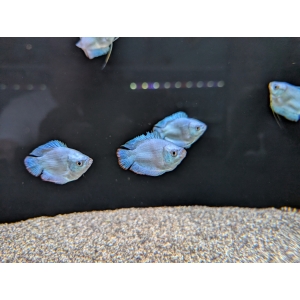
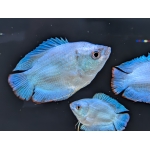
- Common Name: Dwarf Gourami, Flame Gourami, Powder Blue Gourami
- Family: Osphronemidae
- Origin: India, Pakistan, and Bangladesh
- Adult Size: Up to 7.5 cm (3 inches)
- Lifespan: 3 to 5 years
Water Parameters
While relatively hardy, captive-bred strains require excellent water quality to safeguard them against opportunistic infections.
- Temperature: 24°C to 28°C
- pH Range: 6.0 to 7.5 (Slightly acidic to neutral)
- Hardness: 4 to 15 dGH
- Nitrate: Strictly below 15 mg/L
Tank Setup and Environment
Dwarf Gouramis inhabit heavily vegetated areas like marshes, swamps, and sluggish streams. The aquarium should mimic these calm, sheltered conditions.
Tank Size
- Minimum Volume: 40 litres for a single specimen or a well-matched pair.
- Community Footprint: A minimum of 75 litres is recommended if sharing space with other species.
Substrate and Decor
- Substrate: Smooth, dark gravel or sand to accent their iridescent colours.
- Hiding Places: Smooth bogwood, rock caves, and terracotta structures to provide visual barriers.
- Surface Environment: Crucial to leave an open air gap of 2–3 cm between the water surface and the lid. As labyrinth fish, they must gulp atmospheric oxygen directly from the surface.
Filtration and Plants
- Filtration: Low-flow filtration is vital. Strong currents exhaust these fish, disrupt their swimming, and destroy their bubble nests. Use a sponge filter or a baffled canister filter.
- Plants: Dense back-row planting using Vallisneria, Hygrophila, and Java Fern.
- Floating Plants: Essential cover provided by species like Amazon Frogbit, Salvinia, or Duckweed. These diffuse bright lighting and provide anchor points for breeding.
Diet and Nutrition
In the wild, they are opportunistic omnivores feeding on small insects, larvae, and algae crusts. They even exhibit a unique hunting mechanism where they spit water droplets to down terrestrial insects up to 5 cm above the surface.
- Dry Foods: High-quality tropical flakes, freeze-dried granules, and crushed algae wafers.
- Frozen and Live Foods: Regular supplements of Daphnia, bloodworms, cyclops, and enriched brine shrimp.
- Feeding Strategy: Feed small amounts once or twice daily. Ensure food stays at the surface or mid-water column, as they rarely sift the substrate.
Behaviour and Compatibility
They are generally timid community fish but can exhibit territorial behavior amongst their own kind or similarly shaped fish.
Sexual Dimorphism
- Males: Highly vibrant with alternating blue and orange-red diagonal bars, or solid line-bred variations (such as Powder Blue or Flame Red). Their dorsal fins finish in a distinct point.
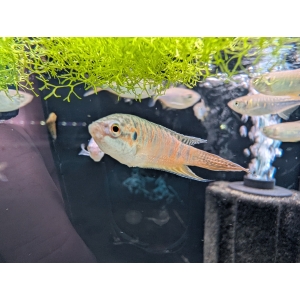
- Females: Considerably more subdued, displaying a plain, silvery-grey body with a rounded dorsal fin.
Tank Mates
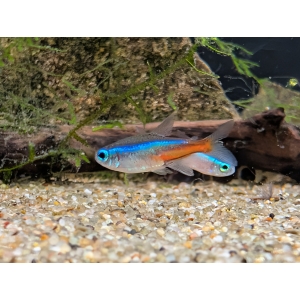
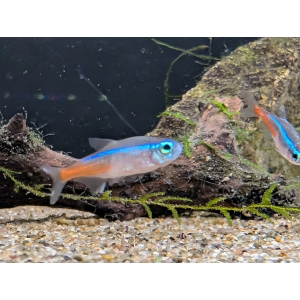
- Suitable: Peaceful schooling fish like Neon Tetras, Harlequin Rasboras, Glowlight Danio, and bottom dwellers like Otocinclus or small Corydoras catfish.
- Avoid: Fin-nippers (e.g., Tiger Barbs) that target the gourami’s long, touch-sensitive, thread-like pelvic fins. Avoid mixing multiple males unless the tank is exceptionally large, as dominant males will relentlessly bully weaker rivals. Do not house them with aggressive species like Siamese Fighting Fish (Betta splendens).
Breeding
Dwarf Gouramis are classic bubble nest builders.
- Conditioning: Separate the male and female, feeding heavily with live foods like bloodworms.
- The Nest: The male constructs an intricate, floating nest made of saliva-coated air bubbles, incorporating bits of floating plant matter.
- Spawning: The male coaxes the female under the nest, wrapping his body around hers to fertilise the eggs as they float upward into the bubbles.
- Post-Spawning Care: Remove the female immediately after spawning, as the male becomes highly aggressive while guarding the nest.
- Rearing Fry: Eggs hatch within 24 to 36 hours. Once the fry are free-swimming, remove the male. Feed the microscopic fry infusoria or liquid fry food for the first week, transitioning to freshly hatched brine shrimp nauplii later.
Convenient nationwide delivery; you’re only a click away!
Our nationwide delivery service makes it easy to receive your fish directly at your door, anywhere in the UK, for a flat rate of just £30. This convenient service allows you to order up to 10kg of fish, with the assurance that they will arrive in excellent condition. To make the fishes journey as comfortable as possible we use Oxygen in the fish bags and heat packs in all the boxes of fish we send out.
For your peace of mind we enclose a slip which will explain what to do in the event of a fish not traveling too well.
We use a licensed courier to deliver your fish directly to you door and will be with you by 1pm the next day.
Our delivery days are as follows:
Tuesday for Wednesday delivery
Wednesday for Thursday delivery
Thursday for Friday delivery
Please put your desired delivery day in the Order Notes on the Checkout page.
General Enquiries
There are no enquiries yet.