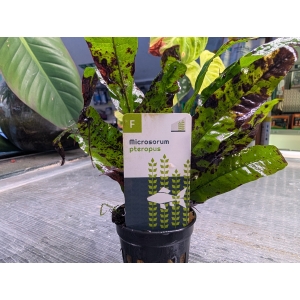



Microsorum pteropus
£7.50
Microsorum pteropus
Bulk Offer – 3 for £18.00
Discount will apply at checkout.
- Description
- Store Policies
- Enquiries
Description
The Java Fern (Microsorum pteropus):
Species Profile:
Microsorum pteropus—universally known as the Java Fern—is an iconic, highly adaptable epiphytic fern native to the tropical and subtropical regions of Southeast Asia, spanning India, China, Malaysia, Indonesia, and the Philippines. Belonging to the family Polypodiaceae, this true aquatic and amphibious fern typically grows anchored to rocks, partially submerged tree roots, and damp riverbanks along fast-flowing jungle streams and waterfalls.
Java Fern is arguably the most resilient and ubiquitous plant in the history of the aquarium hobby. Its thick, leathery foliage and nearly indestructible nature make it a fundamental staple for aquascaping layouts of every energy tier, handling low-light beginner aquaria and high-tech display systems with equal ease.
Taxonomic Cultivars and Leaf Varieties
Through years of selective cultivation and geographic isolation, several highly popular morphs and cultivars of Microsorum pteropus have been stabilized and are widely utilized in the trade:
-
Microsorum pteropus ‘Standard’: The wild type, featuring broad, upright, lance-shaped leaves with a smooth surface and a deep green hue.
-
Microsorum pteropus ‘Windeløv’ (Lacy Java Fern): A highly distinct, patented cultivar named after Tropica’s founder, Holger Windeløv. It is instantly recognizable by its finely branched, crested leaf tips that form a dense, lacy bush.
-
Microsorum pteropus ‘Trident’: A sleek variety displaying narrow, deeply lobed leaves that branch out into three or more distinct trident-like prongs, offering a wilder, more elegant texture.
-
Microsorum pteropus ‘Narrow’: Features significantly narrower, elongated, and slightly arching leaf blades that create a sweeping, grass-like appearance while retaining the classic tough fern structure.
-
Microsorum pteropus ‘Philippine’: A distinct geographical variant that displays a highly textured, hammered, or puckered leaf surface. It is uniquely noted for its higher tolerance to brackish water conditions.
Morphology and Aesthetic Architecture
The structural blueprint of the Java Fern is uniquely tailored for an attached, epiphytic lifestyle.
-
The Rhizome System: The central structural anchor of the plant is its horizontal, creeping, fuzzy dark-green to brown modified stem known as the rhizome. Leaves emerge vertically from the top of this rhizome, while a dense, felt-like network of dark brown, hair-covered anchor roots extends downwards to grip porous surfaces.
-
Leaf Texture and Anatomy: The leaves are lanceolate (spear-shaped), exceptionally tough, fibrous, and leathery to the touch. The leaf tissue features a prominent central midrib with a distinct, net-like venation patterned across the blade. Under water, the foliage exhibits a rich olive-to-forest green tone.
-
Dimensions: Depending on the specific cultivar and nutrient availability, a standard mature Java Fern can achieve vertical heights of 15 to 35 centimetres (6 to 14 inches), with the horizontal root-and-rhizome mass expanding indefinitely to form massive, multi-stemmed focal bushes.
Aquarium Requirements and Water Parameters
Java Fern is a masterpiece of biological plasticity, surviving effortlessly in unheated indoor aquaria, high-temperature setups, and variable water chemistry loops. It is typically positioned in the midground to background zones of the layout.
Optimal Hydrochemical Targets
| Parameter | Target Range |
| Water Temperature | 20°C to 28°C (68°F to 82°F) — Highly heat tolerant |
| pH Range | 6.0 to 7.5 (Tolerates structural extremes from 5.5 to 8.0) |
| General Hardness (dGH) | 2 to 15 dGH (Performs brilliantly in both soft and hard water) |
| Carbonate Hardness (dKH) | 1 to 12 dKH |
| Water Flow | Moderate to High (Good current prevents organic debris stagnation) |
Cultivation and Mount Engineering
⚠️ The Epiphytic Substrate Rule
Under no circumstances should the creeping horizontal green rhizome of Microsorum pteropus be buried beneath the substrate (sand, aqua-soil, or gravel). The rhizome requires direct, unobstructed access to oxygenated water column flow. If buried, anaerobic conditions will quickly suffocate the tissue, causing the rhizome to turn black and rot, resulting in complete leaf drop and the ultimate death of the plant.
Preferred Fixation Techniques:
To cultivate Java Fern successfully, treat it strictly as an epiphyte and mount it onto hardscape assets:
-
Hobby-Safe Cyanoacrylate Gel: Apply small, strategic dots of gel superglue directly to a bare section of the roots or the underside of the woody rhizome. Press the plant firmly onto a piece of bogwood, driftwood, or a porous stone (such as lava rock or slate) for 15 seconds. This can be executed entirely out of water.
-
Thread or Monofilament Wrapping: Gently bind the rhizome to your selected hardscape feature using fine, dark cotton sewing thread or clear nylon fishing line. Over several months, the fuzzy root system will wrap around the structural microscopic cracks of the wood or stone to form a permanent physical bond, at which stage the thread can be cut away.
-
Mechanical Wedging: Thanks to its rigid, springy root matrix, large clumps can simply be slid gently into natural splits, forks, or holes within your hardscape layout.
Nutrition, Light, and Physiological Phenomena
Lighting Strategy
Microsorum pteropus is an obligate low-light specialist. It thrives magnificently in low-energy configurations where other species fail.
-
Low Light: This is the ideal environment. Under modest illumination, the leaves remain deep green, spotless, and easy to maintain.
-
High Light Danger: Exposure to intense, unshaded full-spectrum lighting will cause the leaves to turn translucent, develop pale or yellow tips, and burn out. If high light is necessary for surrounding carpet plants, always position your Java Fern in partial shade—such as beneath the canopy of tall stem plants or under overhanging driftwood branches.
Carbon Dioxide (CO2) and Nutrient Intake
Pressurized carbon dioxide injection is entirely optional; Java Fern handles low-tech setups perfectly. However, because it lacks a standard root system in nutrient-rich soil, it pulls 100% of its sustenance directly from the water column. Regular dosing of a comprehensive liquid macro and micro fertiliser is highly beneficial. It prevents common Potassium (K) deficiencies, which characteristically manifest as tiny, dark pinholes across the older leaf blades.
The “Black Spots” Misconception
Hobbyists frequently panic when they notice rows of dark brown or black circular spots developing on the undersides of mature leaves. This is not a disease. Java Fern is a true terrestrial-derived spore-bearing fern; these dark spots are Sori (clusters of reproductive sporangia). They are a natural sign of structural maturity and reproductive health.
Propagation Modes
Java Fern exhibits two remarkably distinct and fascinating methods of vegetative reproduction:
1. Rhizome Fragmentation (Manual)
The most straightforward propagation method involves simple division. Using a razor-sharp, sterile pair of aquascaping scissors, cut the horizontal creeping rhizome into two or more pieces. Ensure each separated cutting retains at least 3 to 4 healthy leaves and a portion of the root matrix to guarantee rapid, stress-free independent recovery.
2. Adventitious Plantlet Generation (Spontaneous)
When an individual leaf blade reaches the end of its natural life cycle, or when the plant experiences a slight environmental shift, it will automatically initiate a survival mechanism. Dozens of miniature, fully formed baby plantlets will spontaneously sprout straight out of the margins and tips of the older leaves. These adventitious plantlets will grow their own micro-rhizomes and tiny brown root networks while still attached to the mother leaf. Once they reach 2 to 3 centimetres in size, they can be gently plucked away and glued elsewhere, or left to detach naturally to float into new hardscape crevices.
Aquascaping Application and Livestock Safety
-
The Structural Mass: Java Fern is unparalleled at creating the structural “bones” of a layout. When grown into large, mature bushes, its deep forest-green leaves provide a rich, texturally dense background that accentuates the vibrant colours of schooling neon tetras, rasboras, and discus.
-
100% Herbivore Proof: Due to the presence of secondary metabolic deterrents within the leaf tissue, Java Fern tastes incredibly bitter and unpalatable to fish. Destructive diggers and notorious plant-eating species—such as Goldfish, African Rift Lake Cichlids, Silver Dollars, and large Barbs—will leave the foliage completely untouched. Furthermore, because it is glued securely to rocks or roots, it is fully immune to being uprooted by fish that like to rearrange the substrate.
General Enquiries
There are no enquiries yet.