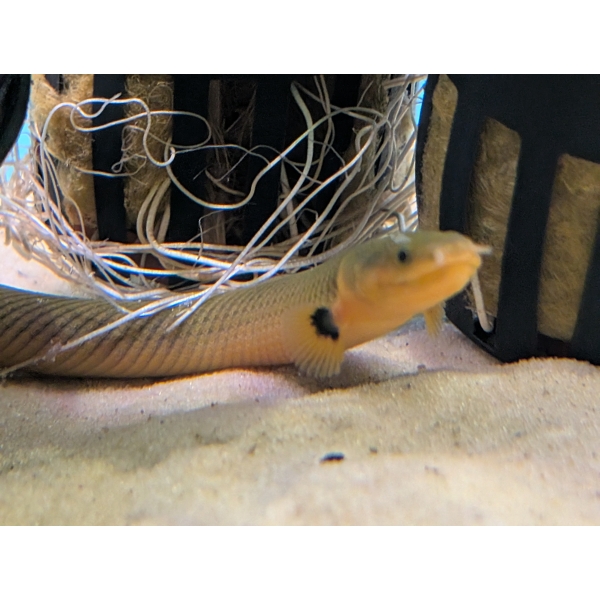

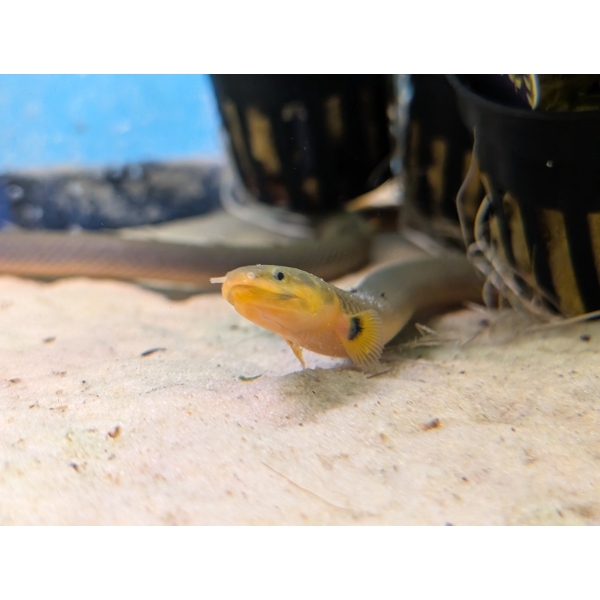
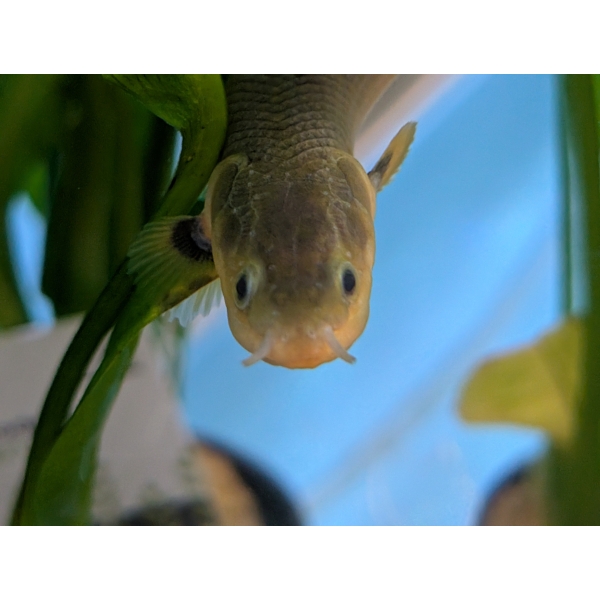


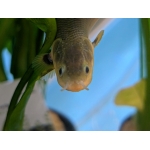


Reed Fish Erpetoichthys Calabaricus
£25.00
Reed Fish
- Description
- Store Policies
- Enquiries
Description
Species Care Guide: Reedfish (Erpetoichthys calabaricus)
The Reedfish (Ropefish)
The Reedfish (Erpetoichthys calabaricus) is a fascinating and peaceful fish native to the sluggish, brackish, and freshwater rivers and swamps of West Africa, specifically from Nigeria to the Republic of Congo. Despite its snake-like appearance, it is a ray-finned fish, closely related to the Bichirs, and is notable for its primitive anatomy, including lungs that allow it to breathe air.
1. Key Species Information
| Characteristic | Detail |
|---|---|
| Common Name | Reedfish, Ropefish, Snakefish |
| Origin | West Africa (Nigeria, Cameroon, Congo) |
| Adult Size | 30 – 50 cm (12 – 20 inches), though they can reach 90 cm in the wild. |
| Temperament | Peaceful (towards fish too large to be eaten). Social with its own kind. |
| Lifespan | Up to 15 – 20 years in captivity. |
| Diet | Carnivore/Piscivore (Worms, crustaceans, small fish). |
| Key Distinction | Has a pair of functional lungs, requiring access to the surface air. Must be housed in an extremely secure, lidded tank. |
2. Aquarium Requirements
The Reedfish needs a long, wide tank that provides plenty of floor space and extremely secure containment.
- Minimum Tank Size: A minimum of 200 Litres (44 Imperial Gallons) is needed for a small group of two or three. The tank should be long (120 cm / 4 ft or more) rather than tall, as they are bottom-dwellers.
- The Lid (CRITICAL): Reedfish are legendary escape artists. Any gap, no matter how small (e.g., filter cut-outs, cable holes, corners), must be securely sealed. They can squeeze through surprisingly tiny openings and survive for a short time outside the water thanks to their lungs.
- Substrate: Fine sand or smooth, small gravel is ideal. Sharp gravel must be avoided as they often rest on the bottom and can damage their delicate undersides.
- Filtration: Robust mechanical and biological filtration is necessary to maintain high water quality, but the flow rate should be low. They are adapted to slow-moving waters and dislike strong currents.
- Decor and Scaping:
- Hiding Places: Provide numerous dark, safe hiding spots. Use smooth pieces of driftwood, PVC pipes, large rocks, and thick clumps of vegetation. They feel safest when they are entirely hidden.
- Plants: They are not destructive to plants. Use tall, dense, and hardy plants like Vallisneria, Amazon Swords, and Java Moss to create a forest-like environment.
- Surface Access: Ensure there are areas of calm water and direct access to the surface so they can take breaths of air.
3. Water Parameters
Reedfish are highly adaptable but prefer soft, slightly acidic water, mimicking their swampy natural habitat.
| Parameter | Optimal Range | Notes |
|---|---|---|
| Temperature | 24°C – 28°C (75°F – 82°F) | A stable temperature is vital; avoid sudden drops. |
| pH | 6.0 – 7.5 (Soft to Neutral) | They tolerate neutral pH but thrive in slightly acidic conditions, often helped by driftwood. |
| Hardness (dGH) | 5 – 15 dGH (Soft to Moderately Hard) | Keep the water clean. They are sensitive to high nitrates. |
| Maintenance | Perform regular weekly water changes (20–25%). The use of peat filtration or Indian Almond Leaves can help condition the water and keep it soft and slightly stained, which they prefer. |
4. Diet and Feeding
Reedfish are nocturnal carnivores and can be slow, fussy eaters. It’s often necessary to target-feed them using tongs or a dropper.
- Primary Diet: They must be offered high-protein foods. They will rarely accept flake or pellet foods unless conditioned from a very young age.
- Acceptable Foods:
- Frozen/Live: Bloodworms, chopped earthworms, Mysis shrimp, krill, and white mosquito larvae.
- Specialised: Prawns, mussel meat, and occasional pieces of fish fillet (ensure it’s not high-fat like tuna).
- Feeding Method: Feed once a day, preferably in the evening as they become more active after dark. Ensure food reaches the bottom, as they have poor eyesight and hunt primarily by scent.
5. Compatibility and Group Dynamics
Reedfish are social fish that prefer to be kept in a small group (3 or more) to display natural behaviour, but they are opportunistic predators.
- Intraspecies: They are completely peaceful towards each other. Keeping them in groups reduces stress and encourages activity.
- Community Safety: If a fish can fit in a Reedfish’s mouth, it will eventually be eaten. They are not aggressive hunters, but if a small fish wanders close while the Reedfish is scent-hunting for food, it will be swallowed.
- Ideal Tank Mates (Robust and Mid-to-Large):
- Medium to large, peaceful Rainbowfish and Tetras (e.g., Congo Tetras).
- Gouramis (e.g., Pearl or Blue Gouramis).
- Large Catfish: Such as Synodontis species or larger, peaceful Plecostomus.
- Peaceful Cichlids: Non-aggressive, slow-moving cichlids that are significantly larger than the Reedfish’s girth.
- Avoid:
- Any fish smaller than 5 cm (2 inches).
- Aggressive or fin-nipping fish (like Tiger Barbs), as the Reedfish’s elongated fins can be tempting targets.
- Other bottom-dwelling fish that are aggressive or require their own caves, as the Reedfish needs plentiful hiding spaces.
The key to a successful Reedfish setup is absolute tank security and providing plenty of dense cover and clean water.
Convenient nationwide delivery; you’re only a click away!
Our nationwide delivery service makes it easy to receive your fish directly at your door, anywhere in the UK, for a flat rate of just £30. This convenient service allows you to order up to 10kg of fish, with the assurance that they will arrive in excellent condition. To make the fishes journey as comfortable as possible we use Oxygen in the fish bags and heat packs in all the boxes of fish we send out.
Please put your desired delivery day in the Order Notes on the Checkout page.
General Enquiries
There are no enquiries yet.