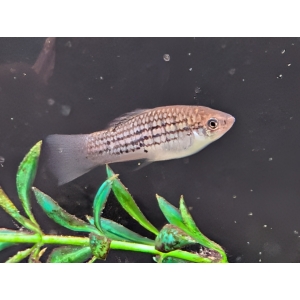
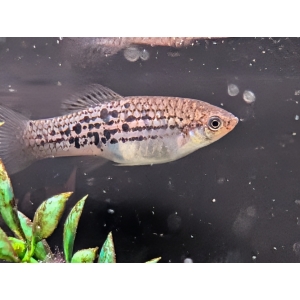


Mountain Swordtail (Xiphophorus nezahualcoyotl)
£85.00
Mountain Swordtail (Xiphophorus nezahualcoyotl)
Price is for the whole group of 6
- Description
- Store Policies
- Enquiries
Description
Mountain Swordtail (Xiphophorus nezahualcoyotl):
Species Profile:
Common Names: Mountain Swordtail, Nezahualcoyotl Swordtail, Northern Mountain Swordtail
Scientific Name: Xiphophorus nezahualcoyotl
Family: Poeciliidae
Origin: Mexico (Endemic to the headwaters of the Rio Tamesí and Rio Pánuco basins, specifically in San Luis Potosí)
1. Overview and Natural Habitat
Xiphophorus nezahualcoyotl is a rare, highly sought-after wild-type livebearer. Named in honour of the 15th-century Aztec poet-king Nezahualcoyotl, this species is far removed from the heavily hybridised, mass-produced commercial swordtails found in standard pet shops.
In the wild, they inhabit high-altitude, fast-flowing mountain streams, springs, and pools. These habitats are characterised by cool, pristine, highly oxygenated waters flowing over rocky and gravelly substrates. Because they are adapted to clean, moving mountain waters rather than stagnant lowland swamps, they require significantly different husbandry compared to common domestic livebearers.
2. Appearance and Size
The Mountain Swordtail possesses a rugged, natural elegance, displaying subtle iridescence and distinct markings that vary based on social hierarchy and mood.
- Size: Males typically reach 5–6 cm (excluding the sword extension), while females are more robust, growing to 6–7 cm.
- Sexual Dimorphism: Males are easily identified by their gonopodium (modified anal fin) and a short, thick, slightly curved “sword” extending from the lower caudal fin. The sword is typically yellow or green, tightly edged in black.
- Colouration: Both sexes sport a greyish-olive to golden-brown body adorned with irregular black speckles and mottling along the flanks. Dominant males often display intense blue-green iridescence along their sides and a darkened dorsal fin when courting or sparring.
3. Aquarium Requirements
Tank Size
Due to their highly active nature and the territorial antics of adult males, ample horizontal swimming space is crucial. A minimum tank size of 90 litres (approx. 75–90 cm in length) is required for a small colony. A 150-litre tank is highly recommended if keeping multiple mature males together.
Décor and Filtration
To replicate a fast-flowing Mexican mountain stream, focus on water movement and oxygenation:
- Water Movement: Strong filtration is essential. The use of an additional powerhead or a directional spray bar is highly beneficial to generate a noticeable current.
- Oxygenation: High oxygen levels are non-negotiable. Ensure vigorous surface agitation to mimic their turbulent natural habitat.
- Layout: Use a substrate of smooth river stones, gravel, and large boulders. Arrange pieces of weathered driftwood to create natural breaks in the current.
- Planting: While their natural streams can be sparsely vegetated, they appreciate hardy plants that can withstand current, such as Vallisneria, Sagittaria, or Java Fern. These provide crucial refuge for pregnant females and newborn fry.
4. Water Parameters
Unlike lowland livebearers that tolerate warm, stagnant conditions, Mountain Swordtails require cooler temperatures and immaculate water chemistry. They will decline rapidly in poorly maintained or overly warm water.
| Parameter | Recommended Range | Notes |
|---|---|---|
| Temperature | 18°C – 23°C | Must be kept cool. Avoid prolonged temperatures above 24°C. |
| pH | 7.0 – 8.2 | Strictly alkaline; they do not tolerate acidic conditions. |
| Hardness | 10 – 25 dGH | Hard, mineral-rich water is essential for their long-term health. |
Maintenance: They have a low tolerance for dissolved organic waste. Weekly water changes of 30–40% are highly recommended to keep nitrates as close to zero as possible.
5. Diet and Feeding
In nature, Xiphophorus nezahualcoyotl is an omnivore, constantly grazing on biofilm, algae, and small aquatic invertebrates found on river rocks.
- Vegetable Matter: Algae and plant-based foods must form the core of their diet. Provide high-quality spirulina flakes, vegetable wafers, and允许 natural green algae to grow on the aquarium rocks.
- Protein Sources: Supplement their diet with live or frozen foods such as daphnia, cyclops, Mysis shrimp, and white mosquitoes. Avoid overfeeding heavy, fatty proteins like bloodworms.
- Grazing Behaviour: They enjoy picking at micro-fauna, so a mature tank with established Aufwuchs (biofilm) will ensure optimal health.
6. Behaviour and Compatibility
The Mountain Swordtail is a highly energetic and fascinating species to observe, though males can be intensely competitive.
- Social Structure: They should be kept in colonies with a specific sex ratio to distribute male attention. Aim for a ratio of one male to at least two or three females. If keeping multiple males, ensure the tank is large enough for each to establish a small territory among the rocks.
- Male Sparring: Males engage in beautiful, non-lethal sparring displays—swimming backwards, shaking their swords, and flaring their fins to assert dominance.
- Tank Mates: Because they require cool, hard, fast-flowing water, standard tropical community fish are unsuitable. Ideal tank mates include:
- Other cool-water livebearers (e.g., Xiphophorus variatus)
- Goodieds (e.g., Characodon or Ataeniobius species)
- Cool-water loaches (e.g., Hillstream Loaches / Gastromyzon spp.)
- Subtropical danios or minnows (e.g., White Cloud Mountain Minnows)
7. Breeding
Like all poeciliids, Xiphophorus nezahualcoyotl is a livebearer, meaning the female gives birth to fully formed, free-swimming fry. However, they are significantly less prolific than domestic guppies or swordtails.
- Gestation: The gestation period lasts roughly 4 to 6 weeks, depending on water temperature.
- Brood Size: Broods are relatively small, usually yielding between 10 to 40 fry per birth cycle.
- Fry Survival: Adults will occasionally cannibalise their young if the tank lacks cover. To maximize survival rates without moving the sensitive female to a stressful breeding trap, provide dense patches of floating plants or fine-leaved mosses at the surface.
- Raising the Young: The fry are quite large at birth and can immediately accept crushed spirulina flakes, micro-worms, and newly hatched brine shrimp (Artemia nauplii).
Convenient nationwide delivery; you’re only a click away!
Our nationwide delivery service makes it easy to receive your fish directly at your door, anywhere in the UK, for a flat rate of just £30. This convenient service allows you to order up to 10kg of fish, with the assurance that they will arrive in excellent condition. To make the fishes journey as comfortable as possible we use Oxygen in the fish bags and heat packs in all the boxes of fish we send out.
For your peace of mind we enclose a slip which will explain what to do in the event of a fish not traveling too well.
We use a licensed courier to deliver your fish directly to you door and will be with you by 1pm the next day.
Our delivery days are as follows:
Tuesday for Wednesday delivery
Wednesday for Thursday delivery
Thursday for Friday delivery
Please put your desired delivery day in the Order Notes on the Checkout page.
General Enquiries
There are no enquiries yet.