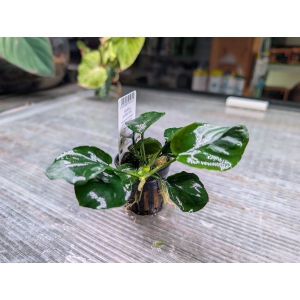


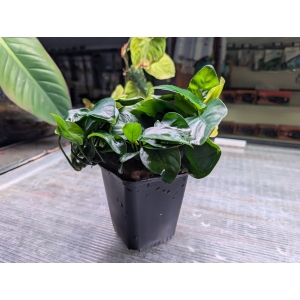
Anubias golden coin
£7.50
Anubias golden coin
Bulk Offer – 3 for £18.00
Discount will apply at checkout.
- Description
- Store Policies
- Enquiries
Description
Golden Coin Anubias (Anubias barteri var. ‘Golden Coin’):
Plant Profile:
Golden Coin Anubias is an exceptionally attractive, slow-growing cultivar of the highly resilient Anubias barteri species. Natively, the parental species hails from the shaded, tropical riverbanks of West Africa. This distinct variant is highly sought after by aquascapers for its unique visual attributes—specifically its small, perfectly rounded, coin-like leaves that exhibit a magnificent bright lime-green to golden-yellow hue. It serves as an exceptional epiphytic accent plant for midground and foreground hardscape arrangements.
Plant Overview.
- Scientific Name: Anubias barteri var. ‘Golden Coin’
- Common Name: Golden Coin Anubias, Anubias Gold Coin, Round Leaf Gold Anubias
- Family: Araceae
- Origin: Cultivar (Wild ancestors originate from West Africa)
- Plant Type: Rhizomatous Epiphyte
- Growth Rate: Very Slow
- Placement: Foreground or Midground
- Height: 5 to 10 cm (approx. 2 to 4 inches)
Cultivation and Water Parameters.
Like all members of the Anubias family, Golden Coin Anubias is an incredibly hardy and forgiving plant. It is an ideal choice for both beginner aquarists and experienced scapers seeking a low-maintenance botanical addition.
Water Conditions
- Temperature: 22°C to 28°C
- pH Range: 6.0 to 7.5
- Water Hardness: 3 to 15 dGH
Lighting and Nutrient Requirements.
- Lighting: Low to medium. Unlike many plants where a golden hue demands intense light, this cultivar naturally retains its lime-gold coloration under moderate illumination. Avoid placing it under intense, direct light, as its slow-growing nature makes the leaves highly susceptible to green spot algae.
- Substrate: Do not bury the rhizome. This plant does not require a nutrient-rich substrate, as it draws its nutrients directly from the water column through its thick roots.
- CO2 Injection: Not required. While it can adapt to high-tech systems with CO2 injection, it thrives perfectly well in low-energy, low-tech environments.
Planting and Maintenance.
Golden Coin Anubias must be treated as an epiphyte, meaning it naturally grows attached to solid surfaces rather than rooted in soil or sand.
- Planting Technique: Use aquarium-safe superglue (cyanoacrylate gel) or black cotton thread to secure the thick root base to pieces of driftwood, porous rocks, or lava stone.
- The Rhizome Rule: If you prefer to place the plant near the substrate, ensure that the thick horizontal stem (the rhizome) remains completely uncovered above the gravel line. Burying the rhizome will cut off oxygen flow, causing it to rot and leading to the eventual death of the entire plant.
- Pruning: Maintenance is incredibly low. If an old leaf becomes yellowed, damaged, or heavily covered in algae, simply snip it off near the base of the rhizome using sharp aquascaping scissors to encourage clean new growth.
Behaviour and Aquascaping Compatibility.
The distinctive round leaves and bright golden-green colour provide a phenomenal texture and contrast when placed against dark lava rocks, muddy-brown driftwood, or deep green mosses.
- Ideal Tankmates: Perfect for almost any community setup. It makes a sturdy resting platform for nano species like Pseudomugil rainbowfish, nano rasboras, and dwarf freshwater shrimp.
- Herbivore and Cichlid Resistant: The leaves are incredibly thick, tough, and leathery. Because they are highly unpalatable and virtually indestructible, Golden Coin Anubias is one of the very few decorative plants that can be successfully housed with aggressive African Cichlids, large tinfoil barbs, and Goldfish.
Propagation.
Propagation is entirely manual but very straightforward, provided the parent plant is established and healthy.
- Method: Propagation is achieved by dividing the main horizontal rhizome.
- Management: Using a very sharp, sterilized blade or scissors, cleanly cut the rhizome into two or more sections. Ensure that each new cutting possesses at least 3 to 4 healthy leaves and a few strong roots. Secure the newly separated piece to a new bit of hardscape to grow a brand-new specimen.
General Enquiries
There are no enquiries yet.